
Data Sovereignty 101: Keeping Your AI Australian
When you paste customer information into ChatGPT, where does that data actually go? When your AI-powered CRM analyses customer behaviour, which servers process that data? When your accounting software’s AI predicts cash flow, whose infrastructure handles your financial records?
For most Australian businesses, the honest answer is: “I have no idea.”
That ignorance is increasingly risky. Australia’s Privacy Act has teeth, and regulators are paying closer attention to how businesses handle data—especially when AI enters the picture.
At CloudGeeks, we’ve helped numerous Australian businesses understand and address data sovereignty requirements. Here’s what every Australian SMB needs to know about keeping their AI Australian.
Why Data Sovereignty Matters
The Legal Framework
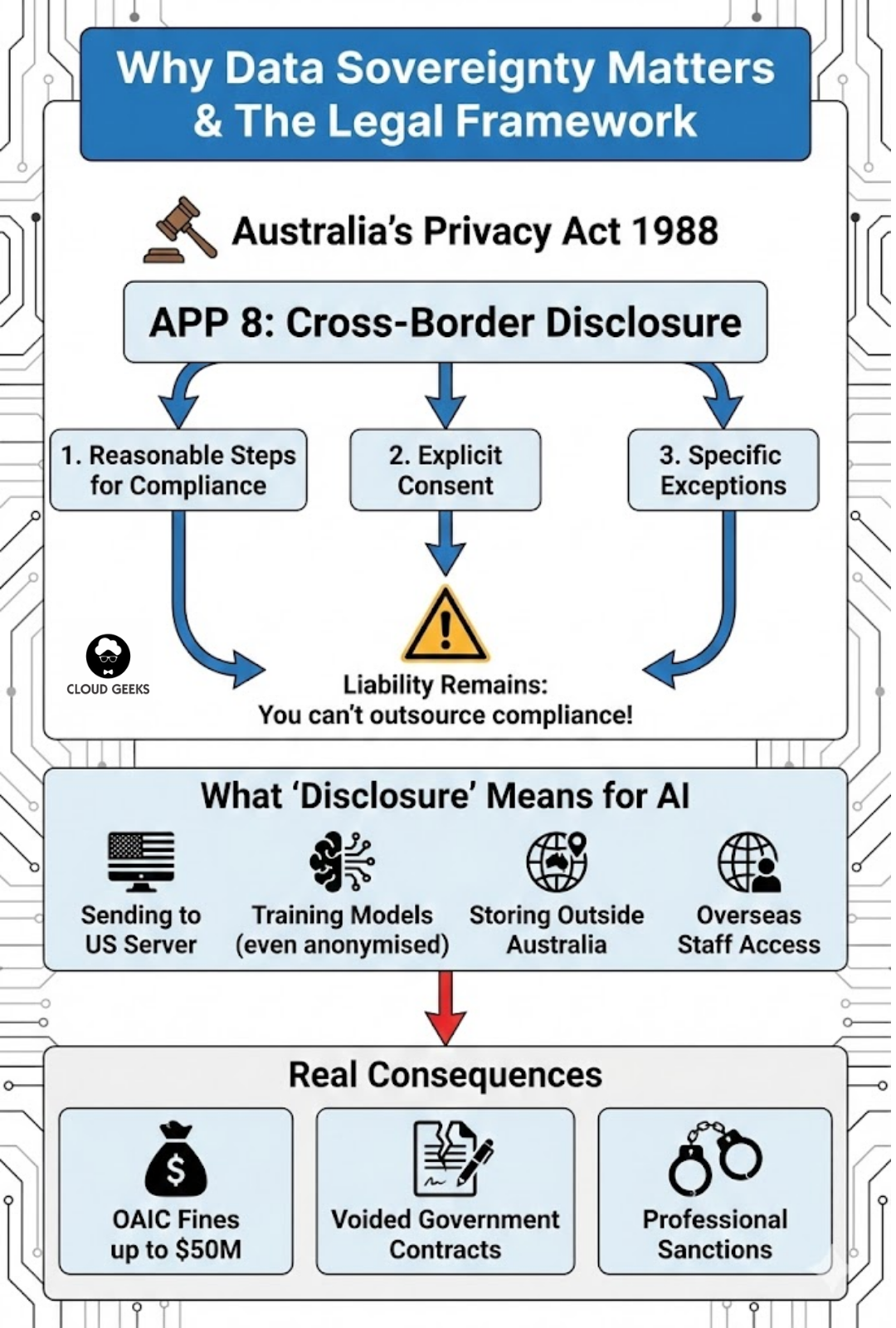
Australia’s Privacy Act 1988 governs how businesses handle personal information. The critical provision for AI is Australian Privacy Principle 8 (APP 8): Cross-Border Disclosure.
APP 8 Summary: Before disclosing personal information to an overseas recipient, you must either:
- Take reasonable steps to ensure they’ll comply with the APPs, OR
- Get the individual’s explicit consent, OR
- Meet specific exceptions (legal requirements, enforcement, etc.)
The Kicker: If you rely on option 1 and the overseas recipient breaches the APPs, you’re still liable. You can’t outsource your compliance obligations.
What “Disclosure” Means for AI
Every time your AI tool:
- Sends customer data to a US server for processing
- Uses customer information to train models (even anonymised)
- Stores any personal information outside Australia
- Allows overseas staff to access Australian data
…you’ve potentially made a cross-border disclosure requiring APP 8 compliance.
Real Consequences
For All Businesses: The OAIC can investigate privacy breaches and impose requirements for remediation. Serious breaches can result in penalties up to $50 million for body corporates.
For Government Contractors: Many government contracts require Australian data sovereignty. Violating these requirements can void contracts and exclude you from future tenders.
For Regulated Industries: Finance, healthcare, and legal sectors have additional data residency requirements that can trigger professional sanctions.
The AI Data Flow Problem
Where Popular AI Tools Send Your Data
Let’s trace where data goes when you use common AI tools:
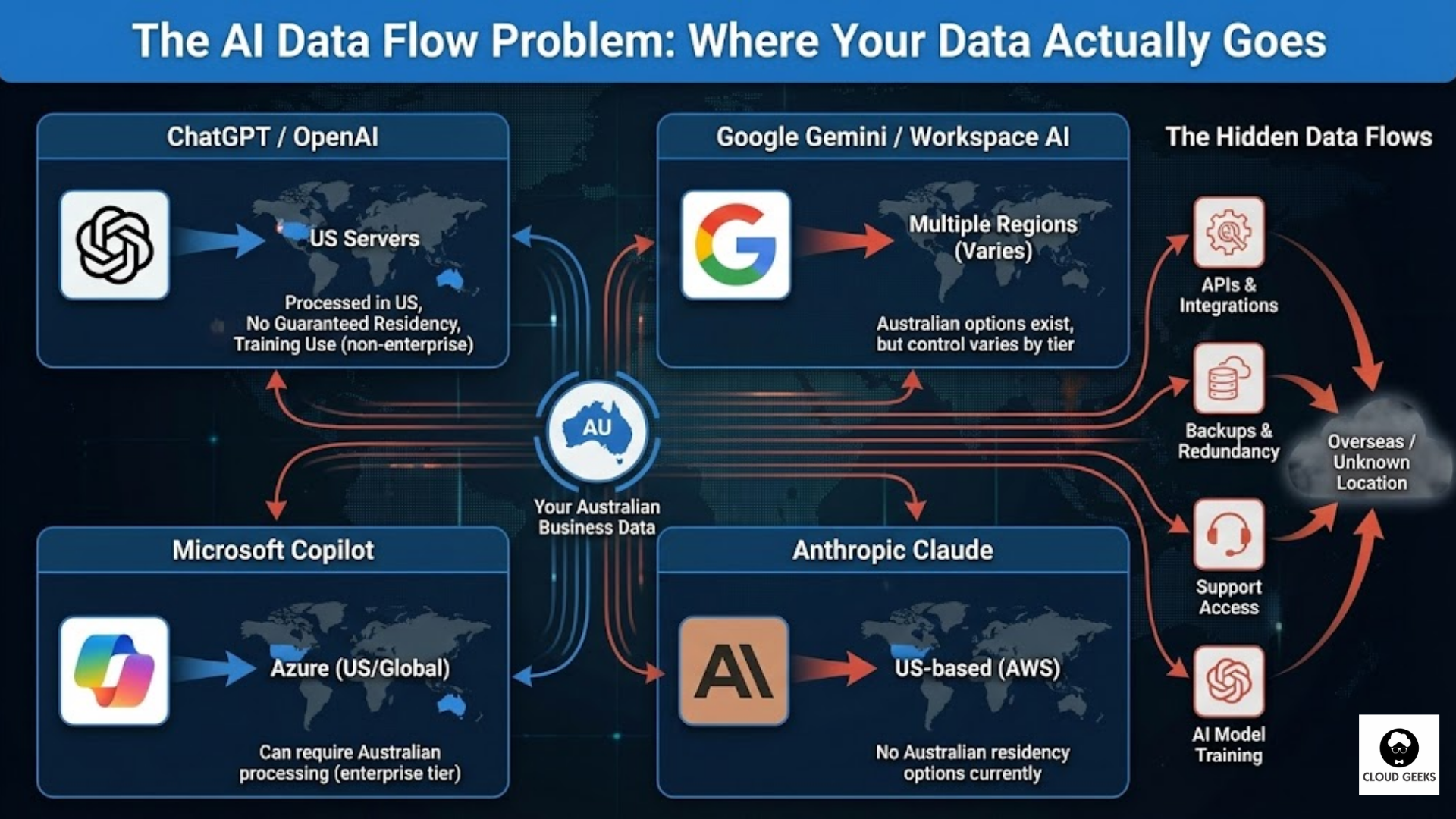
ChatGPT / OpenAI
- Data processed on US servers
- Microsoft Azure infrastructure (primarily US)
- OpenAI may use inputs for model training (unless enterprise tier)
- No guaranteed Australian data residency
Google Gemini / Workspace AI
- Data may be processed in multiple regions
- Google offers Australian regions but processing location varies
- Workspace enterprise allows region restrictions
- Free/lower tiers have minimal control
Microsoft Copilot
- Azure processes data
- Australian customers can require Australian processing
- Enterprise tiers offer data residency commitments
- Consumer/SMB tiers less controlled
Anthropic Claude
- US-based processing
- AWS infrastructure
- No Australian data residency options currently
- Enterprise agreements may address some concerns
Industry-Specific AI Tools
- Varies wildly
- Many US-developed tools use US infrastructure by default
- “Cloud-based” often means “somewhere, who knows where”
The Hidden Data Flows
It’s not just the primary AI tool. Consider:
APIs and Integrations: Your CRM might be Australian, but if it calls a US-based AI API for sentiment analysis, customer data travels overseas.
Backups and Redundancy: Where does your cloud provider back up data? Many Australian-region services back up to Singapore or US.
Support and Maintenance: Can overseas staff access your data for support purposes? That’s a disclosure.
AI Model Training: Some vendors use your data to improve their AI. Where does that training happen?
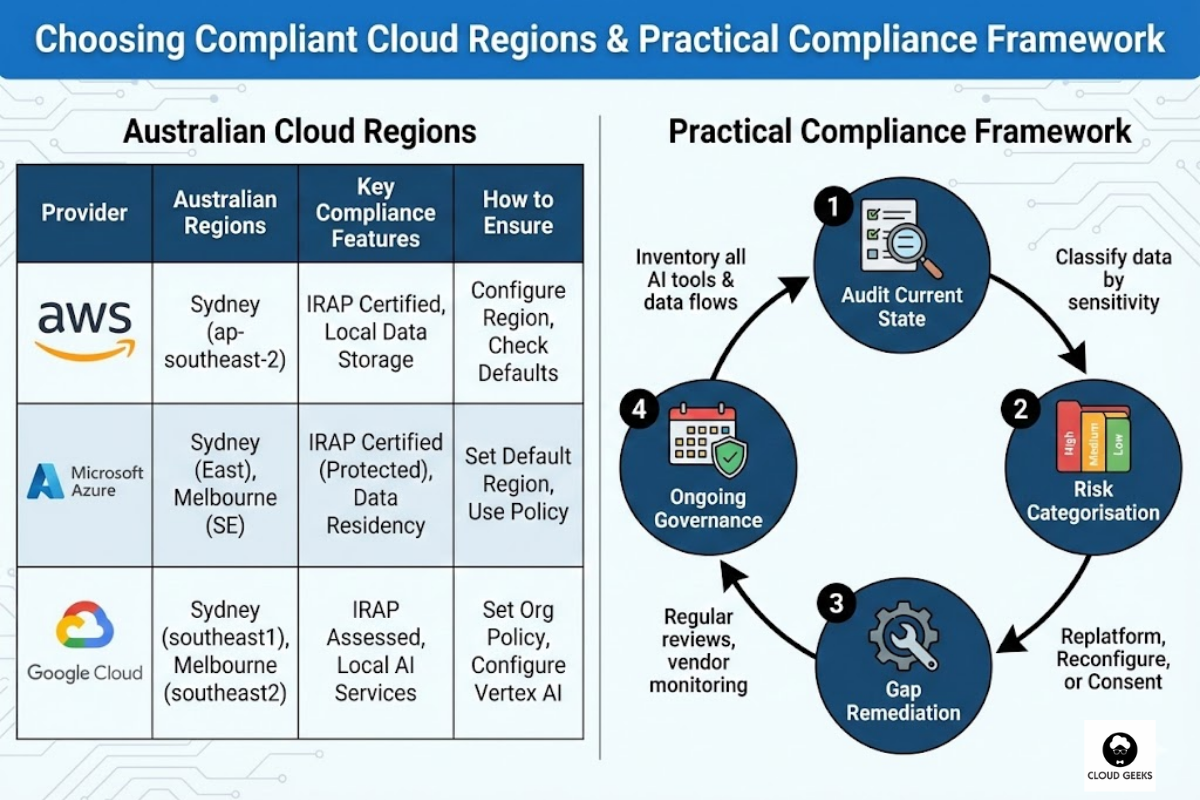
Choosing Compliant Cloud Regions
AWS (Amazon Web Services)
Australian Regions:
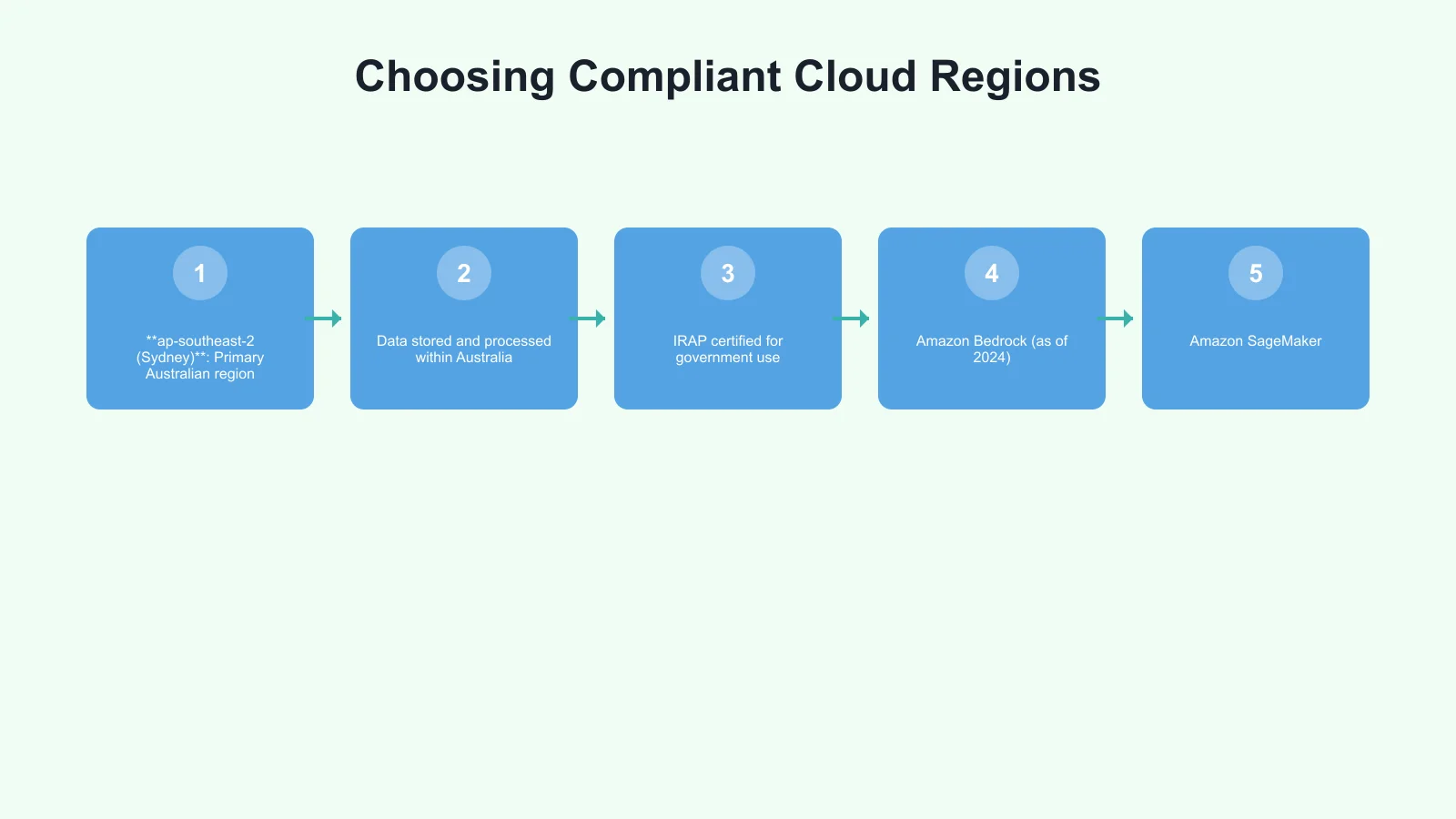
- ap-southeast-2 (Sydney): Primary Australian region
- Data stored and processed within Australia
- IRAP certified for government use
How to Ensure Compliance:
- Configure services to use only ap-southeast-2
- Review default settings (some services default to US regions)
- Use AWS Organizations to enforce region restrictions
- Check that backups remain in-region
AWS AI Services in Sydney Region:
- Amazon Bedrock (as of 2024)
- Amazon SageMaker
- Amazon Comprehend
- Amazon Rekognition
- Amazon Transcribe
- Amazon Translate
Microsoft Azure
Australian Regions:
- Australia East (Sydney): Primary region
- Australia Southeast (Melbourne): Secondary region
- IRAP certified at Protected level
How to Ensure Compliance:
- Set Azure default region to Australia East
- Use Azure Policy to restrict resource locations
- Review Microsoft 365 data residency settings separately
- Check Azure OpenAI Service regional availability
Azure AI Services in Australian Regions:
- Azure OpenAI Service (Sydney)
- Azure Cognitive Services
- Azure Machine Learning
- Power Platform AI features (check settings)
Google Cloud
Australian Regions:
- australia-southeast1 (Sydney): Primary region
- australia-southeast2 (Melbourne): Secondary region
- IRAP assessed
How to Ensure Compliance:
- Set organisation-level location policies
- Configure Vertex AI for Australian regions
- Review Google Workspace data location settings
- Verify that AI features respect region settings
Google AI Services in Australian Regions:
- Vertex AI
- Cloud Natural Language
- Cloud Vision
- Cloud Speech-to-Text
- AutoML features
The Multi-Cloud Reality
Most businesses use multiple cloud providers. Ensure consistency:
- Document where each system processes data
- Apply the same standards across all platforms
- Include cloud regions in vendor assessments
- Audit regularly for drift
Practical Compliance Framework
Step 1: Audit Current State
Create an inventory of every AI tool and cloud service:
| Tool/Service | Vendor | Data Types | Processing Location | APP 8 Compliance |
|---|---|---|---|---|
| CRM | ? | Customer data | ? | ? |
| Accounting | ? | Financial data | ? | ? |
| Email AI | ? | Correspondence | ? | ? |
| Chatbot | ? | Customer inquiries | ? | ? |
For each ”?” fill in actual answers. This often reveals surprises.
Step 2: Risk Categorisation
Classify data by sensitivity:
High Sensitivity (require Australian processing):
- Health information
- Financial records
- Government-related data
- Detailed customer profiles
- Employee records
Medium Sensitivity (prefer Australian, assess risk):
- Customer contact information
- Sales and transaction data
- Business communications
- Operational records
Low Sensitivity (overseas processing acceptable):
- Publicly available information
- De-identified analytics
- Non-personal business data
- Generic content
Step 3: Gap Remediation
For each high-sensitivity data flow to overseas processors:
Option A: Replatform Switch to an Australian-processed alternative.
Option B: Reconfigure Configure existing tool to use Australian regions (if available).
Option C: Consent Obtain explicit, informed consent for overseas processing.
Option D: De-identify Process de-identified data overseas, keep identifiable data local.
Option E: Accept Risk Document the risk and accept it at appropriate management level.
Step 4: Ongoing Governance
Data sovereignty isn’t set-and-forget:
- Quarterly reviews of data processing locations
- Vendor monitoring for changes in data handling
- New tool assessment before deployment
- Staff training on data handling requirements
- Contract clauses requiring notification of processing changes
AI-Specific Considerations
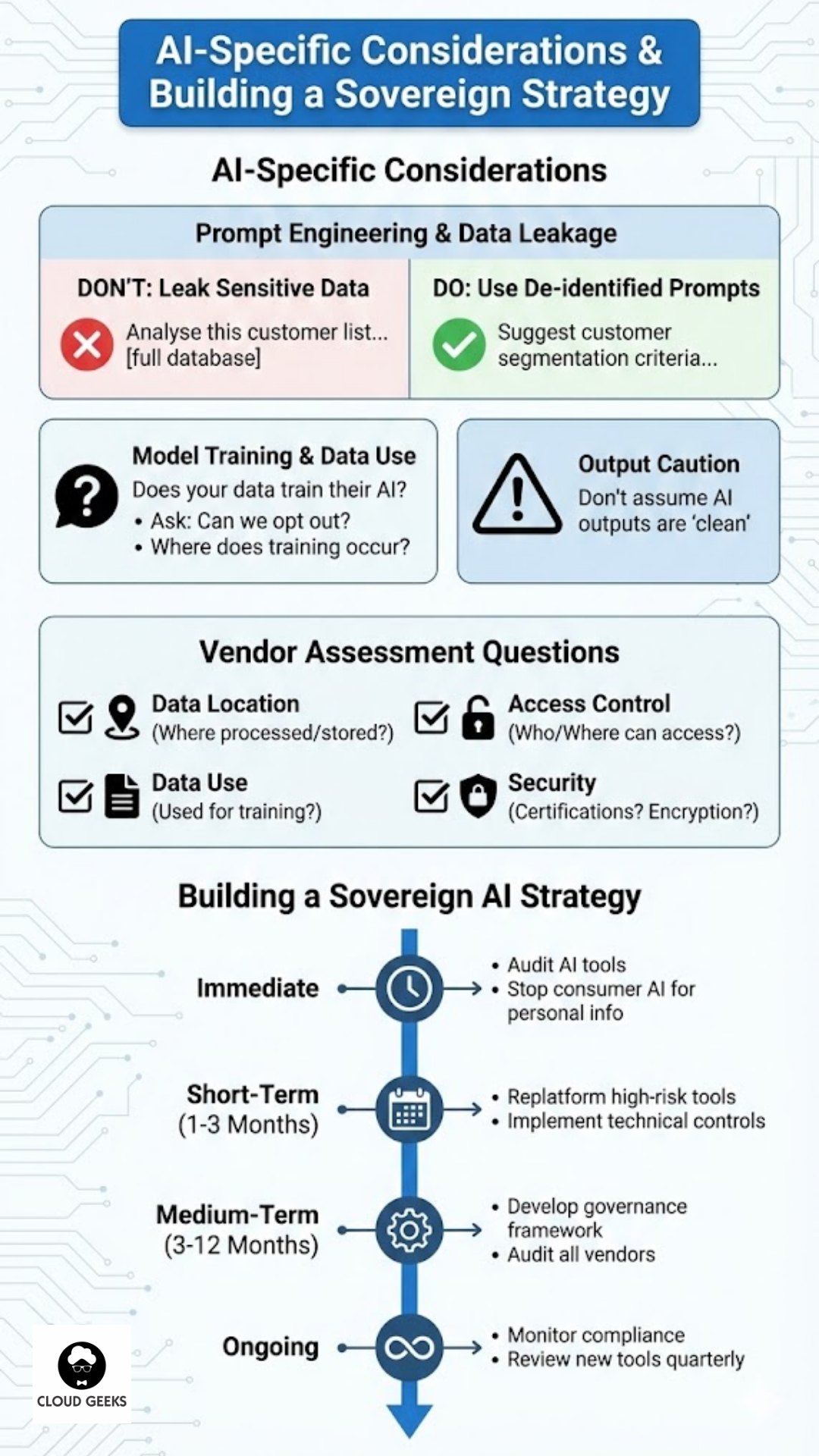
Prompt Engineering and Data Leakage
Even with Australian-processed AI, careless prompts can leak data:
Don’t: “Analyse this customer list and tell me who to target: [paste full customer database]”
Do: “Suggest customer segmentation criteria for a B2B software company targeting Australian SMBs”
Don’t: “Write a personalised email to John Smith at [email protected] who bought $45,000 of products last year”
Do: “Write a template email for high-value customers who made significant purchases in the past year”
Model Training and Data Use
Understand whether your data contributes to AI model training:
Questions to Ask Vendors:
- Is our data used to train or improve your AI models?
- If yes, how is it anonymised?
- Can we opt out of training data contribution?
- Where does model training occur?
Best Practice: Prefer vendors who don’t use customer data for training, or who allow opt-out.
Outputs and Generated Content
AI outputs may contain echoes of training data:
- Don’t assume AI-generated content is “clean” of others’ data
- Be cautious with AI that’s been trained on potentially sensitive datasets
- Consider where generated content is stored and who can access it
Vendor Assessment Questions
When evaluating AI vendors, ask:
Data Location
- Where is our data processed?
- Where is our data stored?
- Where are backups located?
- Can we restrict processing to Australia?
Access Control
- Who can access our data (internal staff, support, partners)?
- From what locations can data be accessed?
- What access logging exists?
Data Use
- How is our data used beyond providing the service?
- Is data used for AI model training?
- Can we opt out of secondary uses?
Security
- What certifications do you hold (IRAP, ISO 27001, SOC 2)?
- How is data encrypted (at rest and in transit)?
- What’s your breach notification process?
Contractual
- Will you provide a data processing agreement compliant with Australian requirements?
- What liability do you accept for data handling?
- How do you handle data at contract termination?
Government and Enterprise Requirements
IRAP (Information Security Registered Assessors Program)
If you work with Australian government or handle government data:
- IRAP certification indicates assessment against ISM controls
- Different levels: OFFICIAL, PROTECTED, SECRET
- Major cloud providers have IRAP certifications for Australian regions
- Certification doesn’t guarantee compliance—you must use certified services correctly
PSPF (Protective Security Policy Framework)
Government entities and contractors must:
- Classify information appropriately
- Handle each classification per PSPF requirements
- Use certified infrastructure for sensitive data
- Maintain sovereign data processing for protected+ information
State Government Requirements
Individual states have additional requirements:
- NSW: GCIO policies, NSW Government cloud guidelines
- Victoria: VGIS, Victorian Protective Data Security Framework
- Queensland: QGCIO policies, Information security policy
- WA, SA, TAS, NT: Various state-specific requirements
Building a Sovereign AI Strategy
Immediate Actions
- Audit AI tools for data location
- Stop using consumer AI (ChatGPT, etc.) for any personal information
- Review cloud configurations for region settings
- Update privacy policy to reflect AI usage and data locations
Short-Term (1-3 Months)
- Replatform high-risk AI tools to Australian alternatives
- Implement technical controls restricting data to Australian regions
- Train staff on data sovereignty requirements
- Create vendor assessment process for new AI tools
Medium-Term (3-12 Months)
- Develop comprehensive data governance framework
- Audit all vendors for compliance
- Negotiate improved data handling terms with key vendors
- Consider Australian-specific AI solutions for sensitive functions
Ongoing
- Monitor vendor compliance and changes
- Review quarterly for new AI tools and data flows
- Update policies as regulations evolve
- Report to leadership on data sovereignty posture
The Competitive Advantage
Data sovereignty isn’t just about compliance—it’s increasingly a selling point:
Government Contracts: Sovereign AI capability opens doors to government work closed to non-compliant competitors.
Enterprise Clients: Large companies increasingly require supply chain privacy compliance.
Customer Trust: Demonstrable data protection builds trust with privacy-conscious customers.
Risk Reduction: Solid data governance reduces breach risk and associated costs.
Conclusion
The question isn’t whether data sovereignty matters—it’s whether you’ll address it proactively or reactively after a breach or regulatory inquiry.
Australian businesses have access to world-class AI capabilities that can be deployed entirely within Australian boundaries. There’s no technical reason to compromise on data sovereignty.
The businesses that thrive in the AI era will be those that embrace both the opportunities and the responsibilities. Data sovereignty is one of those responsibilities.
Ready to ensure your AI strategy meets Australian data sovereignty requirements? Contact CloudGeeks for a comprehensive assessment of your current state and a roadmap to compliant AI. We specialise in helping Australian businesses implement technology that meets local requirements while delivering global capabilities.
Your data sovereignty isn’t someone else’s problem to solve. It’s yours.
Related Articles
- AI for Australian Healthcare Practices: Scheduling, Privacy, and Patient Care
- Managing Vendor Risk: Is Your AI Supply Chain Secure?
- Building a Cybersecurity-First Culture in the Age of AI
- Multi-Cloud Strategy for Australian Businesses: AWS vs Azure vs GCP in 2025
- The Human-in-the-Loop: A Governance Framework for Aussie SMBs
Extend your cloud services to mobile devices. Awesome Apps builds Flutter and React Native apps that integrate seamlessly with AWS, Azure, and GCP backends.
This article is brought to you by Ganda Tech Services — Sydney’s complete digital solutions provider covering cloud, web, and mobile.