
AI for Australian Healthcare Practices: Scheduling, Privacy, and Patient Care

Australian healthcare practices face a unique challenge with AI adoption: the efficiency gains are enormous, but so are the compliance stakes. A single privacy breach can end careers, trigger regulatory action, and destroy patient trust built over decades.
Yet the pressure to adopt AI is real. Patients increasingly expect modern digital experiences. Admin burden is crushing practitioners. Competition from corporate medical centres intensifies. And frankly, some AI applications can genuinely improve patient outcomes.
At CloudGeeks, we’ve helped medical practices navigate this tension—implementing AI that transforms operations while maintaining ironclad privacy compliance. Here’s how to do it right.
The Privacy Non-Negotiables
Before exploring AI applications, let’s establish what cannot be compromised.
Australian Privacy Principles (APPs)
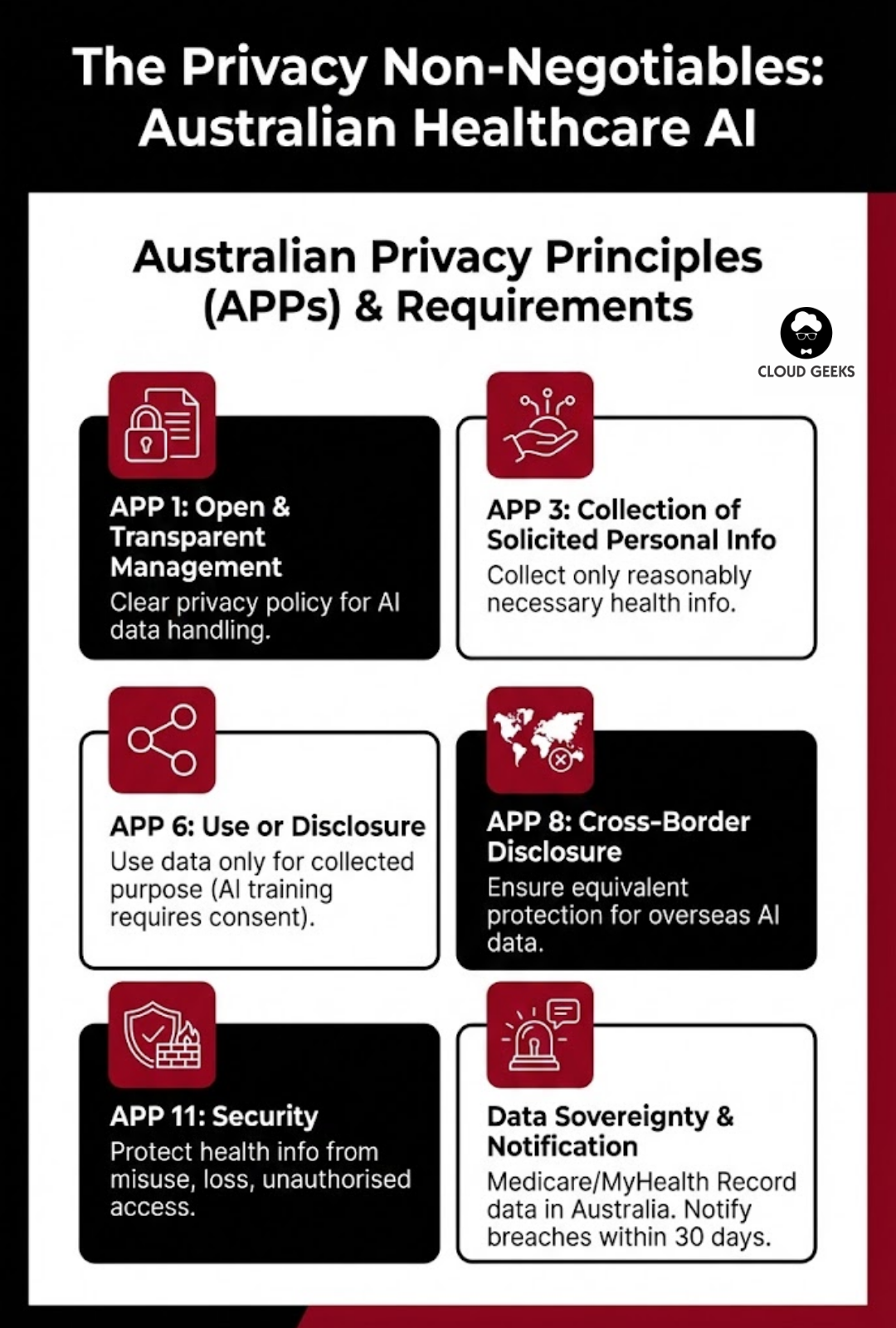
The Privacy Act 1988 establishes 13 Australian Privacy Principles. For healthcare AI, the most critical are:
APP 1: Open and Transparent Management You must have a clear, accessible privacy policy explaining how you collect, use, and disclose health information—including AI processing.
APP 3: Collection of Solicited Personal Information You can only collect health information that’s reasonably necessary for your functions. This limits what data you can feed to AI systems.
APP 6: Use or Disclosure Health information can generally only be used for the purpose it was collected. Using patient data to train AI models may require explicit consent.
APP 8: Cross-Border Disclosure If your AI sends data overseas (including to US-based cloud servers), you must ensure equivalent privacy protection. This is where many AI tools fail.
APP 11: Security You must take reasonable steps to protect health information from misuse, interference, loss, and unauthorised access. AI systems must meet this standard.
Data Sovereignty Requirements
For healthcare practices, data sovereignty isn’t optional:
- Medicare/PBS data: Must remain in Australia
- My Health Record integration: Strict data residency requirements
- State health records: Various state-specific requirements
- Personally Controlled Electronic Health Records: Must comply with PCEHR Act
Practical implication: Many popular AI tools (ChatGPT, Claude, US-based platforms) cannot be used for patient data without significant risk.
Notification Obligations
Under the Notifiable Data Breaches scheme, healthcare practices must notify the OAIC and affected patients of eligible data breaches within 30 days. AI systems that process patient data become part of your breach surface.
Privacy-Safe AI Architecture
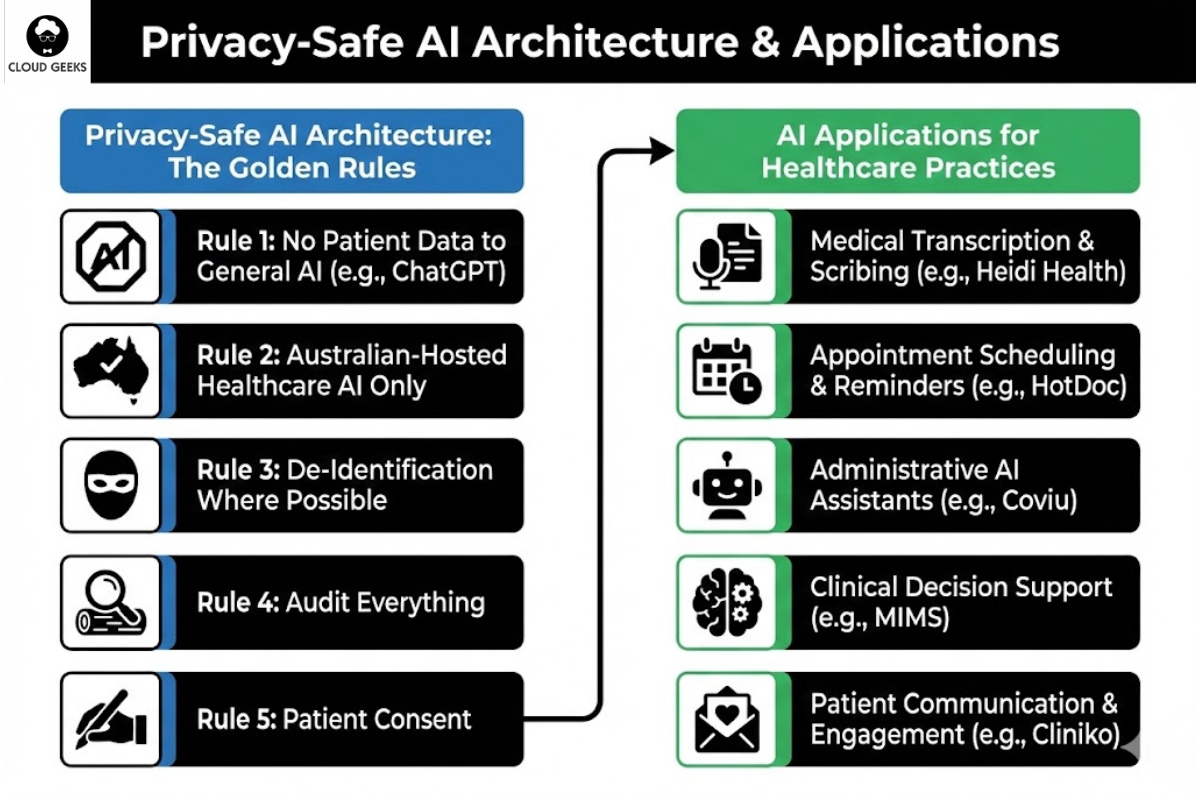
The Golden Rules
Rule 1: No Patient Data to General AI Never paste patient information into ChatGPT, Claude, Gemini, or any consumer AI tool. These platforms may use your inputs for training and don’t guarantee Australian data residency.
Rule 2: Australian-Hosted Healthcare AI Only For patient data processing, use only AI tools that:
- Store and process data exclusively in Australia
- Are certified for healthcare use
- Provide appropriate Business Associate Agreements
- Allow data deletion on request
Rule 3: De-Identification Where Possible When AI processing doesn’t require patient identification, remove or mask identifying information first.
Rule 4: Audit Everything Maintain logs of what AI systems access what patient data, when, and why.
Rule 5: Patient Consent Inform patients when AI is used in their care and obtain consent where required.
AI Applications for Healthcare Practices
Now let’s explore how to implement AI within these constraints.
Application 1: Medical Transcription and Scribing
The Opportunity
Consultation documentation consumes enormous time. AI transcription can:
- Capture conversation during consultations
- Generate structured clinical notes
- Reduce post-consultation documentation from 5-10 minutes to 1-2 minutes
- Improve note completeness and consistency
Privacy-Safe Options
Heidi Health (Australian)
- Australian-founded and hosted
- Designed specifically for Australian medical practices
- Integrates with major practice management systems
- RACGP-endorsed
- Generates structured notes from consultation audio
Cliniko + AI Scribing Partners
- Cliniko is Australian-hosted practice management
- Partners with Australian AI scribing solutions
- Keeps data within compliant systems
Lyrebird Health (Australian)
- Australian company with Australian data processing
- Specifically designed for GP consultations
- Integrates with Best Practice and Medical Director
How It Works (Safely)
- Patient consents to AI-assisted documentation
- Consultation audio is captured (device in room or microphone)
- Audio streams to Australian-hosted AI for transcription
- AI generates clinical note draft
- Practitioner reviews, edits, and approves
- Approved note saved to medical record
- Audio recording deleted (configurable retention)
Implementation Checklist
- Update privacy policy to include AI transcription
- Create patient consent process
- Verify vendor’s Australian data hosting
- Establish review workflow (never auto-approve AI notes)
- Train staff on proper use
- Configure appropriate retention policies
Application 2: Appointment Scheduling and Reminders
The Opportunity
Appointment no-shows cost Australian practices billions annually. AI can:
- Predict likely no-shows
- Optimise reminder timing and channels
- Handle bookings 24/7
- Reduce phone burden on reception
Privacy-Safe Options
HotDoc (Australian)
- Australian company, Australian hosting
- AI-powered appointment optimization
- Integrates with major practice management systems
- Patient-initiated booking with verification
HealthEngine (Australian)
- Similar capabilities to HotDoc
- Australian hosted
- AI features for no-show prediction
Cliniko (Australian)
- Built-in online booking
- AI-assisted reminder optimisation
- Australian data hosting
Implementation Considerations
- Ensure patient portal uses appropriate authentication
- Configure SMS/email reminders with minimal clinical information
- Avoid including diagnosis or treatment details in appointment reminders
- Give patients control over communication preferences
Application 3: Administrative AI Assistants
The Opportunity
Reception staff spend hours on:
- Answering common patient questions
- Explaining billing and fees
- Directing calls
- Managing referral inquiries
AI can handle routine queries, freeing staff for complex tasks.
Privacy-Safe Implementation
For Website/Portal: Deploy chatbots that handle general practice information:
- Opening hours and location
- Services offered
- General fee information
- New patient registration process
Critical: These chatbots should NOT access patient records or discuss individual cases.
For Phone Systems: AI voice assistants can:
- Direct calls to appropriate staff
- Provide practice information
- Take messages for non-urgent matters
- Manage callback requests
Australian-Hosted Options:
- Coviu: Australian telehealth with AI features
- Healthdirect Virtual Assistant: Government-backed, Australian hosted
Application 4: Clinical Decision Support
The Opportunity
AI can assist with:
- Drug interaction checking
- Diagnostic suggestions based on symptoms
- Care gap identification
- Risk stratification
Privacy Requirements
Clinical decision support AI must:
- Be classified as appropriate medical device (TGA regulated)
- Process data within Australian boundaries
- Maintain audit trails
- Support practitioner decision-making (not replace it)
Available Tools
MIMS Integrated Solutions
- Drug interaction and prescribing support
- Integrated with Australian practice software
- Australian data processing
PEN CS CAT4
- Population health analysis
- Care gap identification
- Australian developed and hosted
- Doesn’t send data externally
Best Practice/Medical Director AI Features
- Built-in decision support
- Local processing
- No external data transmission
Application 5: Patient Communication and Engagement
The Opportunity
AI can improve patient engagement through:
- Personalised health reminders
- Post-visit care instructions
- Chronic disease management prompts
- Preventive care recommendations
Privacy-Safe Approach
Use Practice Management Integration: Systems like Cliniko, Best Practice, and Medical Director can trigger personalised communications without exposing data to external AI:
- Recall reminders based on care schedules
- Appointment follow-ups
- Screening due dates
Avoid External AI for Personalisation: Don’t send patient data to external AI systems for “personalisation.” Use rule-based systems built into compliant platforms instead.
Implementing AI: A Staged Approach
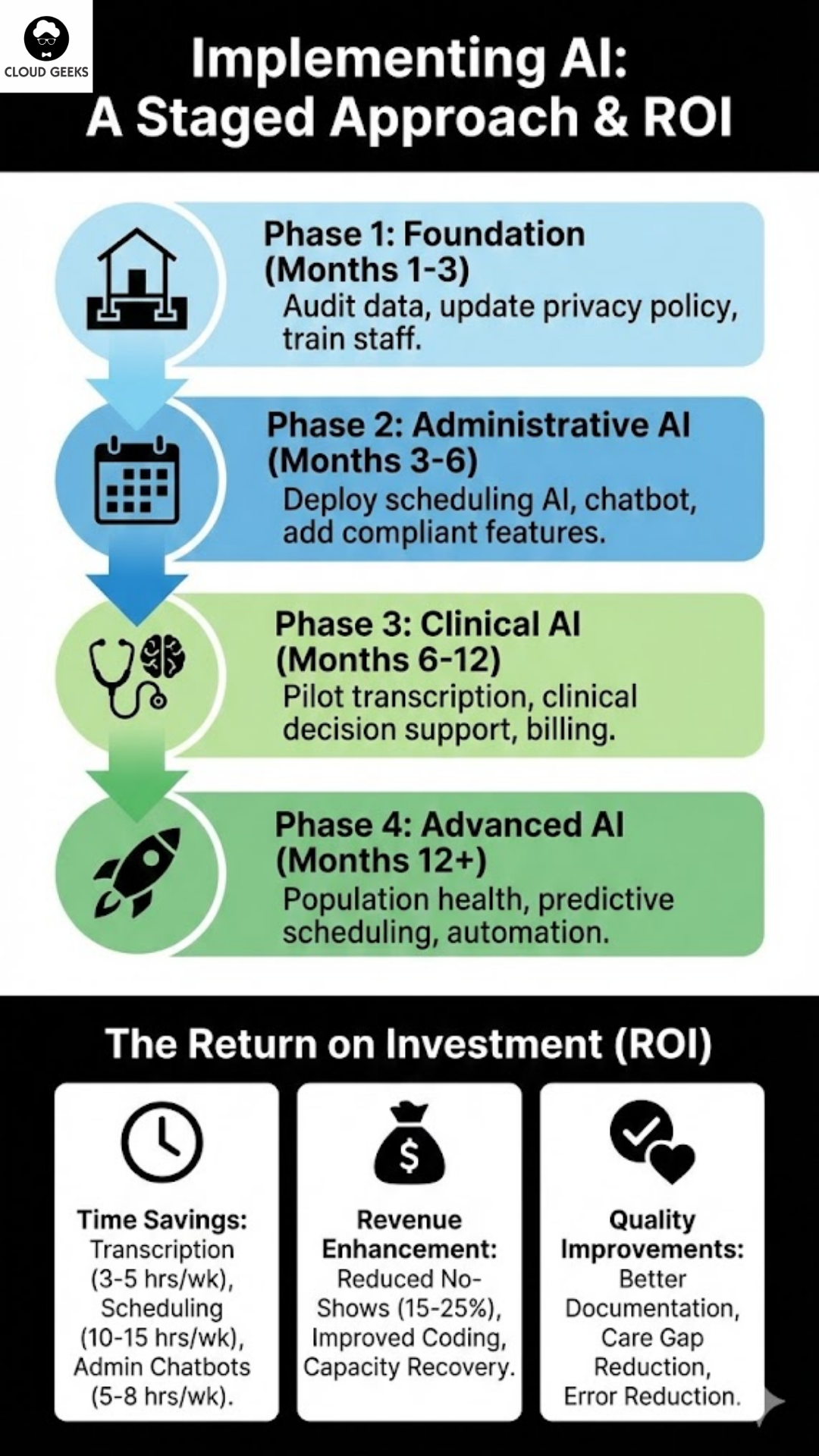
Phase 1: Foundation (Months 1-3)
Actions:
- Audit current data handling practices
- Update privacy policy for AI era
- Review vendor agreements for AI compliance
- Implement or verify Australian-hosted practice management system
- Train staff on privacy-safe AI principles
Focus: Get your house in order before adding AI complexity.
Phase 2: Administrative AI (Months 3-6)
Actions:
- Deploy AI-assisted scheduling (HotDoc, HealthEngine, or similar)
- Implement website chatbot for general inquiries
- Add AI features in existing compliant software
- Establish monitoring and audit processes
Focus: Low-risk AI that doesn’t touch clinical data.
Phase 3: Clinical AI (Months 6-12)
Actions:
- Pilot medical transcription with 1-2 practitioners
- Implement clinical decision support tools
- Add AI-assisted coding and billing
- Develop patient consent and communication processes
Focus: High-value AI with appropriate safeguards.
Phase 4: Advanced AI (Months 12+)
Actions:
- Population health analytics and risk stratification
- Predictive scheduling and resource optimization
- Advanced clinical decision support
- Patient engagement automation
Focus: Transformative AI once foundation is solid.

Vendor Assessment Framework
Before engaging any AI vendor for healthcare, verify:
Data Residency
- Data processed and stored exclusively in Australia
- Written confirmation of no offshore processing
- Ability to audit data location
Security Certification
- ISO 27001 certification
- SOC 2 Type II compliance
- Regular penetration testing
- Encryption at rest and in transit
Healthcare Compliance
- Understanding of APPs and healthcare requirements
- Appropriate business associate agreements
- TGA registration if classified as medical device
- My Health Record compatibility if relevant
Incident Response
- Defined breach notification process
- Aligned with Australian notification requirements
- Clear liability arrangements
- Insurance coverage
Data Rights
- Clear data ownership (practice owns the data)
- Data portability and export capabilities
- Data deletion on termination
- No use of patient data for training without consent
Common Mistakes to Avoid
Mistake 1: Using Consumer AI for Patient Data
The receptionist who pastes appointment notes into ChatGPT to “summarise them quickly” has just created a potential privacy breach. Establish clear policies.
Mistake 2: Assuming “HIPAA Compliant” Means Australian Compliant
HIPAA is US regulation. It doesn’t satisfy Australian privacy requirements, which have different (sometimes stricter) provisions.
Mistake 3: Ignoring State Requirements
Victoria, NSW, Queensland and other states have additional health records legislation. Federal compliance alone may not be sufficient.
Mistake 4: Forgetting Consent
Some AI applications require explicit patient consent. Document your consent processes and maintain records.
Mistake 5: Over-Trusting AI Outputs
AI transcription makes errors. Clinical decision support has blind spots. Always maintain human oversight and review.
The Return on Investment
Despite the compliance overhead, AI delivers substantial ROI for healthcare practices:
Time Savings
Medical Transcription: 3-5 hours saved per practitioner per week Scheduling AI: 10-15 hours saved per week in reception time Administrative Chatbots: 5-8 hours saved per week in phone/email handling
For a 3-GP practice, this represents approximately $150,000-200,000 in annual productivity value.
Revenue Enhancement
Reduced No-Shows: 15-25% reduction through AI-optimised reminders Improved Coding: AI-assisted coding captures more appropriate items Capacity Recovery: Time savings enable additional appointments
Quality Improvements
Documentation Quality: More complete, consistent clinical notes Care Gap Reduction: AI identifies missing preventive care Error Reduction: Decision support catches potential issues
Getting Started
Healthcare AI isn’t optional anymore—patients expect modern experiences, and competitors (especially corporate practices) are implementing rapidly.
But it must be done right. The consequences of privacy failures are too severe to rush or cut corners.
This Week:
- Review your current privacy policy—does it cover AI?
- Audit any AI tools staff might be using (even informally)
- Check your practice management system’s AI capabilities
- Research Australian-hosted medical transcription options
This Month:
- Update privacy policy for AI era
- Establish AI acceptable use policy for staff
- Plan Phase 1 implementation
- Brief staff on privacy-safe AI principles
This Quarter:
- Implement first AI application (scheduling or transcription)
- Measure results and refine approach
- Plan next phase of implementation
Ready to implement AI safely in your healthcare practice? Contact CloudGeeks for specialised guidance on privacy-compliant healthcare technology. We understand the unique requirements of Australian medical practices and can help you capture AI benefits without compliance risks.
Your patients trust you with their most sensitive information. That trust is worth protecting—even as you modernise.
Related Articles
- AI in Healthcare Administration: How Australian Medical Practices Can Streamline Operations
- Data Sovereignty 101: Keeping Your AI Australian
- The Human-in-the-Loop: A Governance Framework for Aussie SMBs
- Building a Cybersecurity-First Culture in the Age of AI
- Managing Vendor Risk: Is Your AI Supply Chain Secure?
If your business also needs a web portal or customer-facing dashboard, Cosmos Web Tech builds custom web applications tailored to Australian SMBs.
Cloud Geeks is the IT infrastructure division of Ganda Tech Services, providing managed cloud and cybersecurity solutions to Australian businesses.