
The True ROI of Cloud Migration: A Complete Guide for Australian Businesses in 2024
Cloud migration has become more than just a technology trend—it’s a strategic imperative for Australian businesses looking to remain competitive in an increasingly digital landscape. Yet, many SMBs across Australia still question whether the investment in cloud migration truly pays off.
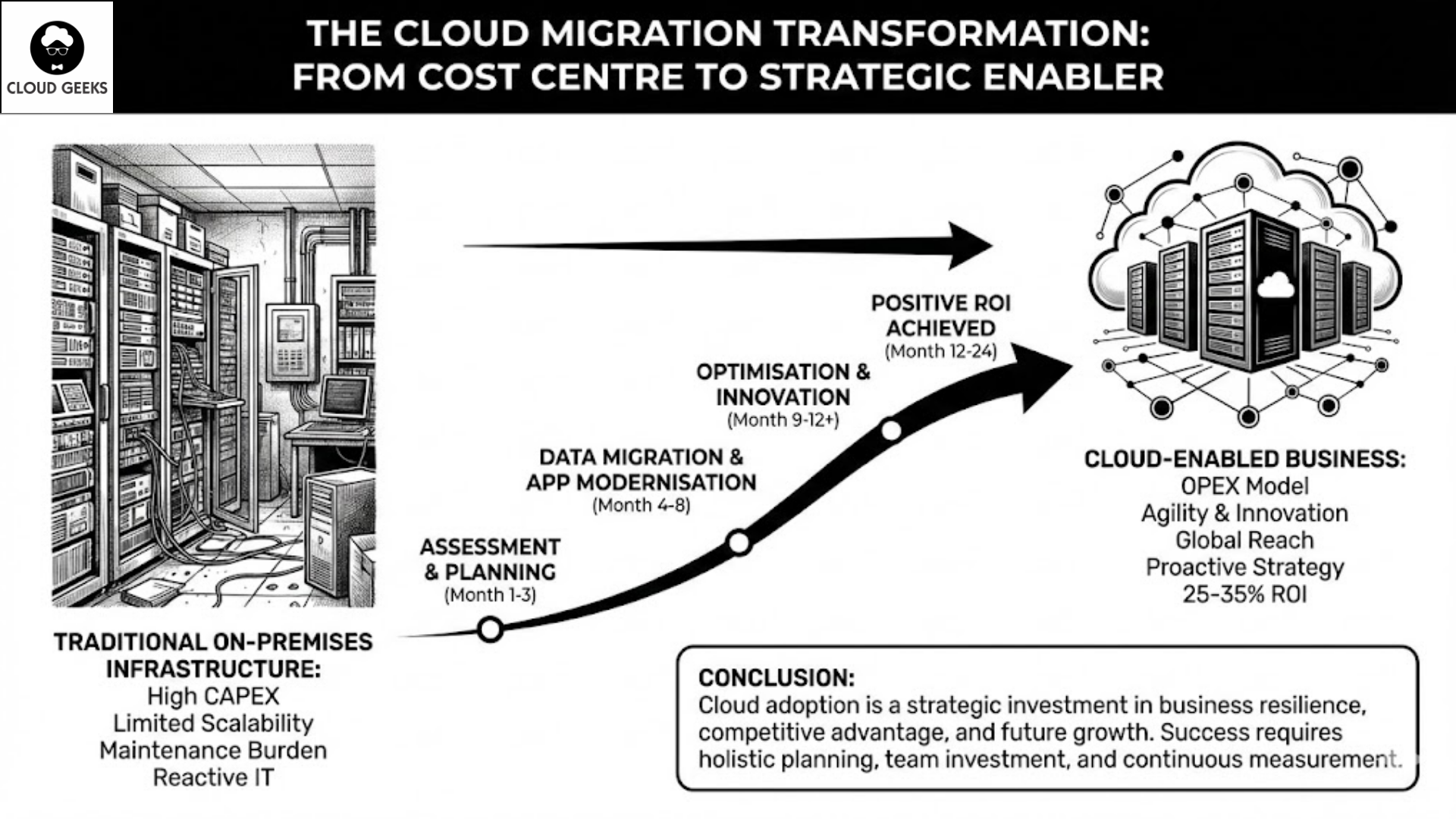
The numbers tell a compelling story. According to recent studies, businesses that successfully migrate to the cloud see an average ROI of 25-35% within the first two years. At CloudGeeks, our cloud migration expertise has helped Australian businesses achieve these results and more. The true value of cloud migration extends far beyond immediate cost savings, encompassing improved agility, enhanced security, and unprecedented scalability opportunities.
For Australian businesses, particularly SMBs, understanding the complete ROI picture is crucial for making informed decisions about their digital transformation journey. This comprehensive guide will demystify the true return on investment of cloud migration and provide you with the insights needed to evaluate this critical business decision.
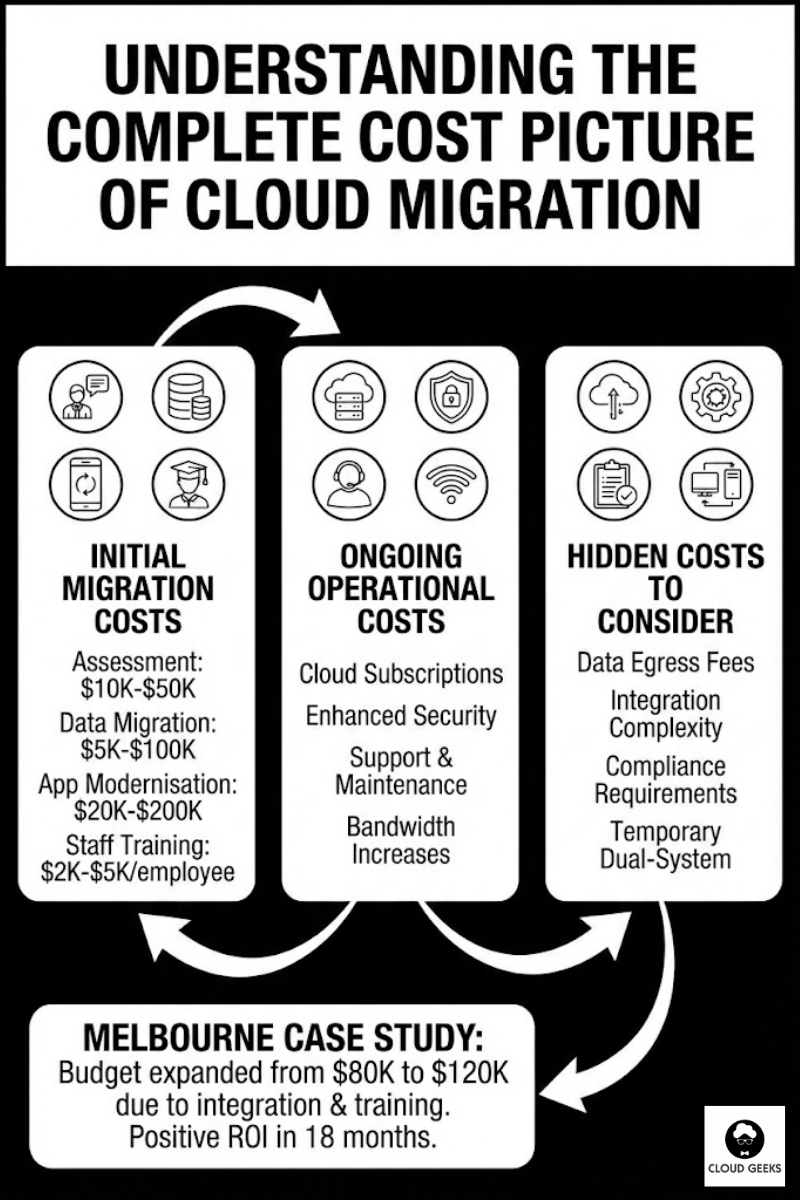
Understanding the Complete Cost Picture of Cloud Migration
When evaluating cloud migration ROI, many Australian businesses make the mistake of focusing solely on infrastructure costs. However, a comprehensive cost analysis must consider both direct and indirect expenses, as well as the often-overlooked hidden costs.
Initial Migration Costs
The upfront investment in cloud migration typically includes:
- Assessment and planning: Professional consultation fees ranging from $10,000 to $50,000 for mid-sized Australian businesses
- Data migration services: Costs varying from $5,000 to $100,000 depending on data volume and complexity
- Application modernisation: Legacy system updates that can range from $20,000 to $200,000
- Staff training and certification: Investment in team development, typically $2,000-$5,000 per employee
Ongoing Operational Costs
Post-migration, businesses face recurring expenses such as:
- Cloud service subscriptions: Monthly or annual fees based on usage and service tiers
- Enhanced security services: Advanced threat protection and compliance tools
- Ongoing support and maintenance: Reduced compared to on-premises but still significant
- Bandwidth and connectivity: Potential increases in internet costs for cloud-first operations
Hidden Costs to Consider
Australian businesses often encounter unexpected expenses including:
- Data egress fees: Costs for moving data out of cloud platforms
- Integration complexity: Additional expenses for connecting cloud services with existing systems
- Compliance requirements: Specific costs related to Australian data sovereignty and privacy laws
- Temporary dual-system operations: Running both old and new systems during transition periods
A Melbourne-based manufacturing company recently shared that their initial $80,000 migration budget expanded to $120,000 due to unexpected integration challenges and extended training requirements. However, their systematic approach to tracking these costs enabled them to achieve positive ROI within 18 months.
Quantifying the Financial Benefits and Cost Savings
While migration costs can seem daunting, the financial benefits of cloud adoption often outweigh the initial investment, particularly for Australian SMBs operating in competitive markets.
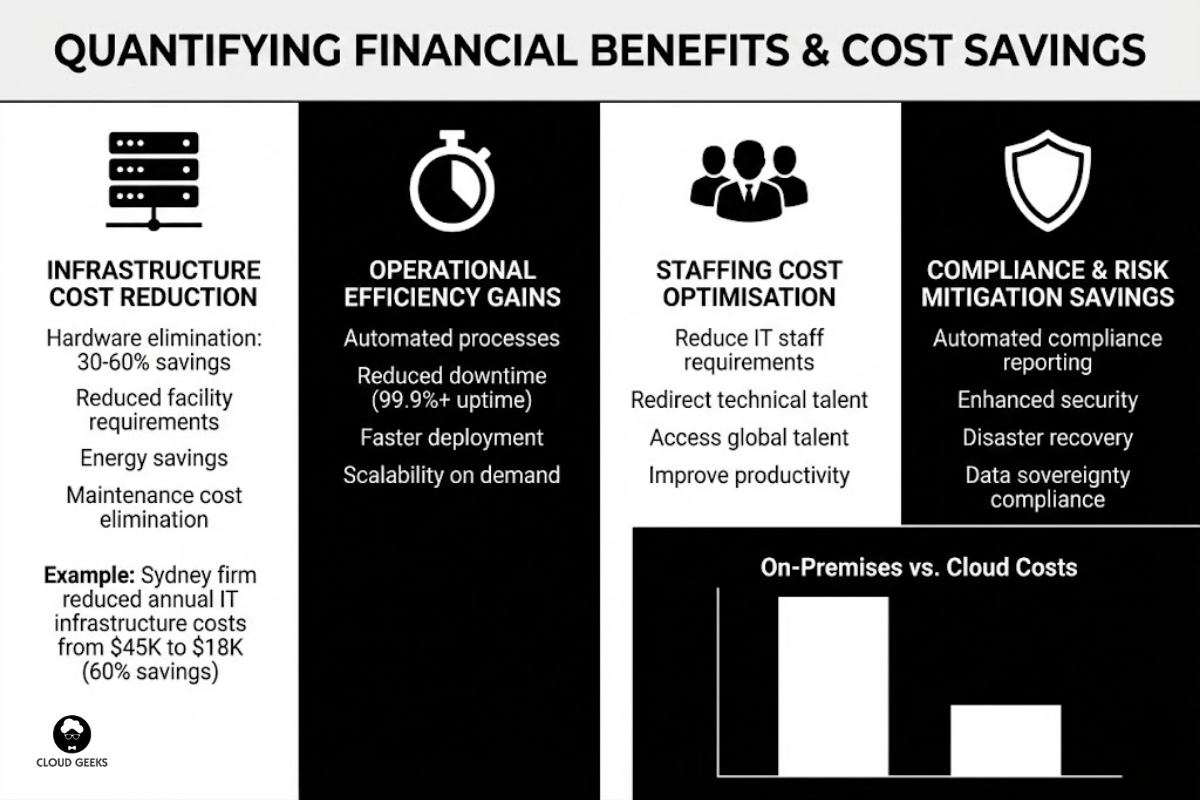
Infrastructure Cost Reduction
The most immediate and measurable benefit comes from reduced infrastructure expenses:
- Hardware elimination: No more server purchases, with typical savings of 30-60% on hardware costs
- Reduced facility requirements: Smaller office spaces due to eliminated server rooms
- Energy savings: Significant reductions in electricity costs, particularly relevant given Australia’s high energy prices
- Maintenance cost elimination: No more hardware maintenance contracts or on-site technical support
A Sydney-based accounting firm reduced their annual IT infrastructure costs from $45,000 to $18,000 by migrating to cloud-based solutions, representing a 60% cost reduction.
Operational Efficiency Gains
- Automated processes: Cloud platforms enable automation of routine tasks, reducing labour costs
- Reduced downtime: Enterprise-grade uptime guarantees (99.9%+) minimize business disruption costs
- Faster deployment: New applications and services can be deployed in minutes rather than weeks
- Scalability on demand: Pay only for resources used, eliminating over-provisioning waste
Staffing Cost Optimisation
Cloud migration often enables Australian businesses to:
- Reduce IT staff requirements: Less need for hardware specialists and maintenance personnel
- Redirect technical talent: Focus skilled staff on innovation rather than maintenance
- Access global talent pools: Cloud-enabled remote work capabilities expand recruitment options
- Improve productivity: Modern cloud tools enhance employee efficiency across all departments
Compliance and Risk Mitigation Savings
For Australian businesses, cloud migration offers significant compliance advantages:
- Automated compliance reporting: Reduced costs for GDPR, Privacy Act, and industry-specific compliance
- Enhanced security: Enterprise-grade security at a fraction of the cost of implementing in-house
- Disaster recovery: Comprehensive backup and recovery solutions without significant capital investment
- Data sovereignty compliance: Australian cloud regions ensure compliance with local data laws
Beyond the Numbers: Strategic and Operational Benefits
While financial metrics are crucial, the strategic advantages of cloud migration often deliver the most significant long-term value for Australian businesses.
Enhanced Business Agility
Cloud infrastructure enables Australian SMBs to compete with larger enterprises by providing:
- Rapid market response: Launch new products or services without infrastructure delays
- Geographic expansion: Serve customers across Australia and internationally without physical infrastructure investment
- Seasonal flexibility: Scale resources up or down based on demand fluctuations
- Innovation acceleration: Access to cutting-edge technologies like AI and machine learning
A Brisbane-based e-commerce retailer leveraged cloud scalability to handle a 400% traffic increase during Black Friday sales, something that would have been impossible with their previous on-premises setup.
Competitive Advantage Through Technology Access
Cloud platforms provide Australian businesses with access to:
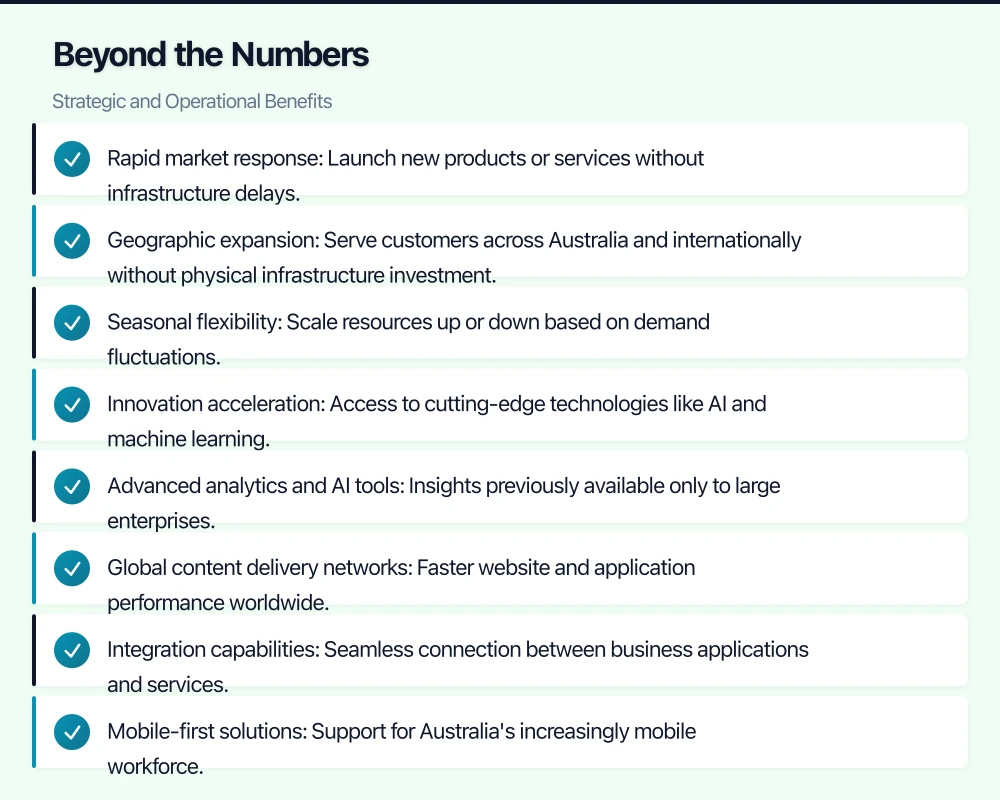
- Advanced analytics and AI tools: Insights previously available only to large enterprises
- Global content delivery networks: Faster website and application performance worldwide
- Integration capabilities: Seamless connection between business applications and services
- Mobile-first solutions: Support for Australia’s increasingly mobile workforce
Improved Collaboration and Productivity
Cloud migration enables:
- Remote work capabilities: Essential for Australian businesses managing distributed teams
- Real-time collaboration: Simultaneous document editing and project management
- Unified communications: Integrated voice, video, and messaging solutions
- Cross-platform accessibility: Access to business applications from any device, anywhere
Future-Proofing Your Business
Cloud infrastructure provides:
- Automatic updates: Always access to the latest features and security patches
- Technology evolution: Seamless adoption of emerging technologies
- Vendor ecosystem access: Integration with best-in-class software solutions
- Sustainability benefits: Reduced carbon footprint through shared infrastructure
These strategic benefits often prove more valuable than direct cost savings, enabling Australian businesses to adapt quickly to market changes and customer demands.
Measuring and Tracking ROI: Key Metrics for Australian SMBs
Successful cloud migration ROI measurement requires a systematic approach to tracking both quantitative and qualitative benefits over time.
Essential Financial Metrics
Total Cost of Ownership (TCO) Comparison:
- Track all costs (hardware, software, personnel, facilities) before and after migration
- Include indirect costs like downtime, maintenance, and upgrade expenses
- Calculate over a 3-5 year period for accurate comparison
Direct Cost Savings Tracking:
- Monthly infrastructure cost reductions
- Energy and facility cost savings
- Reduced personnel costs for IT maintenance
- Eliminated software licensing fees
Revenue Impact Measurement:
- Increased sales due to improved uptime and performance
- New revenue streams enabled by cloud capabilities
- Faster time-to-market for new products or services
- Geographic expansion revenue opportunities
Operational Performance Indicators
System Performance Metrics:
- Application response times (target: 50% improvement)
- System uptime and availability (aim for 99.9%+)
- Data backup and recovery times
- Security incident reduction rates
Productivity Measurements:
- Employee productivity improvements (often 15-30% gains)
- Reduced time spent on IT troubleshooting
- Faster deployment of new applications or updates
- Improved collaboration metrics and project completion times
Strategic Value Indicators
Business Agility Measures:
- Time to deploy new services or applications
- Ability to scale resources based on demand
- Speed of entering new markets or launching products
- Customer satisfaction improvements
Innovation Metrics:
- Number of new technologies adopted
- Time saved on routine IT tasks redirected to innovation
- Integration capabilities with new business tools
- Employee satisfaction with technology tools
ROI Calculation Framework
A practical ROI calculation for Australian SMBs:
ROI = (Total Benefits - Total Costs) / Total Costs × 100

Total Benefits = Cost Savings + Revenue Increases + Productivity Gains
Total Costs = Migration Costs + Ongoing Operational Costs
Case Study Example: A Melbourne-based professional services firm achieved:
- Migration costs: $75,000
- Annual operational cost reduction: $35,000
- Annual productivity gains valued at: $25,000
- New revenue opportunities: $15,000 annually
- 3-year ROI: 200%
Best Practices for ROI Tracking
- Establish baseline metrics before migration begins
- Set realistic timelines - full ROI typically takes 12-24 months
- Track both hard and soft benefits for complete picture
- Regular quarterly reviews to identify optimisation opportunities
- Benchmark against industry standards for Australian businesses in your sector
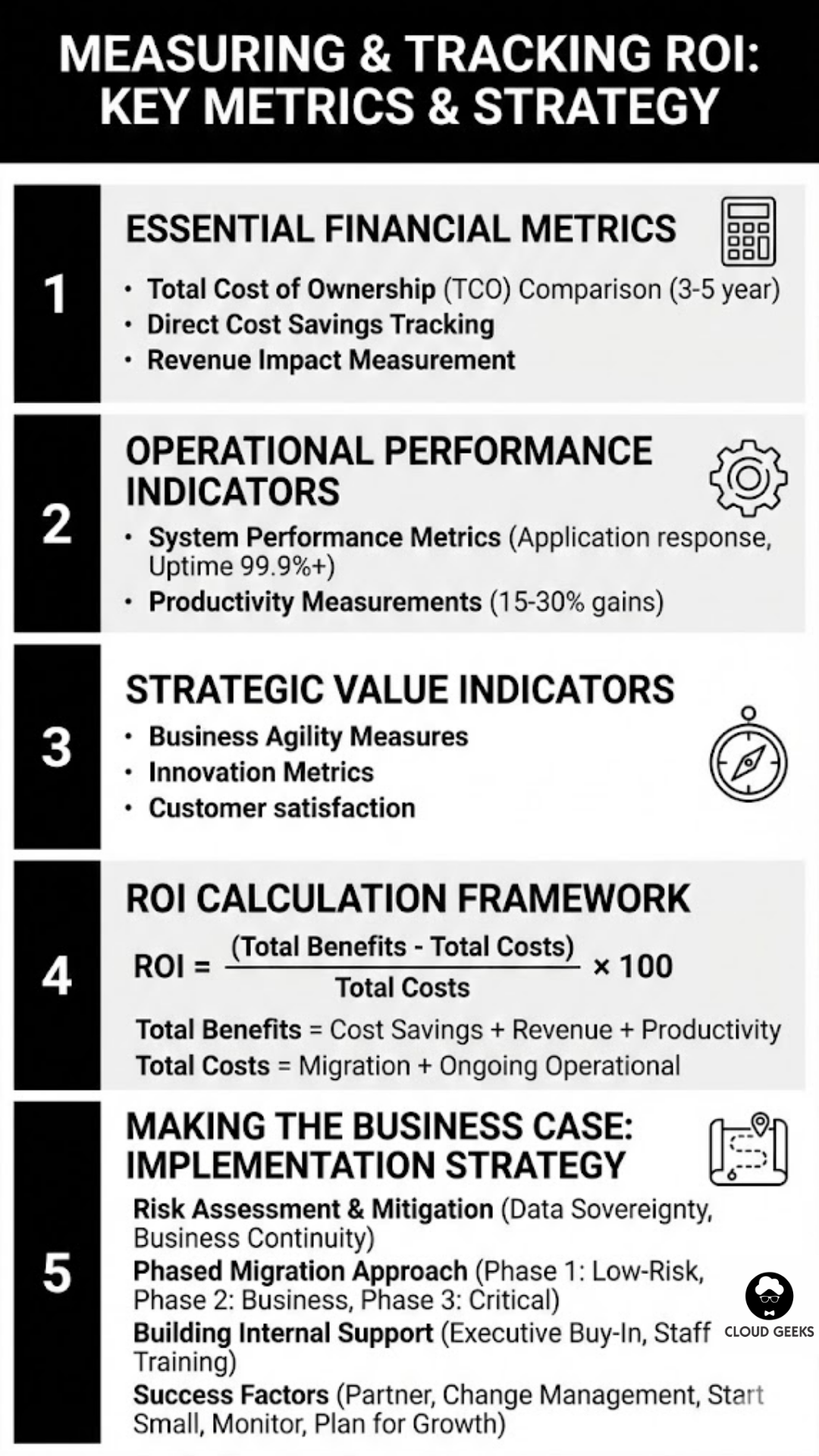
Making the Business Case: Implementation Strategy for Australian SMBs
Developing a compelling business case for cloud migration requires a strategic approach that addresses both financial and operational considerations specific to the Australian market.
Risk Assessment and Mitigation
Data Sovereignty Considerations:
- Ensure cloud providers offer Australian data centres
- Verify compliance with Privacy Act and industry-specific regulations
- Plan for data residency requirements and cross-border data transfer rules
If you’re still deciding between cloud platforms, read our comprehensive Azure vs AWS comparison for Australian businesses to understand which platform best meets your compliance and business needs.
Business Continuity Planning:
- Develop comprehensive disaster recovery strategies
- Plan for potential service outages or connectivity issues
- Establish clear SLAs with cloud service providers
- Consider multi-cloud strategies for critical applications
Phased Migration Approach
Phase 1: Low-Risk Applications (Months 1-3)
- Migrate non-critical applications first
- Build team confidence and experience
- Establish operational procedures and monitoring
- Typical applications: email, file storage, basic productivity tools
Phase 2: Business Applications (Months 4-8)
- Move core business applications
- Implement integration between cloud and remaining on-premises systems
- Focus on applications with clear cost benefits
- Examples: CRM, accounting software, project management tools
Phase 3: Critical Systems (Months 9-12)
- Migrate mission-critical applications
- Implement comprehensive security and monitoring
- Complete data migration and system integration
- Final decommissioning of on-premises infrastructure
Building Internal Support
Executive Buy-In Strategies:
- Present clear financial projections with realistic timelines
- Highlight competitive advantages and market positioning benefits
- Address specific concerns about security and compliance
- Provide examples from similar Australian businesses
Staff Engagement and Training:
- Communicate benefits clearly to all team members
- Invest in comprehensive training programs
- Address concerns about job security and role changes
- Celebrate early wins and success milestones
Success Factors for Australian SMBs
- Choose the right cloud partner: Select providers with strong Australian presence and support
- Invest in change management: Allocate budget for training and process adaptation
- Start small and scale: Begin with pilot projects to prove value
- Monitor and optimise continuously: Regular review of costs and performance
- Plan for growth: Ensure chosen solutions can scale with business expansion
Conclusion: The Path Forward for Australian Businesses
The true ROI of cloud migration extends far beyond simple cost comparisons. For Australian SMBs, cloud adoption represents a strategic investment in business resilience, competitive advantage, and future growth capability.
While the initial migration costs can be significant—typically ranging from $50,000 to $200,000 for mid-sized Australian businesses—the combination of direct cost savings, operational improvements, and strategic benefits usually delivers positive ROI within 12-24 months.
Key Takeaways for Australian Business Leaders:
- Take a holistic view: Consider all costs and benefits, not just infrastructure savings
- Plan systematically: Use a phased approach to minimize risk and maximize learning
- Invest in your team: Training and change management are crucial for success
- Choose Australian-compliant solutions: Ensure data sovereignty and regulatory compliance
- Measure continuously: Track ROI metrics from day one to optimize outcomes
The businesses that will thrive in Australia’s evolving digital economy are those that view cloud migration not as a cost centre, but as a strategic enabler of growth, innovation, and competitive advantage.
Ready to explore how cloud migration could benefit your Australian business? Contact the CloudGeeks team for a comprehensive ROI assessment tailored to your specific situation and goals. Our local expertise and proven track record with Australian SMBs ensure you’ll have the insights needed to make this critical decision with confidence.
Related Articles
- Cloud Migration ROI: Calculating Real Costs for Australian SMBs
- Azure vs AWS for Australian Businesses: Complete Comparison
- Multi-Cloud Strategy for Australian Businesses: AWS vs Azure vs GCP
- Digital Transformation Roadmap: A 7-Step Guide for Australian SMBs
- Data Sovereignty 101: Keeping Your AI Australian
If your business also needs a web portal or customer-facing dashboard, Cosmos Web Tech builds custom web applications tailored to Australian SMBs.
Cloud Geeks is the IT infrastructure division of Ganda Tech Services, providing managed cloud and cybersecurity solutions to Australian businesses.