
Retail Revolution: What Aussie SMBs Can Learn from THE ICONIC's AI Strategy
When Australia’s largest online fashion retailer reduced their “null search results” from 5% to near zero, it wasn’t magic—it was AI. THE ICONIC’s implementation of Google Cloud’s Vertex AI transformed how customers find products, directly boosting revenue and customer satisfaction.
But here’s what most retail coverage misses: the underlying strategies THE ICONIC used aren’t exclusive to companies with massive budgets. The same principles—and increasingly, the same tools—are available to Australian SMB retailers willing to think differently about product discovery.
At CloudGeeks, we’ve helped Australian retailers implement AI strategies that mirror enterprise approaches at SMB budgets. Here’s how THE ICONIC did it, and how you can apply their lessons to your business.
The Problem THE ICONIC Solved
The “Null Search” Revenue Killer
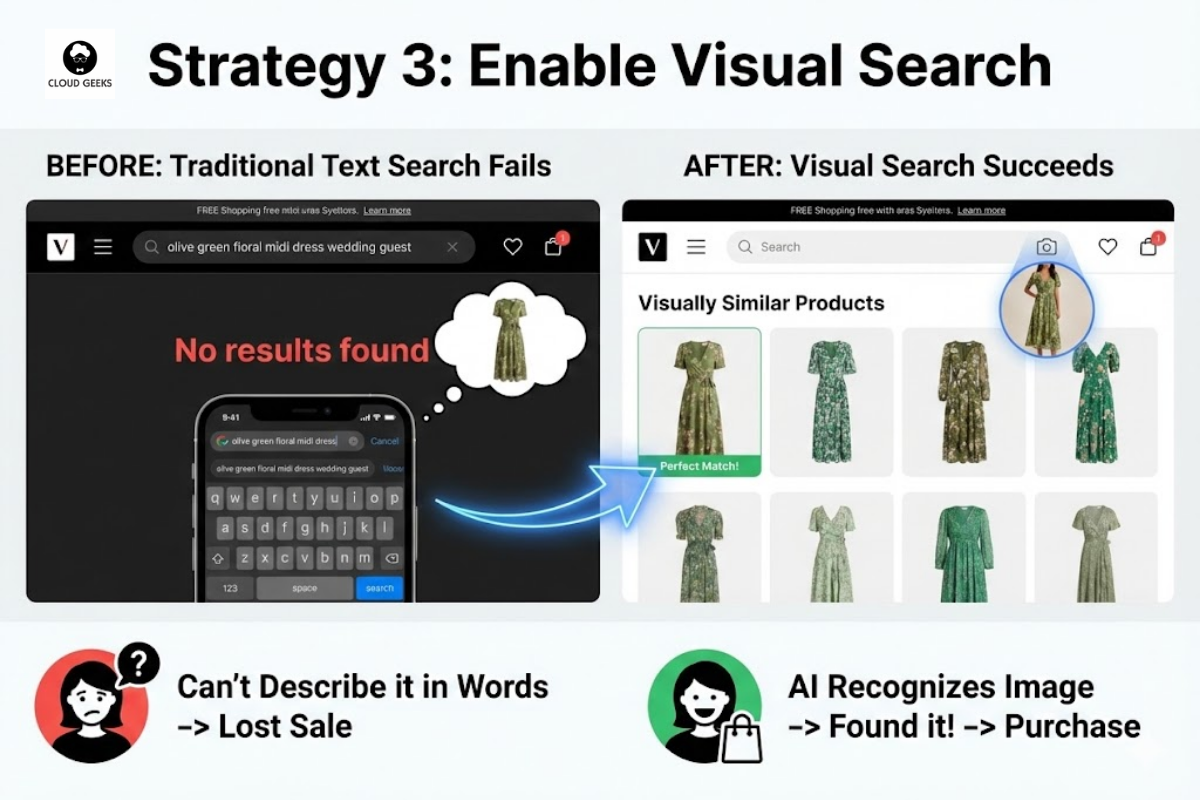
Picture this: A customer visits your online store searching for “olive green midi dress for wedding.” Your search returns: “No results found.”
That customer doesn’t refine their search. They leave. Forever.
THE ICONIC discovered that 5% of their searches returned zero results—representing thousands of potential sales lost daily. In a business processing millions of searches monthly, that 5% translated to substantial revenue leakage.
Why Traditional Search Fails
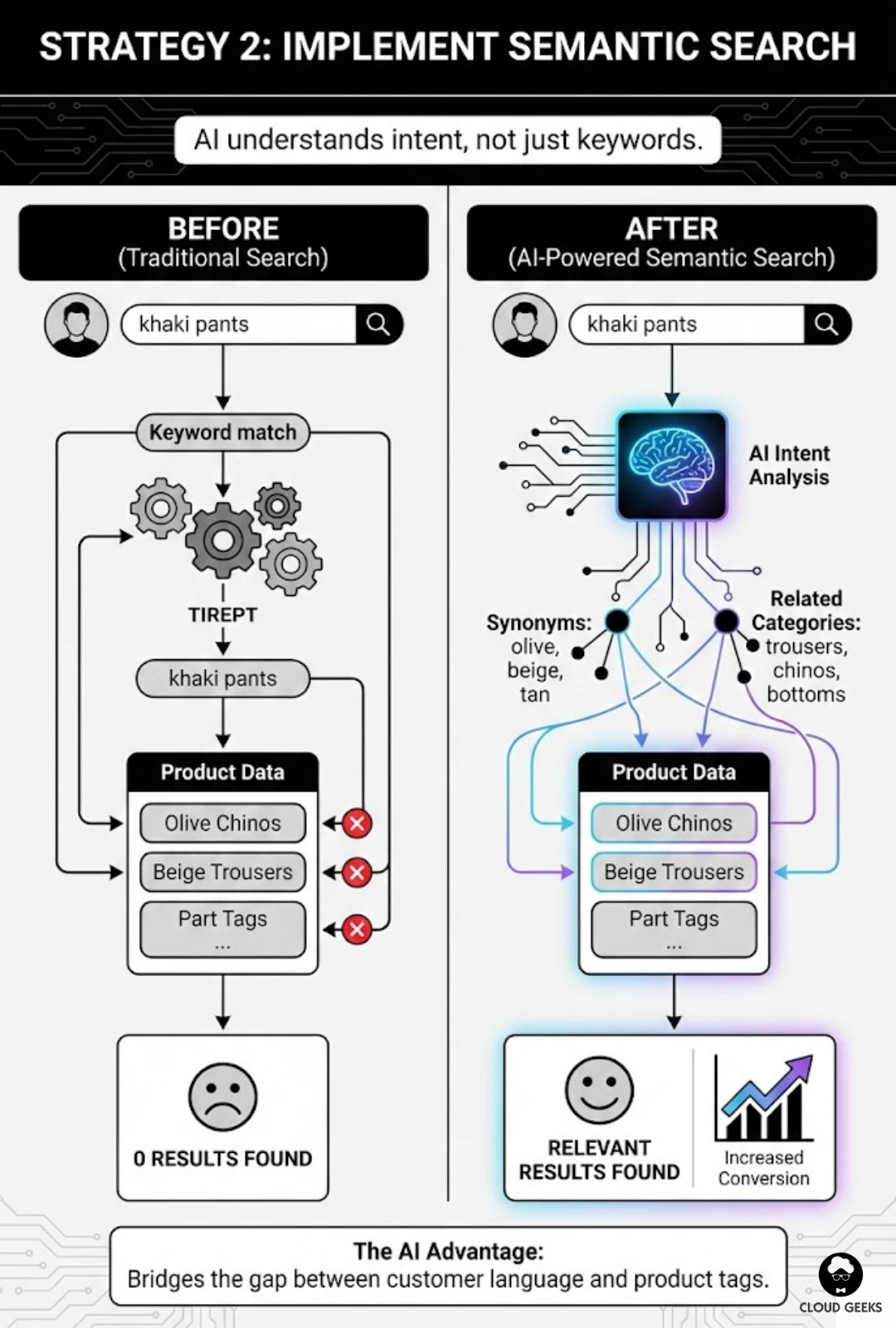
Traditional e-commerce search relies on exact keyword matching. If your product database says “khaki” and the customer searches “olive,” you’ve lost the sale. If they search “work pants” but you’ve tagged items as “business trousers”—same problem.
The gap between how customers describe products and how retailers tag them is the silent killer of e-commerce conversion.
THE ICONIC’s AI Solution
Google Cloud Vertex AI Implementation
THE ICONIC partnered with Google Cloud to implement Vertex AI Search for retail, fundamentally changing how product discovery works.
Semantic Understanding: Instead of matching keywords, the AI understands meaning. “Olive green” and “khaki” are recognised as similar. “Midi dress” and “knee-length dress” connect.
Visual Search Enhancement: Customers can search using images, finding visually similar products even without knowing fashion terminology.
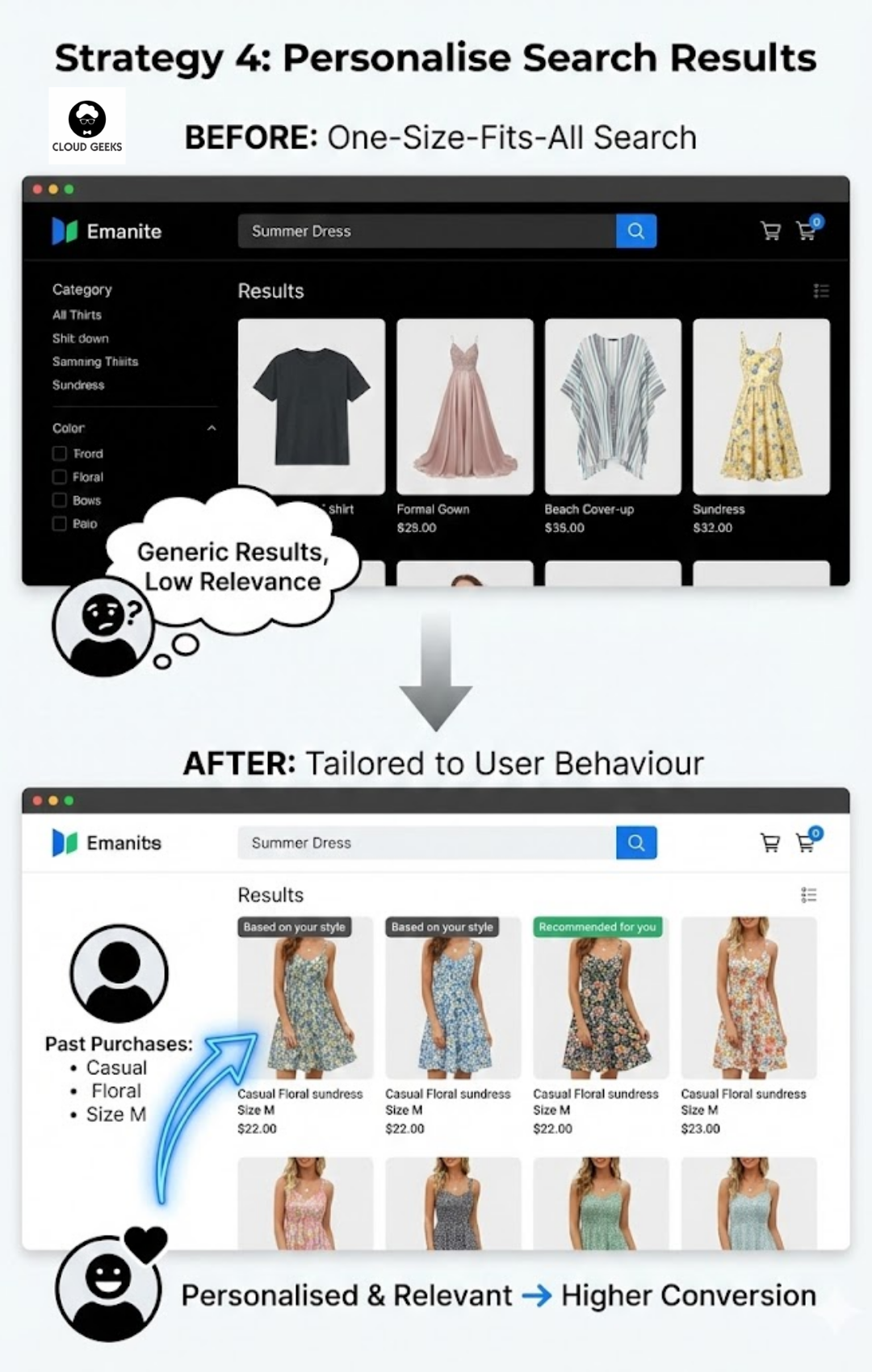
Personalised Ranking: Search results adapt based on individual customer behaviour, showing products most likely to convert for each shopper.
Automated Product Tagging: AI analyses product images and descriptions to generate comprehensive, consistent tags across the entire catalogue.
The Results
- Null search results: Reduced from 5% to near zero
- Search conversion rate: Increased significantly (exact figures proprietary)
- Customer satisfaction: Measurably improved through faster, more accurate product discovery
- Catalogue management: Reduced manual tagging effort by 60%
Translating Enterprise AI to SMB Reality
THE ICONIC spent significant resources on their implementation. But the underlying strategies are accessible at any scale. Here’s how to apply each principle to your business.
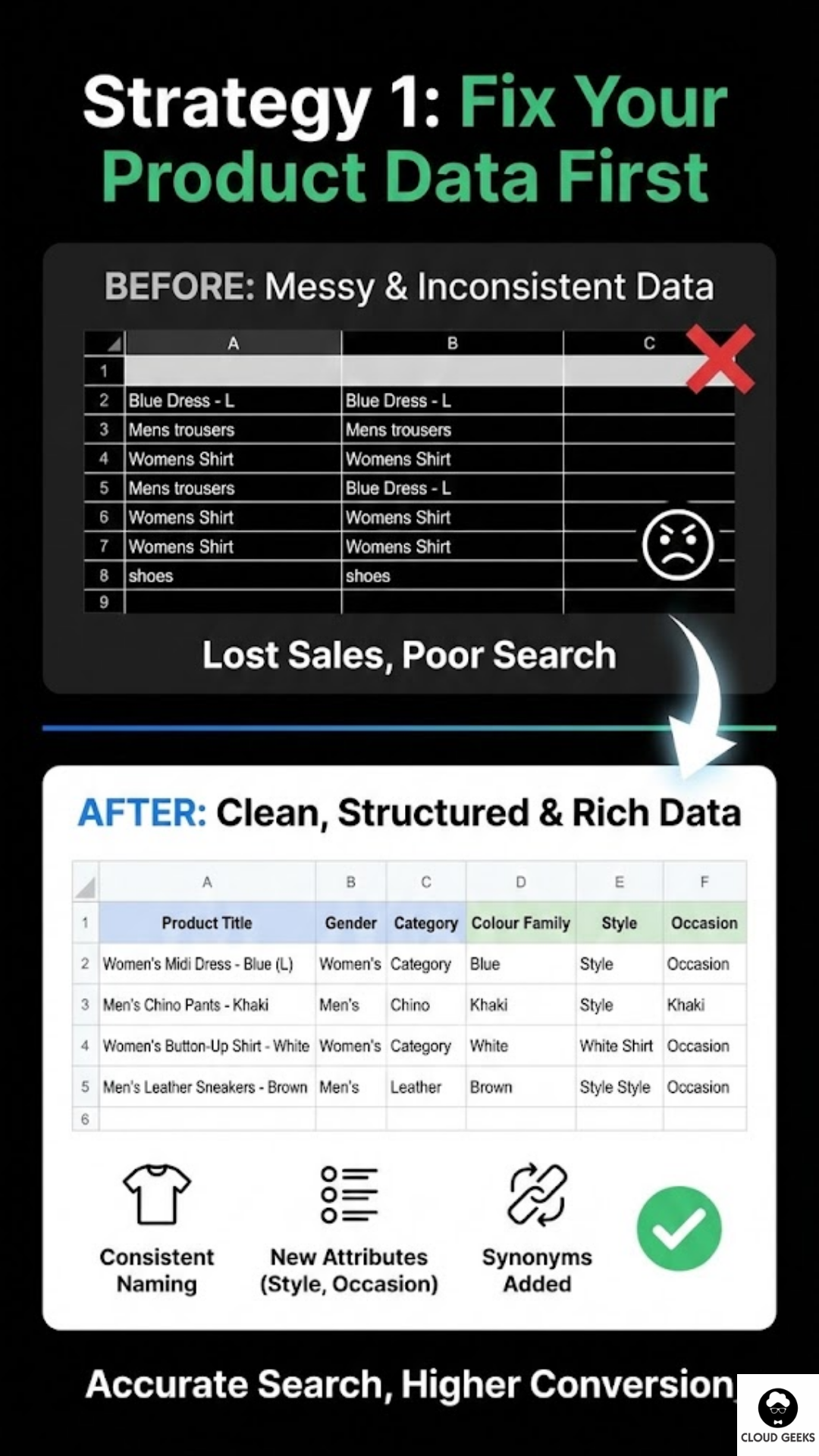
Strategy 1: Fix Your Product Data First
What THE ICONIC Did: Before implementing AI, they cleaned and standardised their product data—ensuring consistent naming conventions, comprehensive attributes, and accurate categorisation.
What You Can Do Today:
-
Audit your product titles: Are they consistent? Do you use “Men’s” sometimes and “Mens” other times? Pick one format and apply it everywhere.
-
Expand your product attributes: Don’t just list “Blue Dress.” Add:
- Colour family (blue, navy, cobalt)
- Style (casual, formal, cocktail)
- Occasion (wedding guest, work, date night)
- Fit (relaxed, fitted, oversized)
- Material (cotton, polyester, silk blend)
-
Add synonym fields: If your product is “trousers,” add a hidden field containing “pants, slacks, bottoms” so searches for any term find it.
Tools for SMBs:
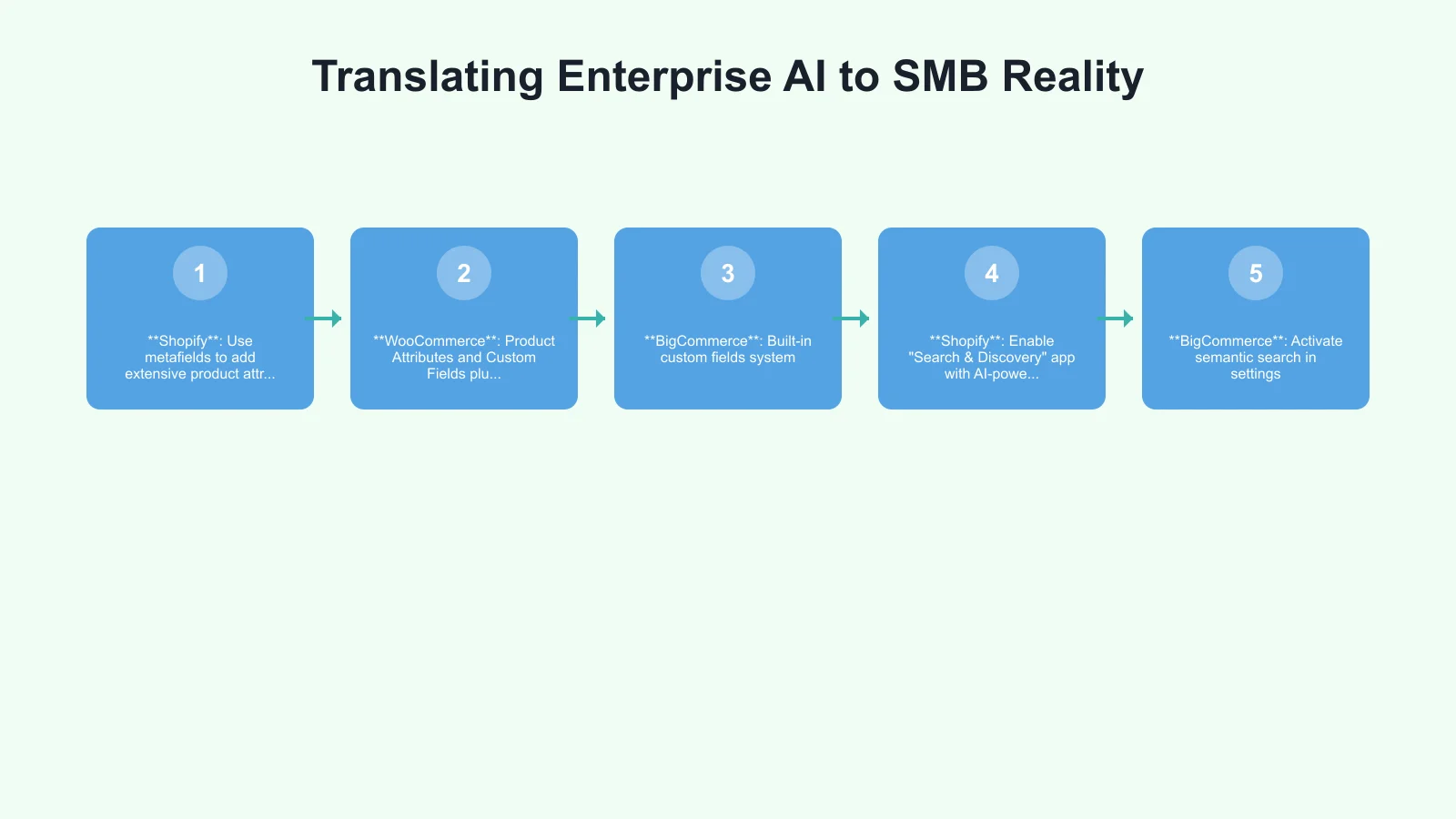
- Shopify: Use metafields to add extensive product attributes
- WooCommerce: Product Attributes and Custom Fields plugins
- BigCommerce: Built-in custom fields system
Cost: Free (just your time)
Strategy 2: Implement Semantic Search
What THE ICONIC Did: Deployed AI that understands search intent, not just keywords.
What You Can Do Today:
Option 1: Platform Built-In AI (Easiest)
- Shopify: Enable “Search & Discovery” app with AI-powered search
- BigCommerce: Activate semantic search in settings
- WooCommerce: Install “SearchWP” or “Relevanssi” plugins with synonym support
Option 2: Third-Party Search Solutions (More Powerful)
- Algolia: AI-powered search starting at $0 for small catalogues
- Searchspring: Australian-friendly with strong fashion/retail focus
- Klevu: Specifically designed for e-commerce semantic search
- Constructor.io: Enterprise-grade with SMB pricing tiers
Typical Cost: $50-300 AUD/month depending on catalogue size and traffic
Implementation Time: 1-2 weeks for basic setup
Strategy 3: Enable Visual Search
What THE ICONIC Did: Allowed customers to upload photos to find similar products.
What You Can Do Today:
Option 1: Platform Integrations
- Syte: Visual AI for fashion and home retailers, integrates with Shopify/Magento
- ViSenze: Image recognition search, used by major Australian retailers
- Slyce: Visual search specifically for retail
Option 2: Google Cloud Vision API
- Direct implementation using Google’s Visual Product Search
- Pay-per-use pricing makes it accessible for SMBs
- Requires some technical setup but delivers enterprise-grade results
Typical Cost: $100-500 AUD/month depending on search volume
Why It Matters: Customers often can’t describe what they want in words. They’ve seen something on Instagram and want to find something similar. Visual search bridges this gap.
Strategy 4: Personalise Search Results
What THE ICONIC Did: Adjusted search rankings based on individual customer behaviour.
What You Can Do Today:
Basic Personalisation (Free):
- Use your e-commerce platform’s built-in “related products” and “recently viewed” features
- Configure search to boost products in categories the customer has previously purchased
- Show “customers also bought” recommendations
Advanced Personalisation (Paid):
- Nosto: AI-powered personalisation for e-commerce ($99-$499/month)
- Dynamic Yield: Enterprise-grade but has SMB packages
- Clerk.io: Product recommendations with personalised search
The Quick Win: Even without AI, you can manually configure search to boost:
- Best sellers (social proof)
- High-margin items (profitability)
- New arrivals (freshness)
- In-stock items over backorders (customer experience)
Strategy 5: Automate Product Tagging
What THE ICONIC Did: Used AI to automatically tag products with comprehensive attributes.
What You Can Do Today:
For New Products:
- Use AI tools like ChatGPT or Claude to generate product descriptions and tags from images
- Prompt: “Analyse this product image and suggest: colour variations, style category, suitable occasions, target demographic, and 10 relevant search terms”
For Existing Catalogues:
- Pixyle.ai: Automated fashion tagging
- Glisten.ai: Product attribute extraction
- Vue.ai: Comprehensive product tagging for fashion
DIY Approach:
- Export your product list
- Use ChatGPT/Claude to batch-process descriptions and suggest additional tags
- Review and approve suggestions
- Import enhanced data back to your platform
Time Investment: 1 hour setup + 10 minutes per 50 products for review
Case Study: Sydney Fashion Boutique
Let’s look at how a real Australian SMB implemented these strategies.
The Business
A Sydney-based boutique selling Australian designer fashion online. 2,000 SKU catalogue, 50,000 monthly visitors, Shopify platform.
The Problem
- 8% of searches returned no results
- Search conversion rate: 2.1% (below industry average of 4.5%)
- Customer complaints about “can’t find anything on your site”
The Solution (Total Investment: $4,200 setup + $250/month)
Month 1: Data Cleanup
- Standardised all product titles
- Added 5 additional attributes to every product
- Created synonym mappings for common terms
- Cost: Staff time only
Month 2: Search Upgrade
- Implemented Algolia search ($150/month)
- Configured semantic search and typo tolerance
- Set up search analytics to identify problem queries
- Cost: $150/month + 8 hours setup
Month 3: Personalisation
- Added Nosto for product recommendations ($99/month)
- Configured personalised search result boosting
- Implemented “complete the look” recommendations
- Cost: $99/month + 4 hours setup
The Results (After 6 Months)
- Null search results: Reduced from 8% to 0.3%
- Search conversion rate: Increased from 2.1% to 4.8%
- Average order value: Up 18% (from recommendation engine)
- Return customer rate: Improved by 12%
ROI Calculation:
- Monthly revenue increase: Approximately $8,500
- Monthly cost: $250
- ROI: 3,300%
Common Mistakes When Implementing Retail AI
1. Ignoring Data Quality
AI amplifies your data quality—good or bad. If your product data is messy, AI search will return messy results. Clean your data first.
2. Over-Relying on AI
AI search is powerful but not magic. If you don’t carry olive green dresses, no AI will find them. Ensure your inventory matches customer demand.
3. Forgetting Mobile
60%+ of Australian e-commerce happens on mobile. Test your AI search experience on phones—not just desktop.
4. Not Measuring Results
Set up search analytics before implementing changes. You can’t prove ROI without baseline measurements.
5. Implementing Everything at Once
Start with one strategy, measure results, then add more. THE ICONIC’s implementation took years—your SMB can move faster but still shouldn’t rush.
The Competitive Imperative
Amazon’s AI-powered search sets customer expectations. When shoppers visit your site after Amazon, they expect the same seamless product discovery. Meeting these expectations isn’t optional—it’s survival.
Australian SMB retailers have an advantage: you can move faster than legacy retailers stuck with outdated systems. Use that agility.
Your 90-Day Action Plan
Days 1-30: Foundation
- Audit and clean product data
- Add comprehensive attributes to top 100 products
- Set up search analytics to establish baselines
Days 31-60: Search Upgrade
- Implement AI-powered search solution
- Configure semantic understanding and synonyms
- Test and refine search results
Days 61-90: Optimisation
- Add personalisation layer
- Implement product recommendations
- A/B test search configurations
Ongoing
- Monitor search analytics weekly
- Update product tags monthly
- Test new AI capabilities quarterly
Getting Started
THE ICONIC’s AI transformation proves that Australian retailers can compete with global giants through smart technology adoption. The tools they used are increasingly accessible to businesses of all sizes.
The question isn’t whether to implement AI in your retail business—it’s how quickly you can close the gap with competitors who already have.
Ready to transform your retail search experience? Contact CloudGeeks for a personalised assessment of your e-commerce AI opportunities. We specialise in helping Australian retailers implement enterprise-grade AI strategies at SMB budgets.
Your customers are searching. Make sure they find what they’re looking for.
Related Articles
- AI Tools for Australian SMBs: Practical Guide with Real Case Studies
- AI Chatbots for Australian Customer Service: Implementation on a Budget
- Multi-Cloud Strategy for Australian Businesses: AWS vs Azure vs GCP
- Digital Transformation Roadmap: A 7-Step Guide for Australian SMBs
- Voice-Enabled Customer Service: A Guide for Australian SMBs
Thinking about the big picture? Ash Ganda shares strategic insights on digital transformation, AI, and technology leadership for Australian businesses.
Ashish Ganda is the founder of Ganda Tech Services, a Sydney-based technology consultancy helping Australian businesses grow through cloud, web, and mobile solutions.