
The Two-Speed Economy: Bridging the AI Gap for Established SMBs
Australia’s economy is splitting into two speeds. On one side, startups and modern businesses are adopting AI at staggering rates—81% have implemented some form of AI capability. On the other side, established SMBs, many family-owned and operating for decades, are struggling to keep pace.
This isn’t about intelligence or work ethic. It’s about legacy—the weight of existing systems, processes, and data that makes AI adoption genuinely harder for businesses that have been operating since before the internet.
At CloudGeeks, we’ve helped numerous traditional Australian businesses bridge this gap. The good news: catching up is absolutely possible. It just requires a different playbook than what works for digital-native startups.
The AI Gap: Understanding the Divide
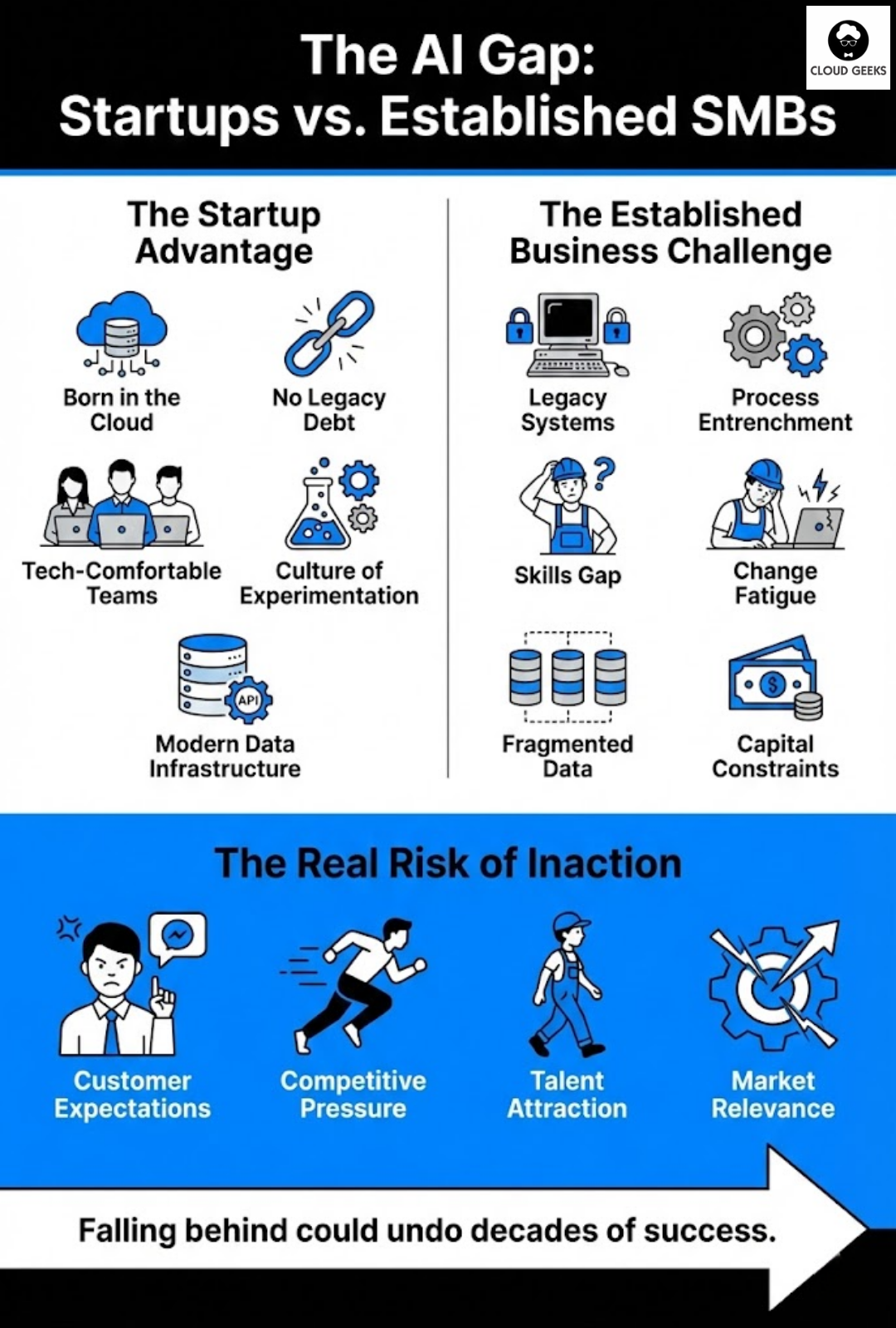
The Startup Advantage
Digital-native businesses have structural advantages for AI adoption:
Born in the Cloud: Their systems are already digital, connected, and data-rich.
No Legacy Debt: They don’t have 20 years of processes built around outdated tools.
Tech-Comfortable Teams: Employees hired in the digital era adapt quickly.
Culture of Experimentation: Failure is expected and learned from.
Modern Data Infrastructure: APIs, integrations, and clean data from day one.
The Established Business Challenge
Traditional businesses face real barriers:
Legacy Systems: Critical data locked in old software, spreadsheets, or even paper.
Process Entrenchment: “We’ve always done it this way” isn’t just resistance—it’s institutional knowledge embedded in workflows.
Skills Gap: Long-tenured employees may lack digital confidence.
Change Fatigue: Staff who’ve survived multiple “technology transformations” are skeptical.
Fragmented Data: Customer information split across systems that don’t talk to each other.
Capital Constraints: Established businesses can’t raise funding like startups; every investment competes with existing operational needs.
The Real Risk of Inaction
The gap isn’t just about efficiency—it’s about survival:
-
Customer Expectations: Consumers now expect AI-powered experiences (instant responses, personalisation, 24/7 service) regardless of who they’re buying from.
-
Competitive Pressure: AI-enabled competitors deliver better service at lower cost.
-
Talent Attraction: Younger workers prefer technologically advanced workplaces.
-
Market Relevance: Industries are being disrupted by AI-native entrants.
For businesses that have thrived for 20, 30, or 50 years, falling behind on AI could undo decades of hard-won success.
The Catch-Up Roadmap
Bridging the AI gap isn’t about implementing the same tools startups use. It’s about a staged approach that respects existing constraints while building toward AI readiness.
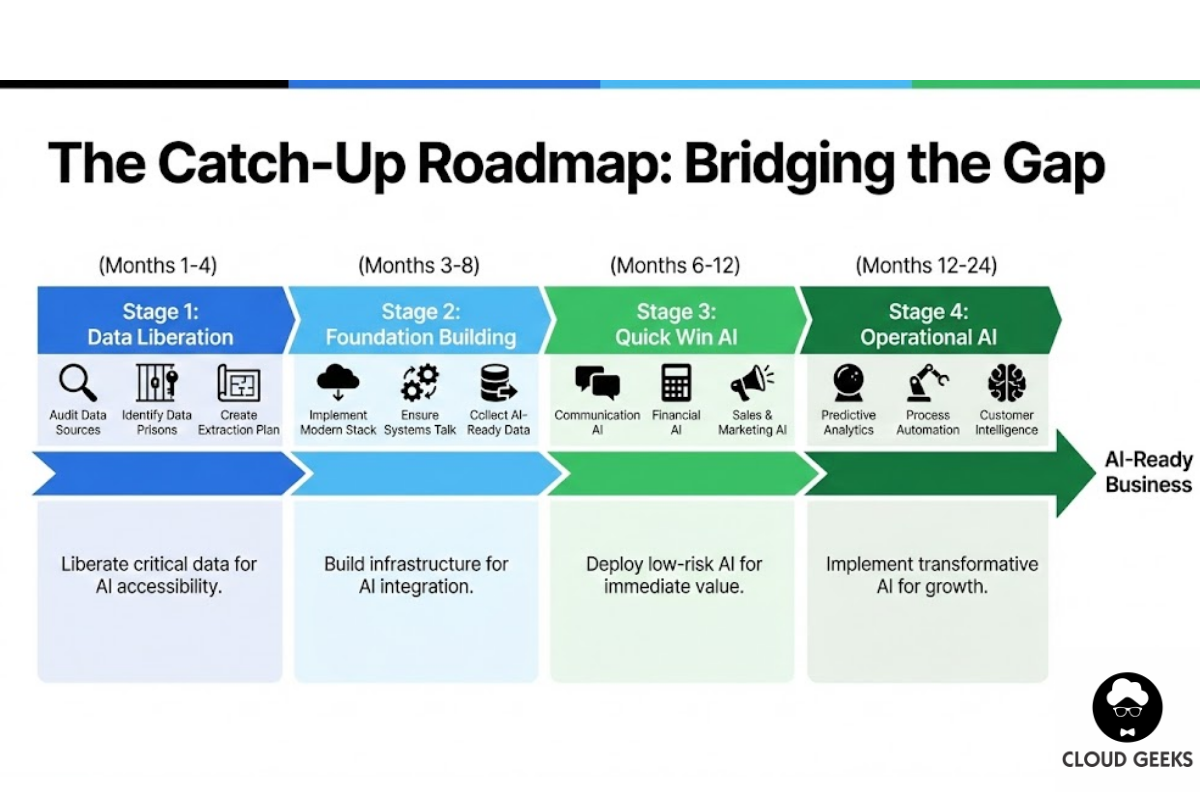
Stage 1: Data Liberation (Months 1-4)
Before you can use AI, AI needs data. For established businesses, this is often the hardest stage.
Audit Your Data Sources
Create an inventory of where critical business information lives:
- Customer records (CRM, accounting system, spreadsheets, filing cabinets)
- Transaction history (POS, invoicing, bank records)
- Product/service information (catalogues, price lists, inventory systems)
- Employee knowledge (procedures, customer preferences, supplier relationships)
- Operational data (schedules, equipment logs, maintenance records)
Identify the “Data Prisons”
Which systems trap data that AI could use?
Common culprits for Australian SMBs:
- Old MYOB or Reckon installations without cloud connectivity
- Industry-specific software with no export capabilities
- Paper records and filing systems
- Email inboxes (critical history locked in personal mailboxes)
- Employee notebooks and “tribal knowledge”
Create Data Extraction Plan
For each data prison, determine:
- What data needs to be liberated?
- What format is it in currently?
- What tools can extract it?
- Where should it live for AI accessibility?
- Who owns this migration task?
Practical Actions:
-
Move accounting to cloud: Xero migration for MYOB/Reckon users unlocks financial data for AI analysis.
-
Consolidate customer data: Import scattered contacts into a single CRM (even a simple one like HubSpot Free).
-
Digitise paper records: Start scanning critical documents. Use AI tools like Google Document AI to extract text and data.
-
Document tribal knowledge: Interview long-term employees about processes, customer preferences, and supplier relationships. Create searchable knowledge bases.
Stage 2: Foundation Building (Months 3-8)
With data becoming accessible, build the infrastructure for AI.
Implement a Modern Core Stack
For most established Australian SMBs, this means:
- Cloud Accounting: Xero or MYOB online (if not already migrated)
- CRM: HubSpot, Salesforce Essentials, or industry-specific option
- Communication: Microsoft 365 or Google Workspace
- Project/Job Management: Industry-appropriate tool (Tradify for trades, Practice Ignition for professional services, etc.)
- Document Management: SharePoint, Google Drive, or Dropbox Business
Ensure Systems Talk to Each Other
The power of modern tools is integration. Ensure your new stack connects:
- Accounting ↔ CRM (customer payment status visible to sales)
- CRM ↔ Email (all communications logged automatically)
- Job Management ↔ Accounting (invoicing from completed work)
- Documents ↔ Everything (files accessible in context)
Start Collecting AI-Ready Data
As you implement new systems, configure them to capture:
- Customer interactions (calls logged, emails tracked)
- Transaction details (not just totals, but line items)
- Time data (how long tasks take, when activity happens)
- Outcome data (which quotes won, which customers renewed)
This data becomes AI fuel later.
Stage 3: Quick Win AI (Months 6-12)
Don’t wait until everything’s perfect. Deploy AI in low-risk areas while foundation-building continues.
Communication AI
- AI-assisted email drafting (built into Microsoft 365 and Google Workspace)
- Chatbots for common customer inquiries (Intercom, Drift, or industry-specific)
- Meeting transcription and summarisation (Otter.ai, Fireflies.ai)
Financial AI
- Cash flow prediction (built into Xero, or add-ons like Float)
- Expense categorisation (AI features in modern accounting platforms)
- Invoice automation (approval workflows, payment reminders)
Sales and Marketing AI
- Lead scoring (HubSpot, Salesforce features)
- Email personalisation (ActiveCampaign, Mailchimp AI features)
- Content generation assistance (Canva Magic Write, ChatGPT with company context)
Stage 4: Operational AI (Months 12-24)
With foundation in place and quick wins demonstrating value, implement transformative AI.
Predictive Analytics
Use historical data to predict:
- Customer churn (who’s likely to leave)
- Demand patterns (when to stock up or staff up)
- Maintenance needs (equipment likely to fail)
- Market opportunities (underserved customer segments)
Process Automation
Deploy AI to handle repetitive workflows:
- Quote generation from inquiry data
- Purchase order creation from inventory levels
- Scheduling optimisation
- Quality control checks
Customer Intelligence
AI that understands your customers:
- Sentiment analysis on feedback and reviews
- Personalisation engines for recommendations
- Predictive lifetime value scoring
- Automated customer journey mapping
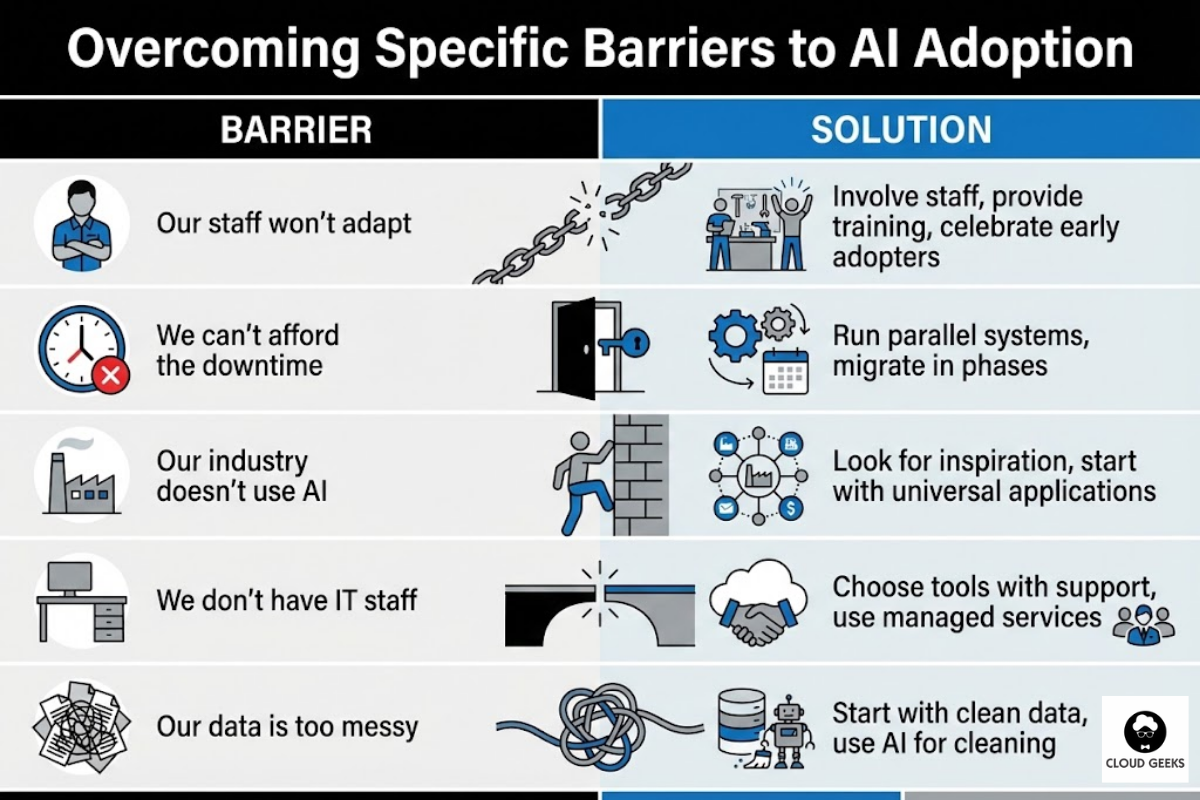
Overcoming Specific Barriers
Barrier: “Our staff won’t adapt”
Reality Check: Most established business employees are capable of learning new tools if properly supported. The real issue is usually fear and inadequate training.
Solutions:
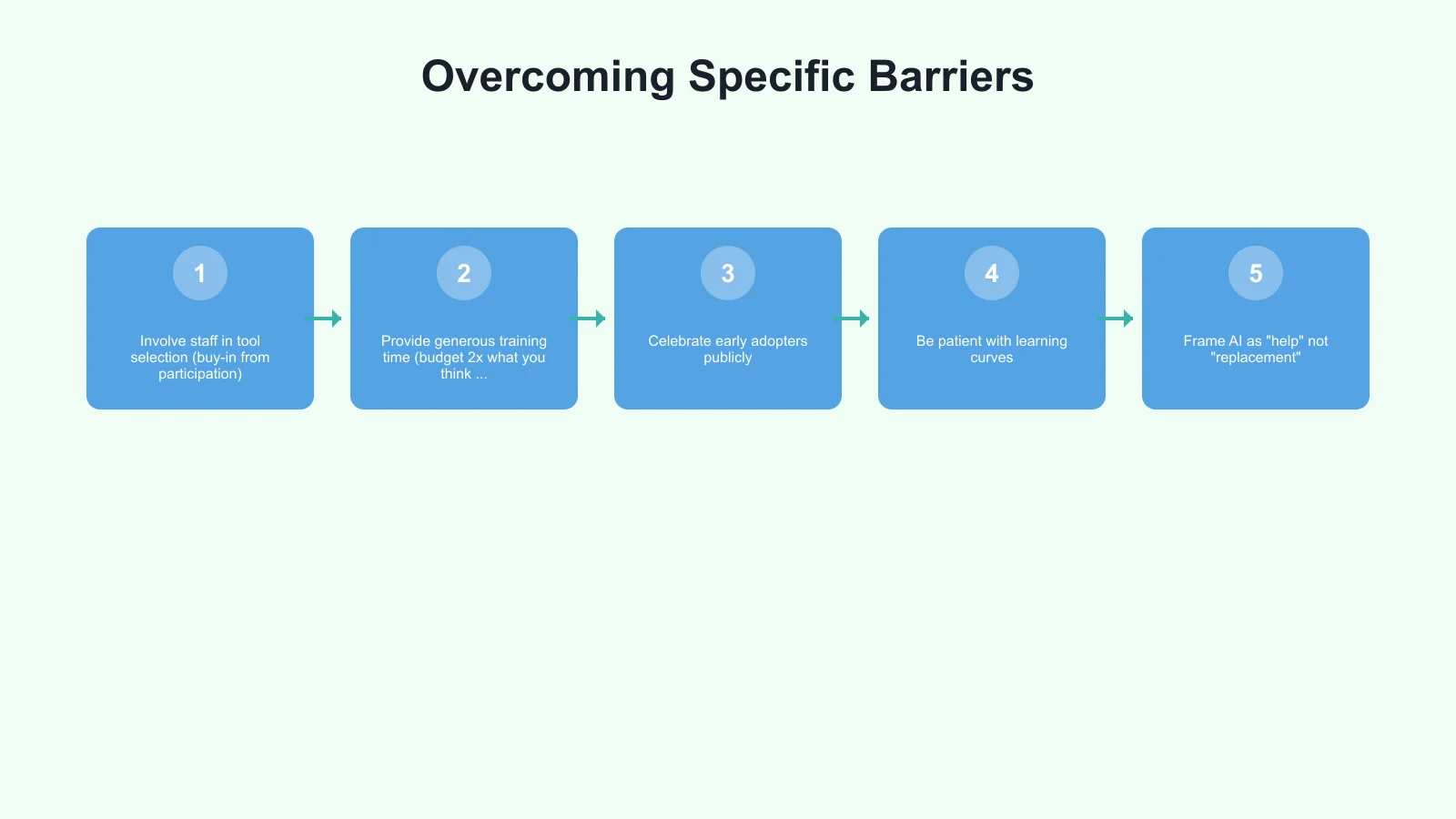
- Involve staff in tool selection (buy-in from participation)
- Provide generous training time (budget 2x what you think needed)
- Celebrate early adopters publicly
- Be patient with learning curves
- Frame AI as “help” not “replacement”
Barrier: “We can’t afford the downtime”
Reality Check: Running old and new systems in parallel is possible, just more expensive. Most businesses can’t afford the downtime of a big bang transition.
Solutions:
- Run parallel systems during transition periods
- Migrate in phases (one department or function at a time)
- Schedule major changes during slow periods
- Have rollback plans for critical systems
Barrier: “Our industry doesn’t use AI”
Reality Check: Every industry is being transformed by AI. If your competitors aren’t using AI yet, that’s an opportunity for first-mover advantage, not a reason to wait.
Solutions:
- Look at adjacent industries for inspiration
- Start with universal applications (communication, finance) before industry-specific
- Connect with industry associations adopting AI
- Be the example others follow
Barrier: “We don’t have IT staff”
Reality Check: Modern cloud tools are designed for businesses without IT departments. You don’t need to hire a CTO.
Solutions:
- Choose tools with excellent support and training
- Use managed service providers for complex setups
- Leverage vendor implementation services
- Partner with technology consultancies like CloudGeeks for strategic guidance
Barrier: “Our data is too messy”
Reality Check: Perfect data doesn’t exist. The question is whether your data is good enough, not perfect.
Solutions:
- Start with the cleanest data sources
- Use AI for data cleaning (it’s good at finding inconsistencies)
- Accept some imperfection—80% clean data still enables useful AI
- Improve data quality over time, not all at once
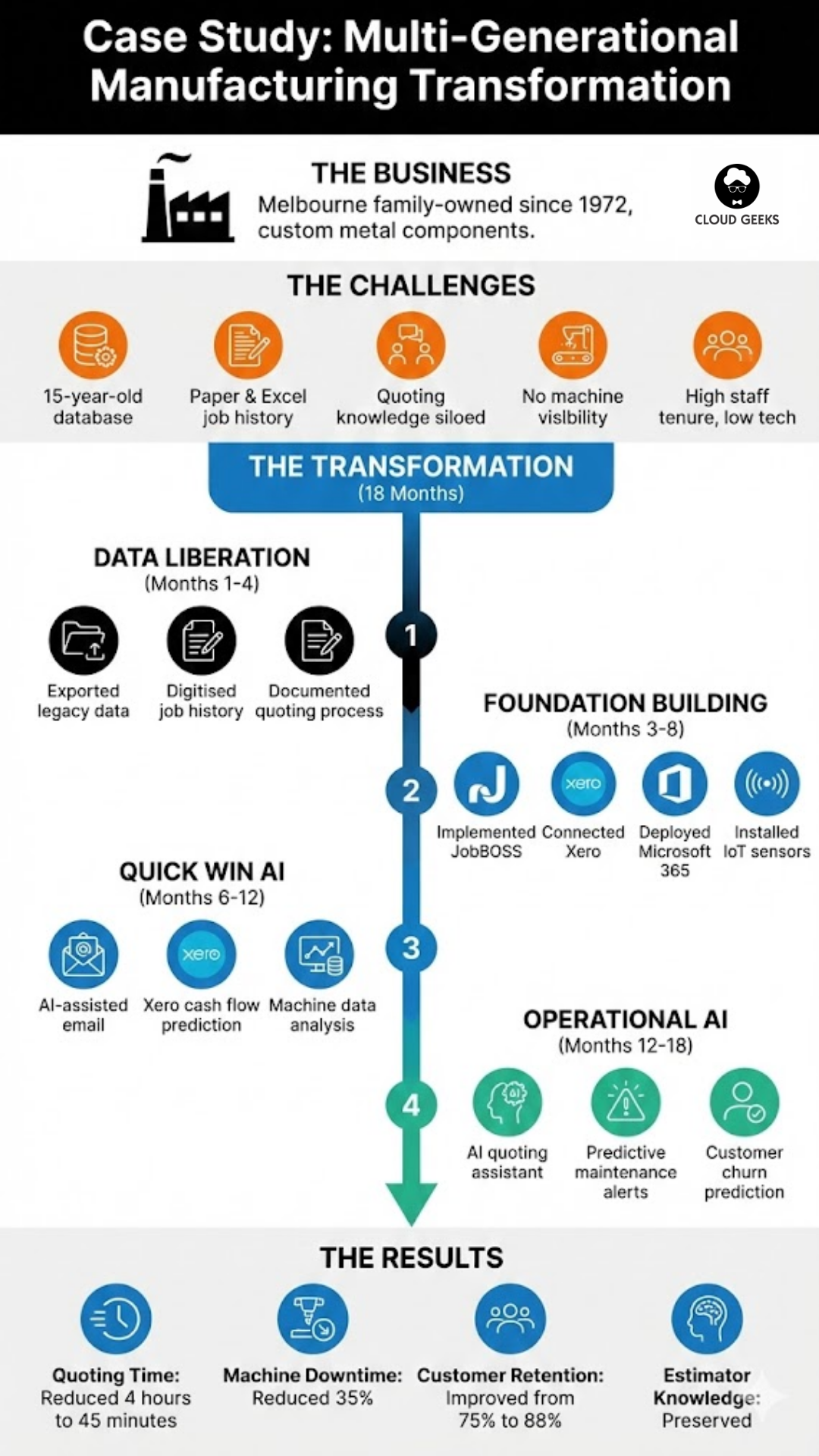
Case Study: Multi-Generational Manufacturing Business
The Business
A Melbourne manufacturing company, family-owned since 1972, producing custom metal components for industrial clients.
The Challenges
- Customer records in a 15-year-old database with no API access
- Job history in paper folders and Excel spreadsheets
- Quoting process relied on one senior estimator’s knowledge
- No visibility into machine utilisation or maintenance patterns
- Employees average 15+ years tenure, limited technology experience
The Transformation (18 months)
Months 1-4: Data Liberation
- Exported customer data from legacy database to CSV
- Engaged accounting firm to clean and migrate to Xero
- Digitised 10 years of job history (selective—major jobs only)
- Interviewed estimator extensively to document quoting knowledge
Months 3-8: Foundation Building
- Implemented JobBOSS manufacturing software
- Connected to Xero for financial integration
- Deployed Microsoft 365 for communication
- Installed basic IoT sensors on key machines
Months 6-12: Quick Win AI
- AI-assisted email drafting reduced response time by 30%
- Xero’s cash flow prediction prevented a potential cash crisis
- Machine sensors feeding data for analysis
Months 12-18: Operational AI
- Developed AI quoting assistant using documented estimator knowledge
- Predictive maintenance alerts from machine sensor patterns
- Customer churn prediction identifying at-risk accounts
The Results
- Quoting time: Reduced from 4 hours to 45 minutes average
- Machine downtime: Reduced 35% through predictive maintenance
- Customer retention: Improved from 75% to 88% annual retention
- Estimator knowledge: Preserved for business continuity
Key Learnings
- Start where pain is greatest: For them, quoting and machine maintenance
- Involve veterans: The estimator became an enthusiastic AI advocate once he saw his knowledge preserved
- Accept imperfection: Their data was never “clean”—good enough was enough
- Celebrate progress: Monthly wins maintained momentum through difficult months
The FOMO Is Real—And Justified
This isn’t artificial urgency. The competitive landscape is genuinely shifting.
What AI-enabled competitors can do that you can’t (yet):
- Respond to inquiries in seconds, 24/7
- Predict customer needs before customers articulate them
- Price dynamically based on real-time market data
- Operate with leaner teams at higher quality
- Make decisions with data you don’t even collect
Every month of delay widens the gap. But it’s a gap that can still be closed with focused effort.
Your 90-Day Starting Plan
Days 1-30: Assessment
- Audit all data sources in your business
- Identify the most critical data prisons
- Survey staff on technology comfort and concerns
- Research modern alternatives to legacy systems
- Get quotes for cloud migrations
Days 31-60: Foundation
- Migrate accounting to cloud platform if not already
- Implement or upgrade CRM
- Begin digitising critical paper records
- Set up cloud document storage with consistent structure
- Deploy communication platform with AI features
Days 61-90: First AI
- Activate AI features in newly implemented tools
- Launch one AI quick win (chatbot, email AI, or financial prediction)
- Measure and document results
- Create plan for next 6 months of AI implementation
- Share successes with team to build momentum
The Path Forward
The two-speed economy is real, but it’s not destiny. Established Australian businesses have assets startups lack: customer relationships, market knowledge, reputation, and operational expertise.
AI doesn’t replace these advantages—it amplifies them. A 40-year-old business with AI capabilities combines the best of both worlds: institutional wisdom with modern efficiency.
The gap is closeable. But the window is narrowing.
Ready to bridge the AI gap in your established business? Contact CloudGeeks for a confidential assessment of your AI readiness. We specialise in helping traditional Australian businesses catch up to—and surpass—digital-native competitors.
The next generation of your business’s success depends on the decisions you make today.
Related Articles
- AI Tools for Australian SMBs: Practical Guide with Real Case Studies
- AI on a Budget: How Australian SMBs Can Harness Artificial Intelligence
- Digital Transformation Roadmap: A 7-Step Guide for Australian SMBs
- Cloud Migration ROI: Calculating Real Costs for Australian SMBs
- The True ROI of Cloud Migration: A Complete Guide for Australian Businesses
Strong cloud infrastructure is the foundation — a great website is the shopfront. Cosmos Web Tech helps Australian businesses turn technical capability into online growth.
This article is brought to you by Ganda Tech Services — Sydney’s complete digital solutions provider covering cloud, web, and mobile.