
The Tradie's Digital Apprentice: AI Tools for Australian Construction
Ask any Australian tradie what they hate most about their job and you’ll hear the same answer: paperwork. Safe Work Method Statements. Induction forms. Defect logs. Variation orders. Progress claims. The administrative burden has grown so heavy that many tradies spend their evenings doing paperwork instead of resting for the next day on site.
But AI is changing this reality. A new generation of Australian-built tools is automating the boring, legal, and repetitive side of construction—so tradies can focus on what they actually signed up for: the build itself.
At CloudGeeks, we’ve been working with construction businesses across Australia to implement technology that works in the real conditions of building sites. Here’s your guide to the AI tools that are becoming every tradie’s digital apprentice.
The Construction Paperwork Problem
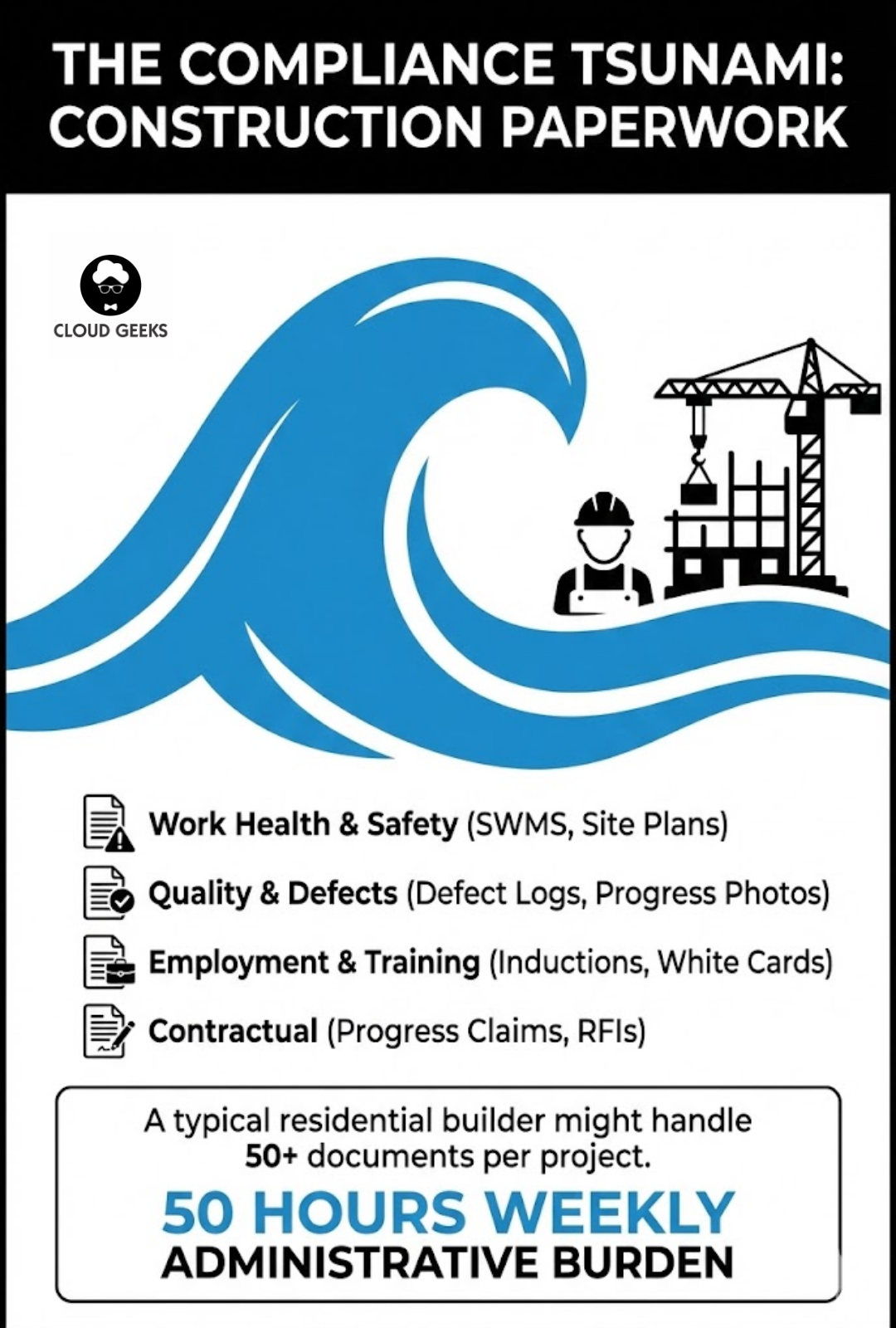
The Compliance Tsunami
Australian construction faces more regulatory requirements than ever:
Work Health and Safety
- Safe Work Method Statements (SWMS) for high-risk construction work
- Site-specific safety plans
- Toolbox talk records
- Incident reports
- First aid records
Quality and Defects
- Defect identification and logging
- Variation documentation
- Progress photography
- Quality hold points
- Completion certificates
Employment and Training
- Worker inductions (site-specific and general)
- Competency records (White Cards, EWP, etc.)
- Subcontractor agreements
- Time tracking and payroll
Contractual
- Progress claims
- Variation orders
- RFIs (Requests for Information)
- Contract administration
A typical residential builder might handle 50+ documents per project. Commercial builders deal with hundreds.
The Real Cost
This paperwork isn’t just annoying—it’s expensive:
- Time: Builders report spending 3-5 hours weekly on administrative tasks
- Errors: Manual documentation leads to compliance gaps and disputes
- Delays: Waiting for paperwork holds up projects
- Risk: Poor documentation exposes businesses to legal and safety liability
For a business running 10 projects simultaneously, that’s potentially 50 hours weekly of administrative burden—more than a full-time salary.
AI Tools Built for Australian Construction
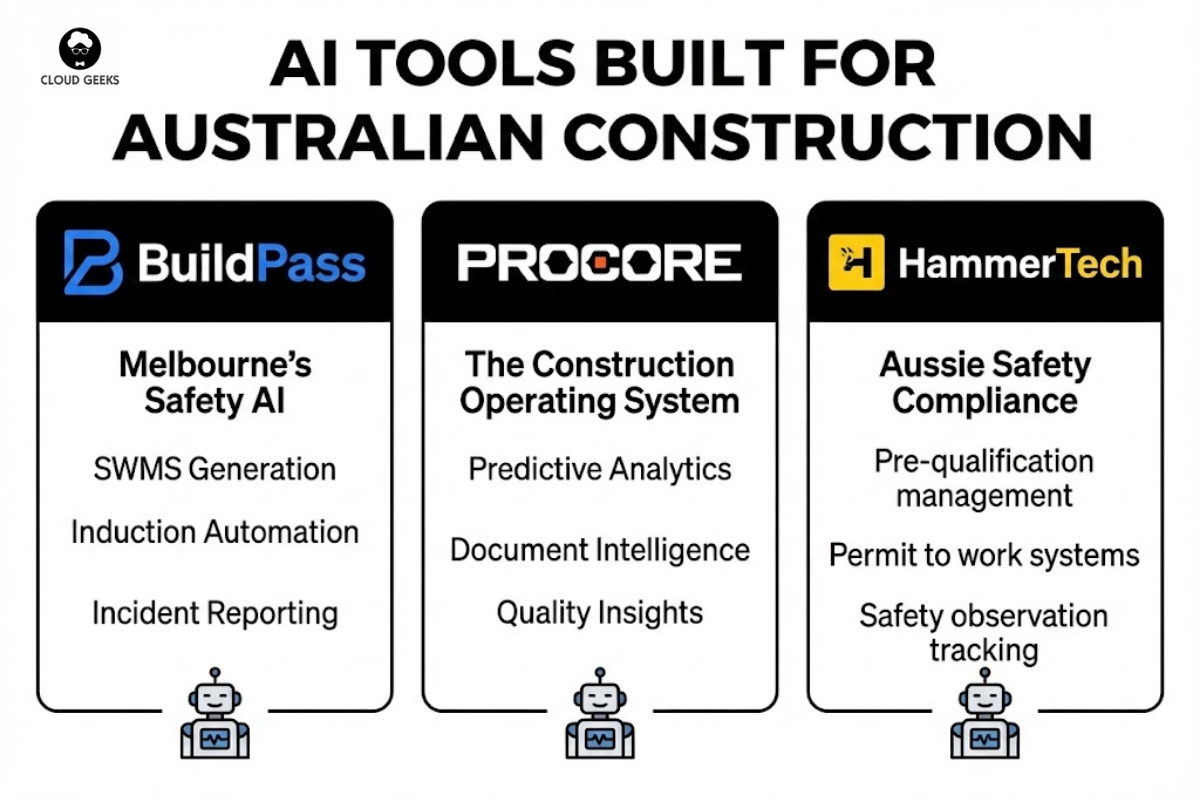
BuildPass: Melbourne’s Safety AI
BuildPass is a Melbourne-based platform specifically designed for Australian construction safety requirements.
What It Does
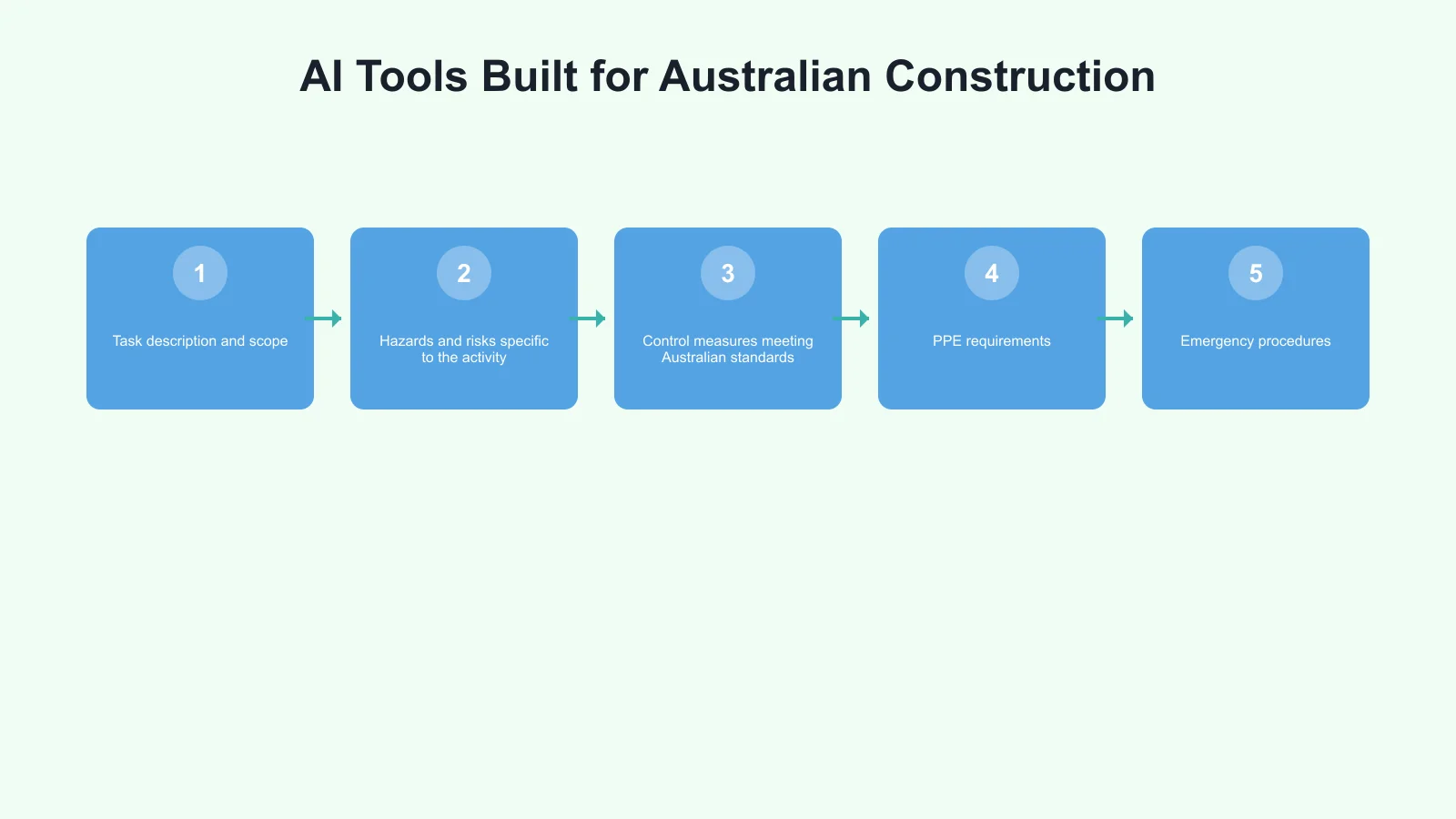
SWMS Generation: AI generates Safe Work Method Statements based on task descriptions. Input “Installing roof sheeting on a two-storey residential build” and BuildPass creates a comprehensive SWMS covering:
- Task description and scope
- Hazards and risks specific to the activity
- Control measures meeting Australian standards
- PPE requirements
- Emergency procedures
- Required competencies
Site Safety Plans: Automated generation of site-specific safety plans that comply with WHS regulations.
Induction Automation: Digital inductions that workers complete on their phones, with automatic record-keeping and competency tracking.
Incident Reporting: AI-assisted incident documentation that prompts for required information and generates compliant reports.
Why It Works for Tradies
- Mobile-first: Everything works from a phone on site
- Australian standards: Built specifically for Australian WHS requirements
- Integration: Connects with common accounting and project management tools
- Offline capable: Works without constant internet (crucial for remote sites)
Pricing: Starting around $99/month for small teams, scaling with users and projects.
Procore: The Construction Operating System
While not Australian-built, Procore has become the dominant construction management platform in Australia and has heavily invested in AI capabilities.
AI Features for Australian Construction
Predictive Analytics: Analyses project data to predict delays and cost overruns before they happen.
Document Intelligence: AI extracts key information from contracts, drawings, and specifications automatically.
Quality Insights: Identifies patterns in defects to prevent recurring issues.
RFI Automation: Suggests answers to RFIs based on similar past questions.
Reality: Procore is enterprise-grade and priced accordingly. Most suitable for builders with $5M+ annual revenue.
Pricing: Typically $500-2,000/month depending on modules and users.
HammerTech: Aussie Safety Compliance
HammerTech is another Australian-built construction safety platform with strong AI capabilities.
Key Features
- Pre-qualification management for subcontractors
- Permit to work systems
- Safety observation tracking
- Compliance dashboards
- Audit trail automation
Sweet Spot: Medium-sized builders wanting more than basic tools but not ready for Procore’s complexity.
PlanGrid (Autodesk): AI-Powered Drawing Management
PlanGrid uses AI for:
Drawing Comparison: Automatically identifies changes between drawing revisions—no more manually comparing sheets.
Issue Tracking: AI suggests categories and priorities for logged issues.
Search: Natural language search across all project documents (“show me all electrical RFIs for level 3”).
Pricing: Starts around $39/user/month for basic features.
Practical AI Applications for Everyday Trade Work
Application 1: Quote Generation
The Problem: Creating detailed quotes takes hours and often misses items.
The AI Solution: Tools like Buildxact and CoConstruct use AI to generate quotes from plan analysis.
How it works:
- Upload plans (PDF or CAD)
- AI extracts quantities and measurements
- Apply your pricing database
- Generate itemised quote
Time Saved: What took 4 hours now takes 30 minutes with AI assistance.
Australian Options:
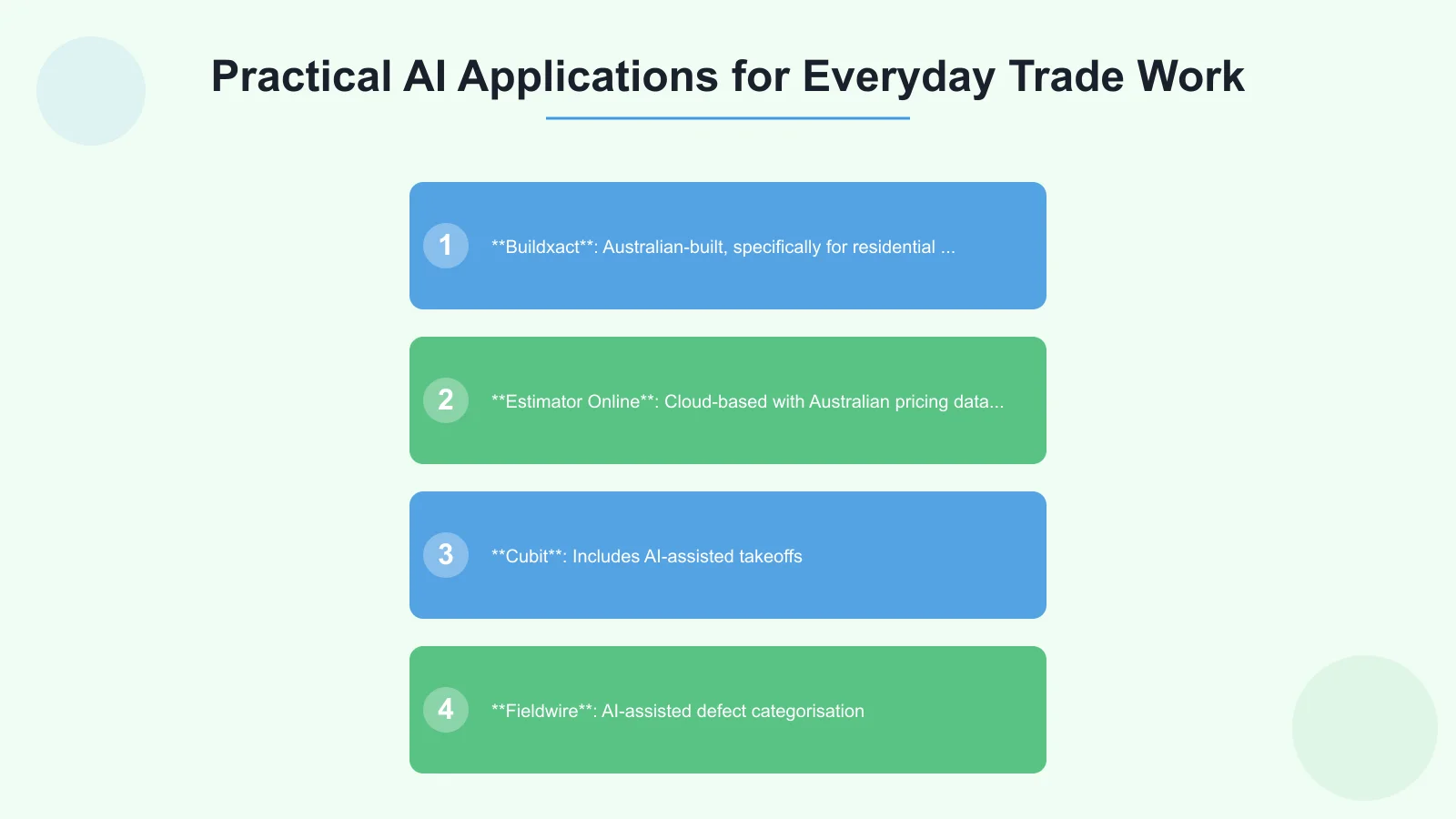
- Buildxact: Australian-built, specifically for residential builders
- Estimator Online: Cloud-based with Australian pricing databases
- Cubit: Includes AI-assisted takeoffs
Application 2: Defect Documentation
The Problem: Defects get reported verbally, documented inconsistently, and become disputes.
The AI Solution: Mobile apps with AI-powered defect logging.
How it works:
- Take a photo of the defect
- AI analyses the image and suggests:
- Defect category (waterproofing, structural, finish, etc.)
- Severity rating
- Location based on GPS and plan overlay
- Suggested responsible trade
- Generate defect report with timestamp and metadata
- Automatically notify relevant parties
Tools:
- Fieldwire: AI-assisted defect categorisation
- Buildertrend: Integrated defect management
- iAuditor (SafetyCulture): AI-enhanced inspection checklists
Application 3: Project Communication
The Problem: Critical information is scattered across texts, emails, and verbal conversations.
The AI Solution: Centralized communication with AI summarisation.
How it works:
- All project communication flows through a central platform
- AI summarises daily activity
- Key decisions are automatically flagged and documented
- Searchable history prevents “he said, she said” disputes
Tools:
- Slack with AI features: Summarises channels, answers questions about past discussions
- Microsoft Teams: Similar AI capabilities
- Buildertrend: Construction-specific communication with context
Application 4: Site Diary Automation
The Problem: Site diaries are legally important but tedious to maintain.
The AI Solution: Automated site diary generation from multiple inputs.
How it works:
- AI aggregates data from:
- Worker sign-in/out times
- Weather data (automatic)
- Equipment logs
- Delivery records
- Photos taken on site
- Generates daily diary entry for review
- Supervisor approves/edits
- Creates legally defensible record
Time Saved: Daily diary from 20 minutes manual entry to 2 minutes review.
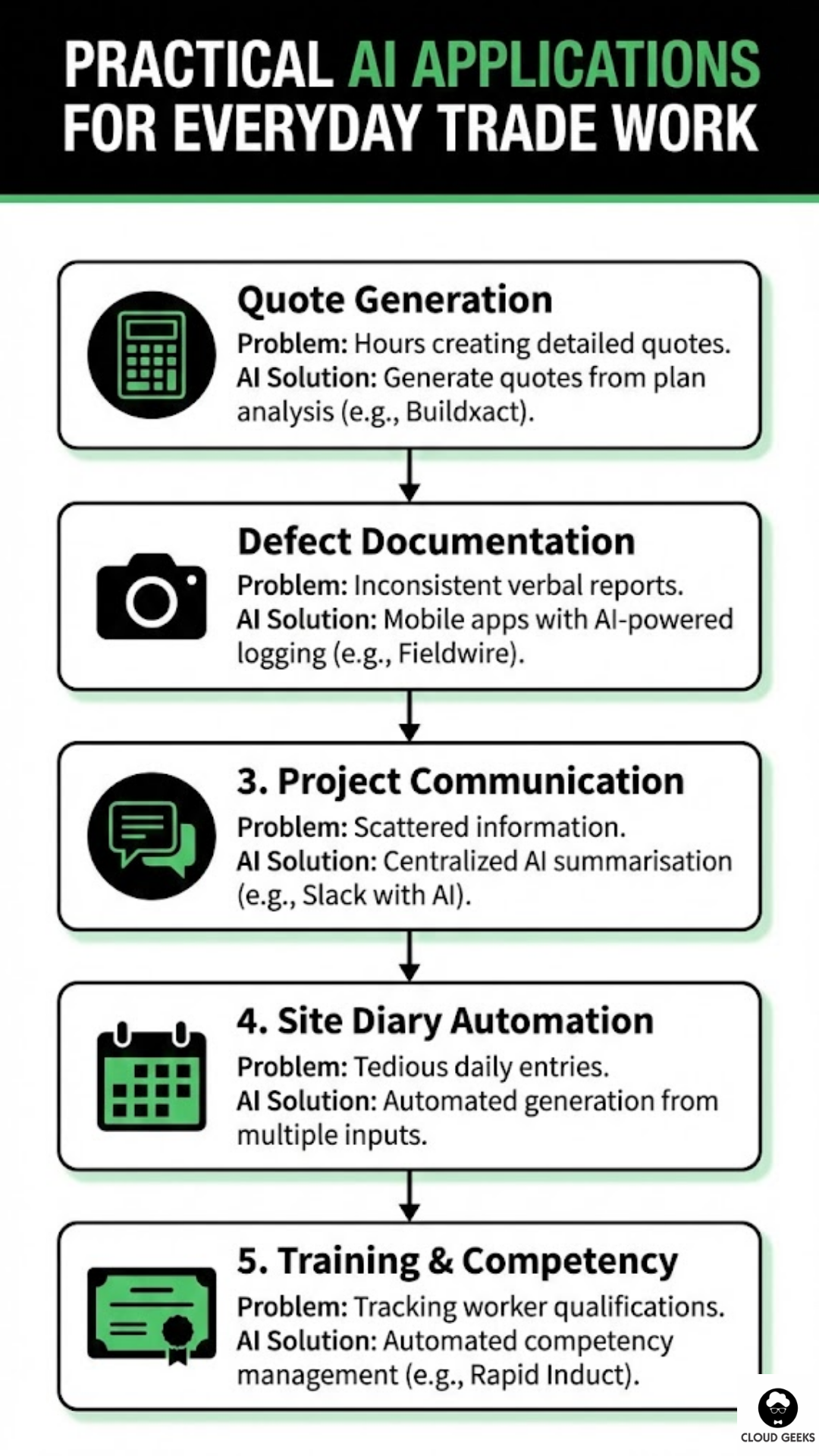
Application 5: Training and Competency
The Problem: Tracking who’s qualified to do what across multiple sites and trades.
The AI Solution: Automated competency management.
How it works:
- Workers upload credentials (White Card, licences, tickets)
- AI extracts expiry dates and competency types
- Automatic alerts before credentials expire
- Gate access linked to competency (can’t access site without valid tickets)
- AI suggests required training based on project tasks
Tools:
- Rapid Induct: Australian-focused with construction modules
- Sitepass: Competency and access management
- ELMO: Broader HR with construction capabilities
Building Your Construction AI Stack
For Sole Traders and Small Teams (1-5 people)
Essential Stack:
- Xero: Invoicing and accounting
- Buildxact or Tradify: Quoting and job management
- BuildPass Lite or iAuditor: Safety documentation
- Google Workspace: Communication and document storage
Monthly Cost: $150-300
AI Benefits:
- Automated invoicing and follow-ups
- AI-assisted quotes from plans
- SWMS generation
- Searchable project history
For Growing Businesses (5-20 people)
Enhanced Stack:
- Xero + WorkflowMax: Job costing and project accounting
- Procore Essentials or Buildertrend: Project management
- HammerTech or BuildPass: Safety compliance
- Microsoft 365: Communication and collaboration
Monthly Cost: $500-1,500
Additional AI Benefits:
- Predictive project insights
- Automated document management
- Team performance analytics
- Integrated compliance tracking
For Established Builders (20+ people)
Enterprise Stack:
- Procore: Full construction management suite
- Viewpoint or COINS: Enterprise accounting
- SafetyCulture: Comprehensive safety and quality
- Power BI: Custom analytics and reporting
Monthly Cost: $2,000-10,000
Full AI Benefits:
- Enterprise-wide insights
- Predictive analytics
- Automated workflows
- Custom integrations
Real Savings: An Australian Builder’s Story
The Business
A Melbourne residential builder completing 15-20 homes annually, 12 employees plus subcontractors.
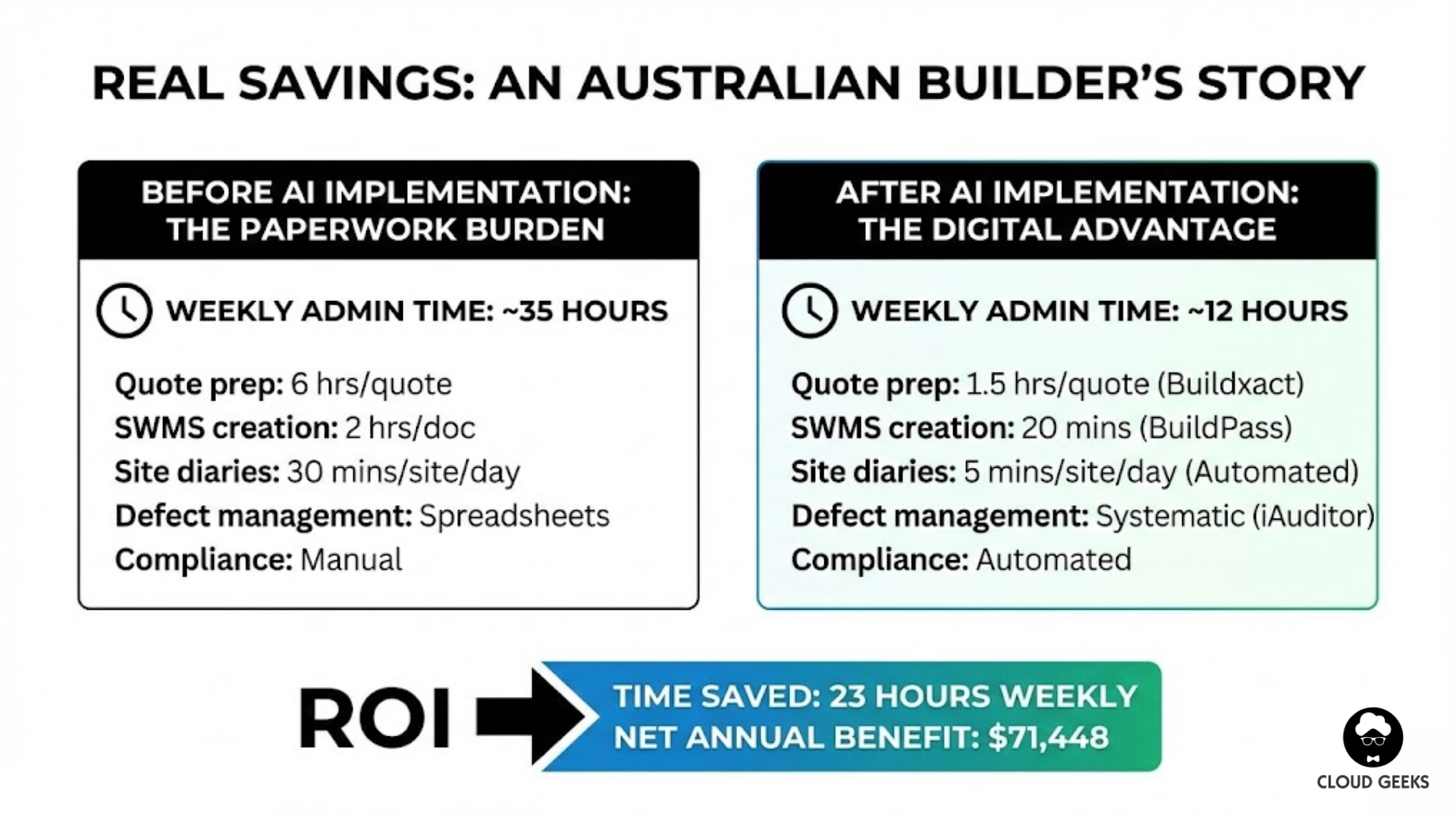
Before AI Implementation
- Quote preparation: 6 hours average per quote
- SWMS creation: 2 hours per document (created 3-4 weekly)
- Site diaries: 30 minutes daily per site (3 active sites)
- Defect management: Spreadsheets, constant disputes
- Compliance tracking: Manual, often found gaps during audits
Weekly administrative time: ~35 hours across the team
After AI Implementation
Tools deployed:
- Buildxact for quoting ($149/month)
- BuildPass for safety ($199/month)
- Buildertrend for project management ($499/month)
- iAuditor for defects ($99/month)
Post-implementation:
- Quote preparation: 1.5 hours average (AI-assisted takeoffs)
- SWMS creation: 20 minutes (AI generation + review)
- Site diaries: 5 minutes (auto-generated, just approve)
- Defect management: Systematic, documented, fewer disputes
- Compliance tracking: Automated, audit-ready always
Weekly administrative time: ~12 hours across the team
The ROI
Time saved: 23 hours weekly × 48 weeks = 1,104 hours annually Value of time (at $75/hour effective rate): $82,800 Technology cost: $946/month × 12 = $11,352 Net annual benefit: $71,448
Plus harder-to-quantify benefits:
- Fewer disputes (legal cost avoidance)
- Better compliance (reduced WHS risk)
- Faster quotes (more wins)
- Happier team (less after-hours paperwork)
Getting Started: Your First AI Tool
Don’t try to implement everything at once. Start with your biggest pain point.
If Quoting Is Your Bottleneck
Start with Buildxact or Estimator Online. The AI-assisted takeoffs and pricing will show immediate time savings.
If Safety Compliance Keeps You Up at Night
Start with BuildPass or iAuditor. Get your SWMS and induction processes automated first.
If Project Chaos Is the Problem
Start with Buildertrend or CoConstruct. Centralise communication and documentation.
If Cash Flow Is Unpredictable
Start with Xero + WorkflowMax integration. Get real-time job costing and automated invoicing.
The Future of Construction AI
What’s coming in the next 2-3 years:
Computer Vision on Sites: Cameras that automatically detect safety violations and progress.
Robotic Process Automation: Bots that handle repetitive data entry between systems.
Predictive Maintenance: AI that knows when equipment will fail before it does.
Generative Design: AI that suggests optimal construction sequences and methods.
Natural Language Interfaces: Talk to your project management system like talking to a person.

Don’t Get Left Behind
The construction industry is notoriously slow to adopt technology. But AI is different—it solves problems tradies actually have, in ways that work on building sites.
Early adopters are already seeing competitive advantages:
- Faster quotes winning more jobs
- Better documentation reducing disputes
- Compliance confidence reducing stress
- Time saved growing businesses
Your competitors are starting to implement these tools. The question is whether you’ll lead or follow.
Ready to find your digital apprentice? Contact CloudGeeks to discuss which AI tools make sense for your construction business. We understand the unique challenges of Australian building sites and can help you implement technology that actually works when it’s 40 degrees and covered in dust.
The paperwork isn’t going away. But it doesn’t have to eat your evenings anymore.
Related Articles
- AI Tools for Australian SMBs: Practical Guide with Real Case Studies
- AI on a Budget: How Australian SMBs Can Harness Artificial Intelligence
- Document Processing for Australian Businesses: Automated Text Extraction
- Digital Transformation Roadmap: A 7-Step Guide for Australian SMBs
- Building a Cybersecurity-First Culture in the Age of AI
Cloud is one piece of the digital puzzle. Ash Ganda writes about enterprise technology strategy and how to align IT investments with business growth.
Part of the Ganda Tech Services family, Cloud Geeks delivers specialist IT and cloud solutions for Australian small and medium businesses.