
AI in Aussie Real Estate: From Virtual Staging to Predictive Selling

The Australian real estate industry is in an AI arms race. From boutique agencies in Brisbane to national networks like LJ Hooker, agents are discovering that AI isn’t just a gimmick—it’s becoming essential for competitive survival.
But here’s what most agents get wrong: they’re using AI for the easy stuff (generating listing descriptions) while ignoring the transformative applications (predicting who’s about to sell before they even call an agent).
At CloudGeeks, we’ve helped real estate businesses implement AI strategies that go beyond surface-level automation. Here’s the full picture of AI in Australian real estate—the good, the lazy, and the genuinely game-changing.
The State of AI in Australian Real Estate
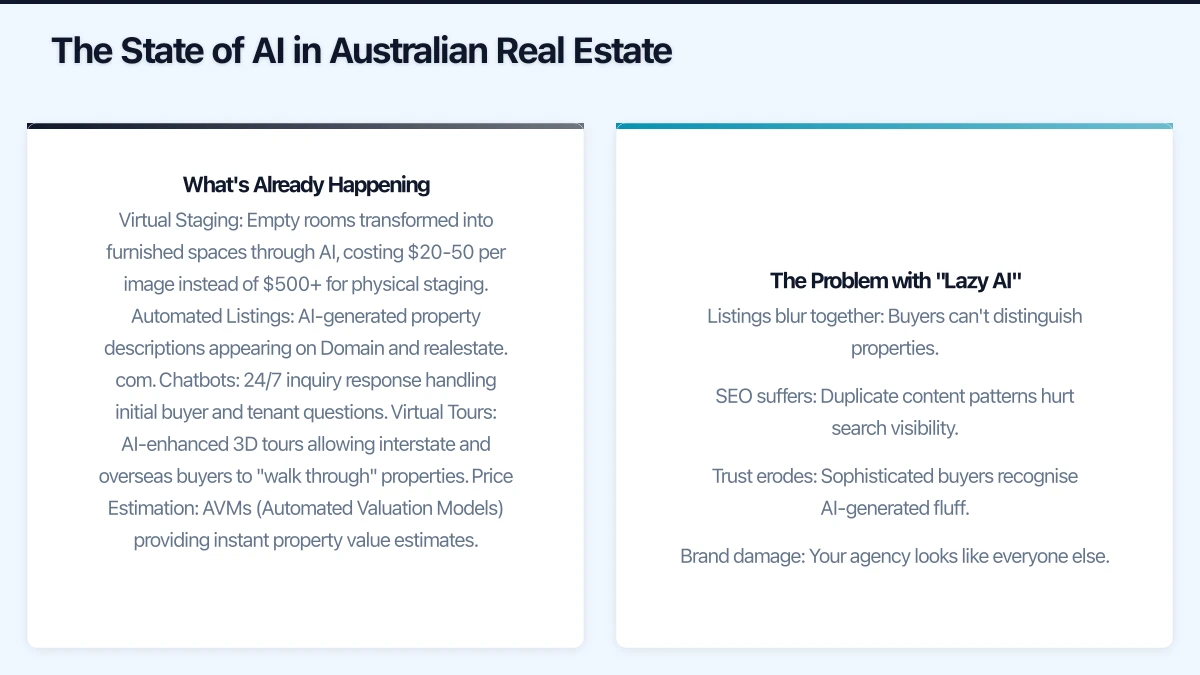
What’s Already Happening
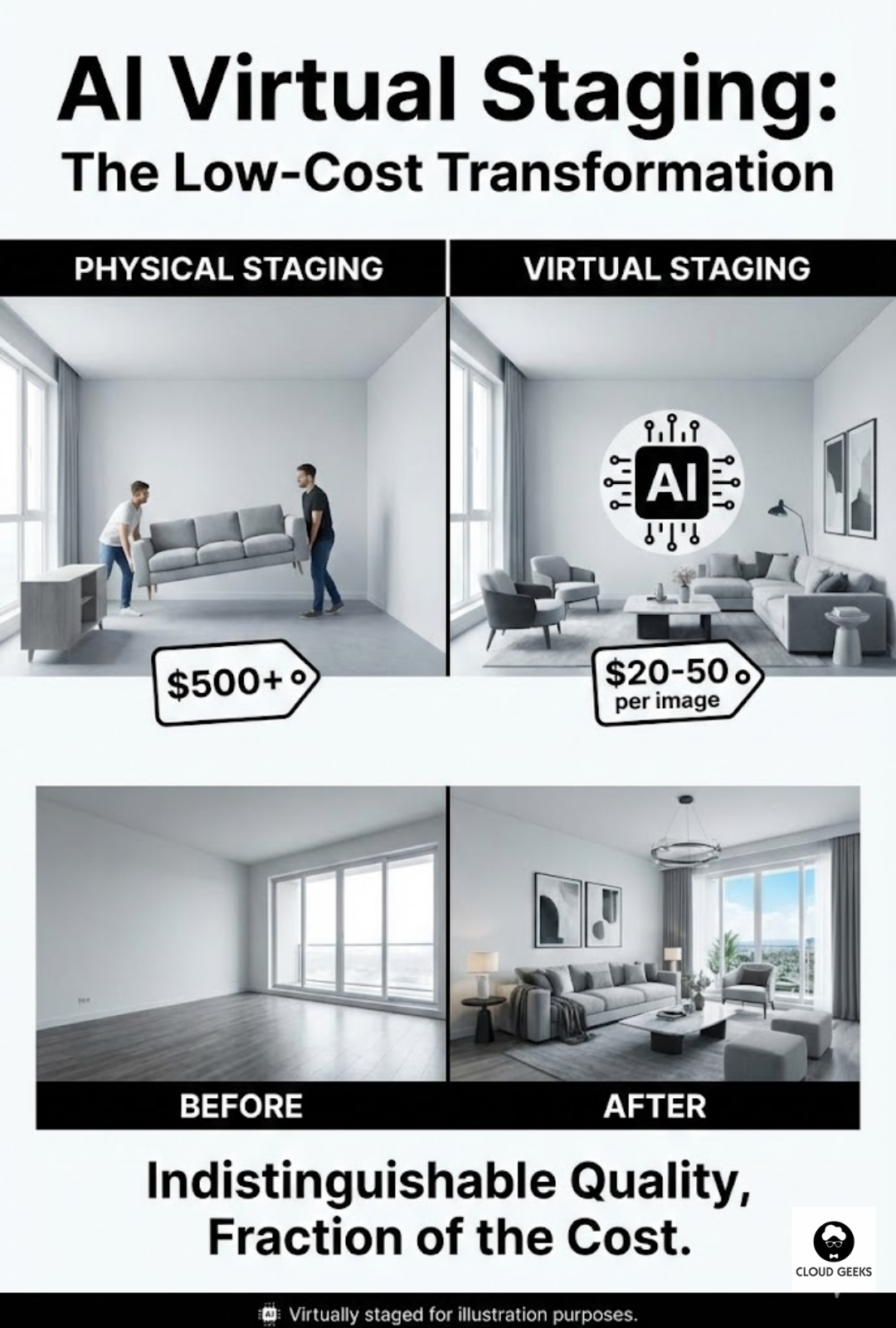
Virtual Staging: Empty rooms transformed into furnished spaces through AI, costing $20-50 per image instead of $500+ for physical staging.
Automated Listings: AI-generated property descriptions appearing on Domain and realestate.com.au within minutes of photographing a property.
Chatbots: 24/7 inquiry response handling initial buyer and tenant questions.
Virtual Tours: AI-enhanced 3D tours allowing interstate and overseas buyers to “walk through” properties.
Price Estimation: AVMs (Automated Valuation Models) providing instant property value estimates.
The Problem with “Lazy AI”
Walk through any Australian suburb’s real estate listings and you’ll notice something: they all sound identical.
“Welcome to this stunning residence offering the perfect blend of modern living and timeless charm. Featuring generous living spaces, quality finishes throughout, and positioned in a highly sought-after location…”
This is “lazy AI”—using ChatGPT or similar tools to generate generic descriptions without thoughtful prompting or human refinement. The result:
- Listings blur together: Buyers can’t distinguish properties
- SEO suffers: Duplicate content patterns hurt search visibility
- Trust erodes: Sophisticated buyers recognise AI-generated fluff
- Brand damage: Your agency looks like everyone else
Smart AI: The Differentiation Opportunity
The agents winning with AI aren’t using it to automate the obvious. They’re using it to:
- Predict who’s likely to sell before competitors know
- Personalise communications at scale
- Analyse market patterns invisible to human observation
- Enhance rather than replace human expertise
Virtual Staging: Done Right
The Basics
Virtual staging uses AI to digitally furnish empty properties. The technology has matured significantly—modern virtual staging is nearly indistinguishable from photography of actually furnished rooms.
Major Players:
- BoxBrownie: Australian-founded, now global leader
- Virtual Staging AI: US-based but commonly used in Australia
- Apply Design: Part of realestate.com.au ecosystem
- Styldod: Budget option with decent quality
Typical Costs:
- Basic staging: $15-30 per image
- Premium staging: $40-75 per image
- Day staging (brighten dark rooms): $10-20 per image
- Virtual renovation: $50-150 per image
Beyond Basic: Advanced Virtual Staging Strategies
Multiple Style Options: Stage the same room in three different styles (contemporary, Hamptons, minimalist) to appeal to different buyer demographics.
Virtual Renovation: Show buyers what a dated property could look like with a kitchen or bathroom update. Include estimated renovation costs for transparency.
Twilight Enhancement: Convert daytime exteriors to dramatic twilight shots that perform better on listing portals.
Seasonal Adjustment: Add outdoor furniture to deck shots, fire to fireplaces, or adjust landscaping to peak presentation.
Legal Requirements in Australia
Virtual staging must comply with Australian Consumer Law:
- All virtually staged images must be clearly labelled
- Cannot misrepresent structural changes
- Must show unfurnished images alongside staged versions
- Cannot stage over significant defects
Best practice: Include “Virtually staged for illustration purposes” watermark on all enhanced images.
Predictive Selling: The Real AI Opportunity
This is where AI transforms from time-saver to business-builder.
What Predictive Selling Means
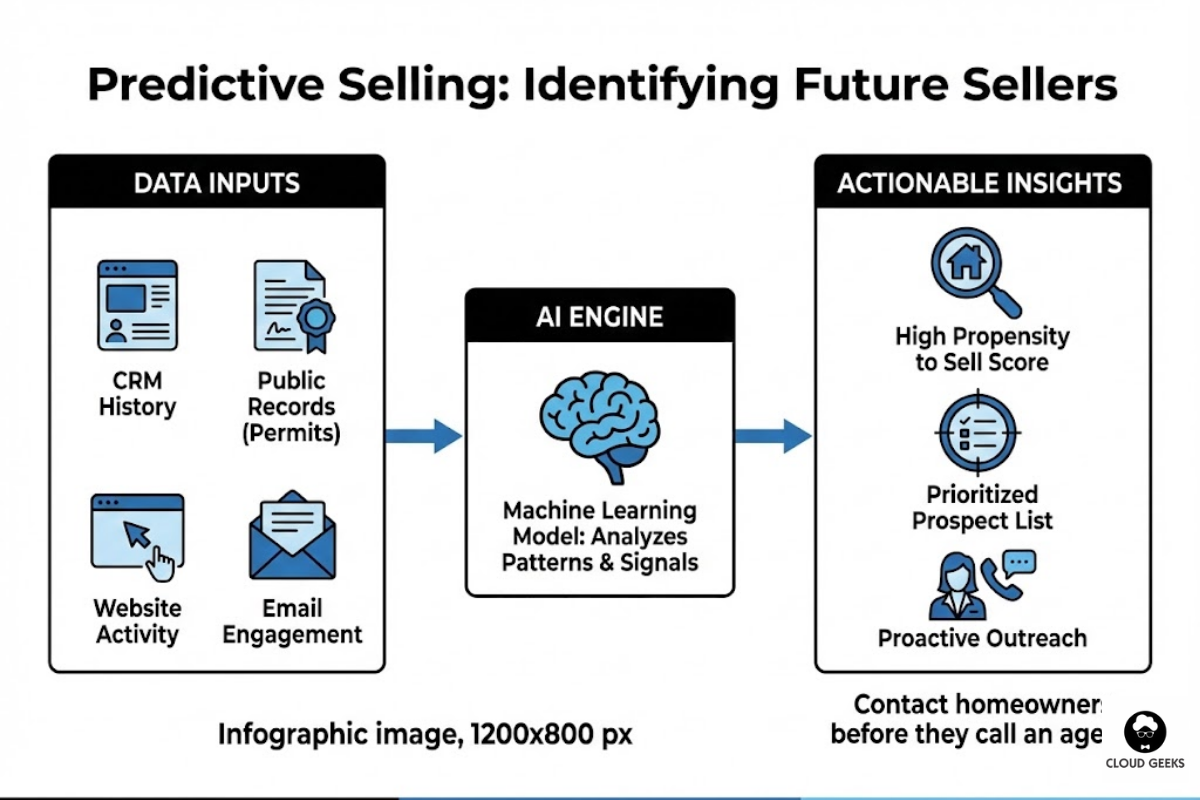
Instead of waiting for homeowners to contact you, AI identifies properties likely to sell in the next 6-12 months based on data patterns.
Signals AI Can Detect:
- Ownership duration (average hold periods before selling)
- Life stage indicators (property type vs. likely household composition)
- Renovation activity (council permits suggest either selling prep or long-term stay)
- Local market conditions (price peaks motivate sales)
- Behavioural signals (increased online property searches)
Data Sources for Australian Predictive Models
Public Data:
- CoreLogic property data
- Council records (building permits, DA approvals)
- Electoral roll changes
- Utility connection data
Proprietary Data:
- Your CRM (past client interactions)
- Website analytics (who’s checking property values)
- Email engagement (who opens market updates)
- Social media activity (who’s engaging with property content)
Tools for Predictive Real Estate
Microburbs: Australian platform providing suburb-level insights and household predictions. Identifies “propensity to sell” scores for individual properties.
Realhub: Australian real estate tech platform with predictive features and CRM integration.
ActivePipe: Australian-built email marketing with AI-driven lead scoring and prediction.
Rexlabs (Rex): CRM with predictive features identifying likely sellers from your database.
Case Study: Sydney Northern Beaches Agency
A boutique agency implemented predictive analytics with these results:
Before:
- Cold calling hit rate: 2% (1 in 50 calls led to an appraisal)
- Listings from prospecting: 15% of total listings
- Marketing cost per listing: $1,200
After (18 months with predictive AI):
- Targeted outreach hit rate: 12% (1 in 8 contacts led to an appraisal)
- Listings from predictive prospecting: 35% of total listings
- Marketing cost per listing: $450
The edge: They were calling homeowners likely to sell before competitors knew to call.
Personalisation at Scale
The Traditional Problem
Good agents personalise communications. But personalisation doesn’t scale—you can’t manually craft unique emails to 5,000 database contacts.
AI-Enabled Personalisation
Modern AI enables genuine personalisation at scale:
Dynamic Content: Different property recommendations for each recipient based on their search behaviour.
Timing Optimisation: AI sends emails when each recipient is most likely to open (not the same time for everyone).
Tone Matching: Formal for some contacts, casual for others, based on their previous communication style.
Lifecycle Relevance: First-home buyers get different content than downsizers, automatically.
Implementation Example
Using ActivePipe or similar:
- Import your database with property ownership and past interaction data
- AI segments contacts into personas (investors, upgraders, downsizers, renters)
- Create content variants for each persona
- AI selects and sends appropriate content to each contact
- Machine learning optimises over time based on engagement
Result: 3x higher email engagement than generic broadcasts.
Listing Descriptions: Beyond Generic
If you’re going to use AI for listings, do it properly.
The Lazy Way (Don’t Do This)
Prompt: “Write a property listing for a 4 bedroom house in Sydney”
Result: Generic, forgettable, identical to 1,000 other listings.
The Smart Way
Detailed Brief:
Property: 4-bedroom family home at 123 Example Street, Mosman NSW 2088

Key selling points:
- 180-degree harbour views from living areas
- Recently renovated kitchen with Miele appliances
- North-facing backyard, level, fully fenced
- 200m walk to Balmoral Beach
- In catchment for Mosman Public and High schools
- Original 1930s character with modern updates

Target buyer: Upgrading family from inner-west, dual income professionals,
2-3 school-age children, values lifestyle over commute

Unique story: Current owners raised three children here over 18 years,
added the kitchen extension themselves with architect help

Tone: Warm but sophisticated, avoid clichés like "stunning" or
"entertainer's dream", focus on lifestyle not just features
Result: A unique listing that sounds like a human who actually knows the property.
AI-Assisted, Human-Finished
The best workflow:
- AI generates first draft from detailed brief
- Agent adds personal observations and story
- Agent removes any clichés or generic phrases
- Final human review for accuracy and compliance
This is faster than writing from scratch but produces better output than pure AI.
Virtual Tours and AI Enhancement
Current State
Matterport and similar platforms create 3D property tours. AI is enhancing these with:
Intelligent Annotations: AI identifies and labels room types, features, and dimensions automatically.
Virtual Decluttering: Remove personal items and clutter from scans.
Measurement Extraction: Accurate room dimensions from 3D scans.
Tour Analytics: Track which rooms buyers spend time in, where they zoom.
Practical Application
A Melbourne agency found that:
- Properties with 3D tours received 40% more inquiries
- Interstate buyer inquiries increased 3x
- Time to first offer reduced by 5 days average
The AI enhancement: Automatic highlighting of features matching each buyer’s stated preferences during tour viewing.
Chatbots: The 24/7 Agent
What Works
AI chatbots excel at:
- Answering FAQs (inspection times, price guides, strata info)
- Qualifying leads (budget, timeframe, requirements)
- Booking inspections
- Providing after-hours response
What Doesn’t Work
Chatbots fail at:
- Complex negotiation discussions
- Emotional support during stressful transactions
- Building the trust that wins listings
- Anything requiring nuance or judgment
Best Practice
Use chatbots as triage, not replacement:
- Chatbot handles initial inquiry (24/7)
- Qualifies lead with key questions
- Books callback or inspection
- Alerts agent with lead summary
- Agent takes over for relationship building
Avoid: Chatbots that try to be too clever and frustrate users wanting human contact.
Implementation Roadmap for Australian Agents
Phase 1: Foundation (Months 1-2)
Quick Wins:
- Implement virtual staging for all listings ($200-500/month)
- Set up basic AI chatbot for after-hours inquiries ($50-100/month)
- Upgrade listing description process with detailed AI briefs
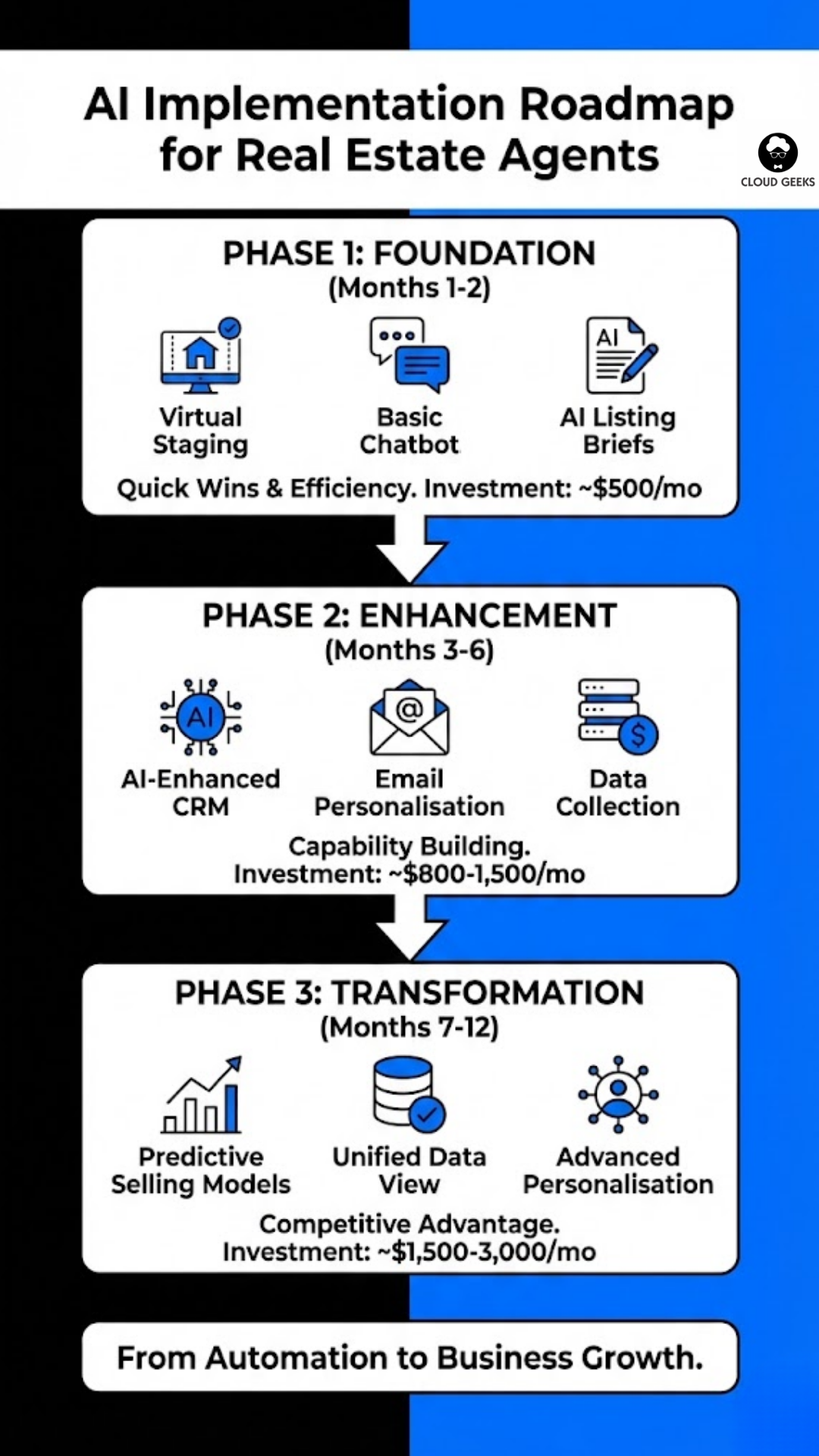
Investment: ~$500/month + setup time
Phase 2: Enhancement (Months 3-6)
Capability Building:
- Deploy AI-enhanced CRM (Rex, Agentbox with AI features)
- Implement email personalisation platform (ActivePipe)
- Begin collecting data for predictive analytics
Investment: ~$800-1,500/month
Phase 3: Transformation (Months 7-12)
Competitive Advantage:
- Activate predictive selling models
- Integrate all systems for unified data view
- Advanced personalisation across all touchpoints
Investment: ~$1,500-3,000/month
The Ethical Considerations
Transparency
Be honest about AI use:
- Clearly label virtual staging
- Don’t pretend chatbot responses are from agents
- Disclose when AI generates content
Data Privacy
Real estate handles sensitive personal information:
- Ensure AI vendors comply with Australian Privacy Principles
- Be clear about how you use predictive data
- Give contacts control over their data
Human Oversight
AI should enhance, not replace, professional judgment:
- Never let AI determine property values without human verification
- Keep agents in the loop on all significant communications
- Use AI as a tool, not an autopilot
The Competitive Imperative
The gap between AI-enabled agencies and traditional operators is widening. Leaders are:
- Winning more listings through predictive prospecting
- Converting more leads through personalised communication
- Presenting properties better through smart staging
- Working more efficiently through automation
Followers are:
- Competing on the same leads as everyone else
- Sending generic communications that get ignored
- Looking increasingly dated in presentation
- Working harder for the same results
Getting Started
The real estate AI revolution isn’t coming—it’s here. The question is whether you’ll use it strategically or let competitors gain the advantage.
Start this week:
- Sign up for BoxBrownie and virtually stage your next listing
- Audit your listing descriptions for generic AI fluff
- Review your CRM’s AI capabilities (you might already have features you’re not using)
- Research predictive tools like Microburbs
Ready for comprehensive AI integration in your real estate business? Contact CloudGeeks to discuss strategies that go beyond basic automation. We help Australian real estate professionals implement technology that genuinely differentiates.
The best agents have always used every advantage available. AI is simply the latest—and perhaps most powerful—edge.
Related Articles
- AI Tools for Australian SMBs: Practical Guide with Real Case Studies
- AI on a Budget: How Australian SMBs Can Harness Artificial Intelligence
- AI Chatbots for Australian Customer Service: Implementation on a Budget
- Document Processing for Australian Businesses: Automated Text Extraction
- Digital Transformation Roadmap: A 7-Step Guide for Australian SMBs
Need mobile access to your cloud systems? Our app development team at Awesome Apps builds iOS and Android apps for Australian businesses.
Ganda Tech Services brings together cloud infrastructure, web development, and mobile app expertise to help Australian businesses thrive in the digital economy.