
IT Support Models: In-House, MSP, or Hybrid for Australian SMBs
Every growing Australian SMB eventually asks: “How should we handle IT support?” The answer depends on your size, complexity, budget, and strategic priorities.
The three main models—in-house IT staff, Managed Service Provider (MSP), or a hybrid approach—each have strengths and weaknesses. This guide helps you choose the right model for your situation.
Understanding the Options
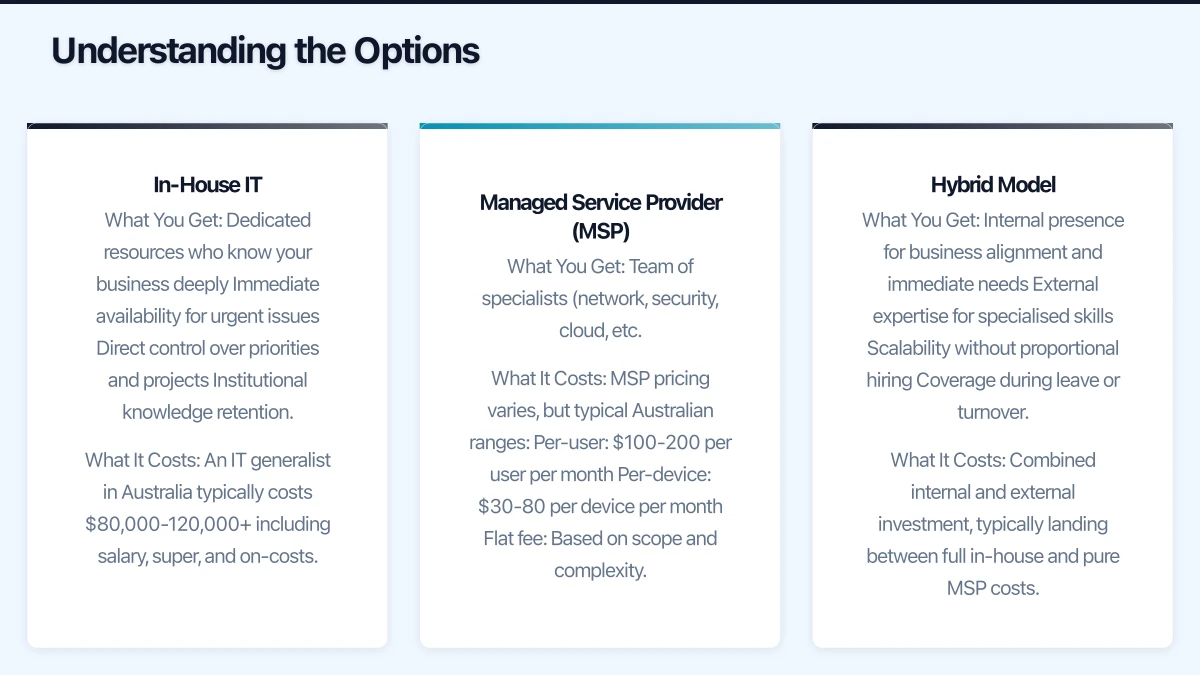
In-House IT
Employing IT staff directly as part of your organisation.
What You Get
- Dedicated resources who know your business deeply
- Immediate availability for urgent issues
- Direct control over priorities and projects
- Institutional knowledge retention
What It Costs An IT generalist in Australia typically costs $80,000-120,000+ including salary, super, and on-costs. For meaningful coverage, you likely need at least 1.5-2 FTE (accounting for leave, sick days, and turnover).
Minimum effective in-house IT: ~$150,000-200,000 annually
Managed Service Provider (MSP)
Outsourcing IT support to a specialised provider for a monthly fee.
What You Get
- Team of specialists (network, security, cloud, etc.)
- Coverage beyond what one person can provide
- Established processes and tools
- Shared cost of expertise across clients
What It Costs MSP pricing varies, but typical Australian ranges:
- Per-user: $100-200 per user per month
- Per-device: $30-80 per device per month
- Flat fee: Based on scope and complexity
For a 25-person business, MSP costs might be $30,000-60,000 annually.
Hybrid Model
Combining internal IT staff with MSP support.
What You Get
- Internal presence for business alignment and immediate needs
- External expertise for specialised skills
- Scalability without proportional hiring
- Coverage during leave or turnover
What It Costs Combined internal and external investment, typically landing between full in-house and pure MSP costs.
When Each Model Makes Sense
Choose In-House When
You have specialised or complex needs If your IT environment is unique or highly customised, in-house staff who deeply understand your systems provide better service than an MSP managing dozens of different clients.
IT is core to your business Software companies, tech-enabled service businesses, or any organisation where IT directly produces revenue benefit from dedicated internal resources.
You’re large enough for a team A single IT person creates single points of failure. If you can afford a team (3+ people), in-house becomes more viable.
You have strong IT leadership In-house IT needs management. Without someone to direct, develop, and retain IT staff, the model struggles.
Budget: Generally requires 50+ employees to justify the investment fully.
Choose MSP When
You’re too small for a team For businesses under 30-40 people, a full IT team is often not cost-effective. An MSP provides team-level capability at fractional cost.
You need predictable costs MSPs typically charge fixed monthly fees, making IT costs predictable. In-house costs can spike with projects, emergencies, or turnover.
You lack IT management capability If no one internally can manage IT staff effectively, an MSP’s management overhead is handled externally.
You need broad expertise Networks, security, cloud, compliance—an MSP brings specialists across domains that no single hire can cover.
You want to focus on core business If IT is a necessary function but not a differentiator, outsourcing lets you focus management attention elsewhere.
Budget: Typically attractive for businesses with 10-50 employees.
Choose Hybrid When
You need internal presence but can’t afford a team One internal IT coordinator plus MSP backup provides presence without team overhead.
You have specialised needs plus general needs Internal staff handle business-specific systems; MSP handles standard infrastructure.
You’re in transition Growing organisations often use hybrid while building internal capability, or when winding down in-house IT.
You want risk mitigation Internal staff plus external partner means no single point of failure for IT support.
Budget: Often appropriate for businesses with 30-100 employees.
Evaluating MSPs
If you’re considering an MSP, evaluation matters. Quality varies dramatically.
Essential Questions
Coverage and Response
- What hours is support available?
- What’s the guaranteed response time for different issue severity?
- How many support staff are available?
- Where are support staff located (Australia vs. offshore)?
Scope and Pricing
- What’s included in the base fee?
- What costs extra (projects, after-hours, hardware)?
- How are price increases handled?
- What’s the contract term and exit terms?
Security and Compliance
- What security certifications do they hold?
- How do they handle access to your systems?
- What’s their incident response process?
- How do they manage their own security?
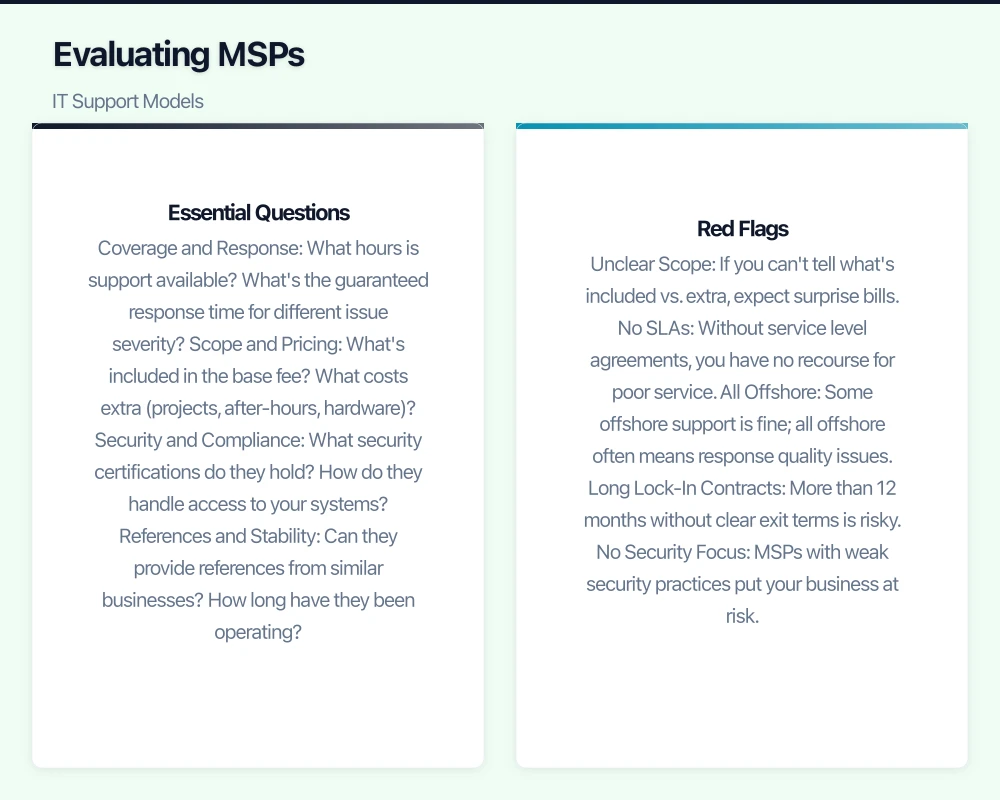
References and Stability
- Can they provide references from similar businesses?
- How long have they been operating?
- What’s their staff turnover?
- Who will actually work on your account?
Red Flags
Unclear Scope If you can’t tell what’s included vs. extra, expect surprise bills.
No SLAs Without service level agreements, you have no recourse for poor service.
All Offshore Some offshore support is fine; all offshore often means response quality issues.
Long Lock-In Contracts More than 12 months without clear exit terms is risky.
No Security Focus MSPs with weak security practices put your business at risk.
Making In-House Work
If you choose in-house, success requires more than hiring good people.
Structure for Coverage
Avoid Single Points of Failure
- At least two people covering critical systems
- Documented processes for key tasks
- Cross-training on critical capabilities
- Relationship with external support for escalations
Plan for Absence
- Who covers during leave?
- What happens during illness?
- How do you handle turnover?
Support Your Team
Professional Development IT skills require constant updating. Budget for:
- Training and certifications
- Conference attendance
- Learning resources
Career Path Where does your IT person go from here? Without growth opportunity, retention suffers.
Appropriate Tools Good IT staff need good tools. Underinvestment in tooling wastes human time.
Manage Effectively
Someone needs to:
- Set priorities and allocate work
- Evaluate performance
- Handle escalations and difficult decisions
- Connect IT work to business needs
If you lack IT management capability, consider whether MSP might be better.
Hybrid Model Structures
Several hybrid configurations work well:
Internal Coordinator + MSP
One internal person handles:
- First-line user support
- Business liaison and prioritisation
- Vendor coordination
- Simple changes and projects
MSP handles:
- Complex technical issues
- After-hours support
- Specialised expertise (security, cloud)
- Major projects and escalations
This works well for businesses wanting internal presence without full team cost.
Internal Team + MSP Specialisation
Internal team handles:
- Day-to-day operations
- Business-specific applications
- User support and training
- Standard projects
MSP provides:
- Security monitoring and response
- Cloud platform management
- Specialised consulting
- Overflow capacity
This works well for larger businesses with specific capability gaps.
Internal Development + MSP Operations
Internal staff focus on:
- Custom application development
- Business process automation
- Technical innovation
MSP handles:
- Infrastructure management
- End-user support
- Standard IT operations
This works well for tech-enabled businesses where IT development is strategic.
Cost Comparison Example
For a 30-person Australian professional services firm:
Full In-House (2 staff)
- Salaries and on-costs: $200,000
- Tools and software: $15,000
- Training: $5,000
- Contractors for gaps: $20,000
- Total: ~$240,000/year
Full MSP
- Monthly fee (30 users × $150): $54,000
- Projects and extras: $15,000
- Total: ~$70,000/year
Hybrid (1 internal + MSP)
- Internal staff: $100,000
- MSP (reduced scope): $30,000
- Total: ~$130,000/year
Cost isn’t everything—the right model depends on your specific needs, risk tolerance, and management capability.
Making the Decision
Assessment Questions
-
What’s your size and growth trajectory? Growing from 20 to 50 people has different needs than stable at 30.
-
How complex is your IT environment? Standard Microsoft 365 needs differ from custom applications and integrations.
-
Is IT a differentiator or utility? Core to business vs. necessary function suggests different approaches.
-
Do you have IT management capability? Someone needs to manage IT, whether internal staff or MSP relationship.
-
What’s your risk tolerance? Single points of failure, coverage gaps, and response times affect risk.
-
What’s your budget reality? Be honest about what you can sustainably invest.
Common Scenarios
Fast-growing startup (15 people): MSP makes sense—focus on growth, not IT infrastructure Established SMB (40 people): Hybrid likely optimal—internal presence plus external expertise Professional services (60 people): Consider in-house team with MSP backup for security/specialisation Tech company (25 people): Strong in-house likely needed—IT is core to the business
Getting Started
Whether you choose MSP, in-house, or hybrid, getting the model right matters. At CloudGeeks, we work with Australian SMBs across all models—as your MSP, supporting your internal team, or helping you design the right hybrid approach.
If you’re evaluating your IT support model, we can help you assess your needs and find the right fit for your business.
Related Articles
- Email Security for Australian SMBs: The Practical Protection Guide
- Cloud Security Fundamentals for Australian Small Business
- Choosing Business Software: The Australian SMB Evaluation Guide
For insights on building a technology roadmap that ties cloud, web, and mobile together, visit Ash Ganda’s blog.
Cloud Geeks operates under the Ganda Tech Services umbrella, delivering end-to-end technology solutions for Australian businesses.