
How WAF + AI Stop 94% of Cyber Attacks — and Why the Other 6% Still Bankrupt SMBs
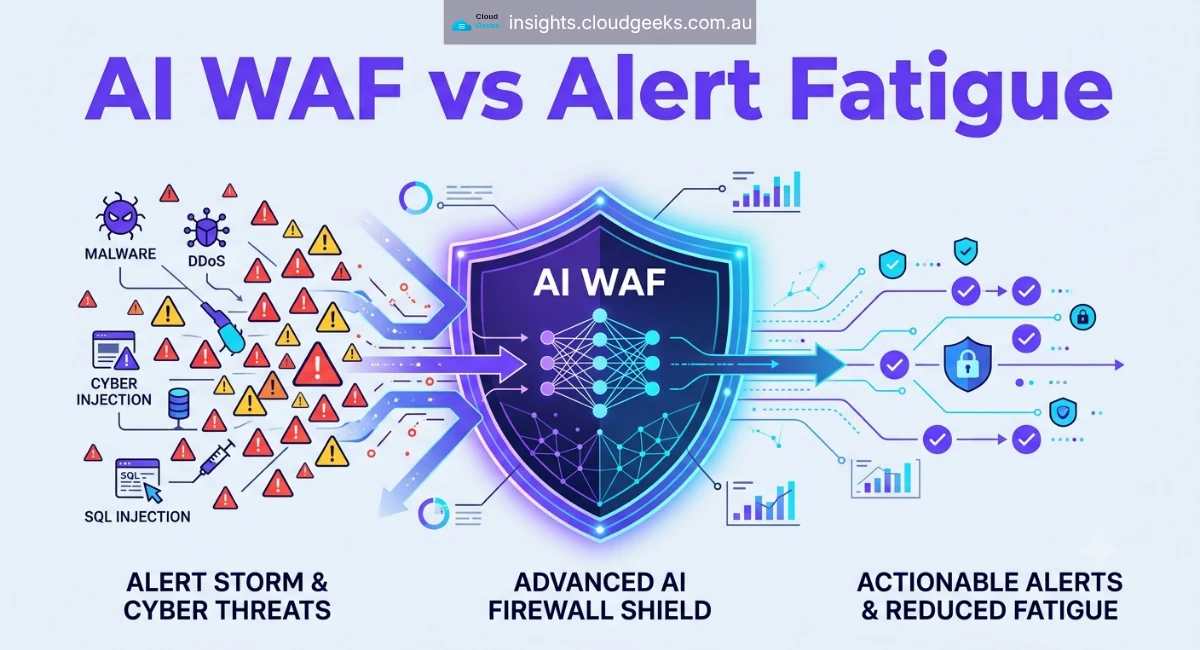
The Australian Cyber Security Centre’s 2023-24 Annual Cyber Threat Report logged 94,000 cybercrime reports — one every six minutes — with self-reported losses to Australian businesses averaging $97,200 per incident for medium businesses (ACSC Annual Cyber Threat Report 2023-24). Behind those numbers is a much less-discussed operational reality: security teams are being buried by alert volume, and most of what could hurt you is being ignored not because it’s undetectable — but because no human is looking.
This is the version of the WAF + AI story that skips the vendor slides and gets to the math.
Watch the 8-minute companion video → How WAF + AI Stop Attacks — on the Cloud Geeks YouTube channel (link updates after upload)
The alert-fatigue crisis — 200,000 alerts, 10% capacity, 180,000 ignored
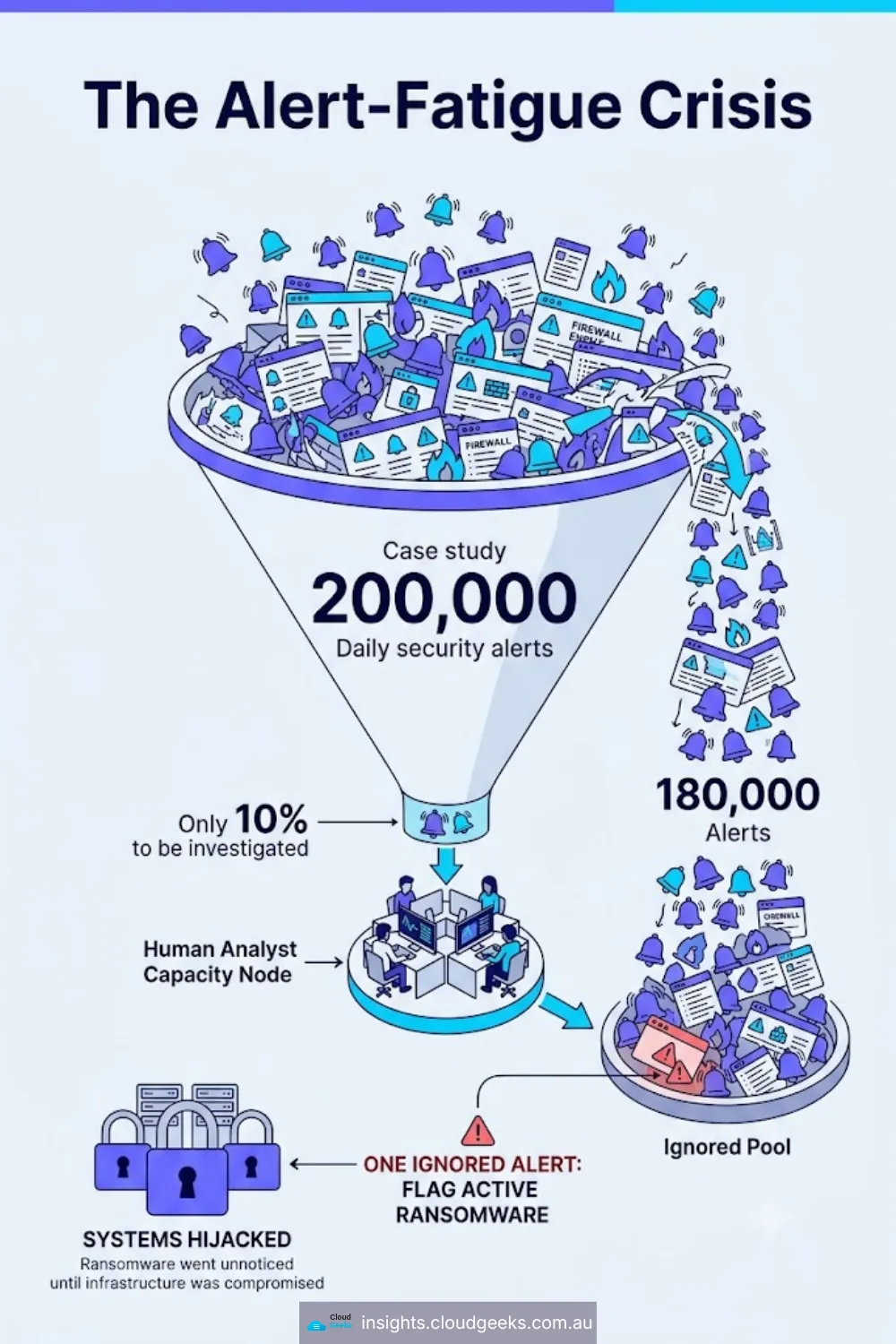
A 2023 case study of a healthcare company security team documented the real shape of the problem. Their systems were flagging 200,000 unique security alerts every single day. Their human analysts — regardless of coffee intake, hours worked, or headcount — could investigate a maximum of 10% of that volume.
That leaves 180,000 alerts vanishing into the digital ether each day, unchecked.
The math isn’t abstract. In that same case study, one of the ignored alerts flagged active ransomware encrypting patient records. By the time a human analyst finally noticed, the attackers had already hijacked the infrastructure.
That’s the operational cost of the vulnerability gap: not “we didn’t see it” — “we saw it and it was in position 47,382 on today’s queue.”
| Metric | Value |
|---|---|
| Daily security alerts (healthcare case study) | 200,000 |
| Max human-analyst investigation capacity | 10% |
| Alerts ignored per day | 180,000 |
| Alert that flagged the ransomware | 1 (in the 180,000) |
AI + WAF: closing 94% of the gap
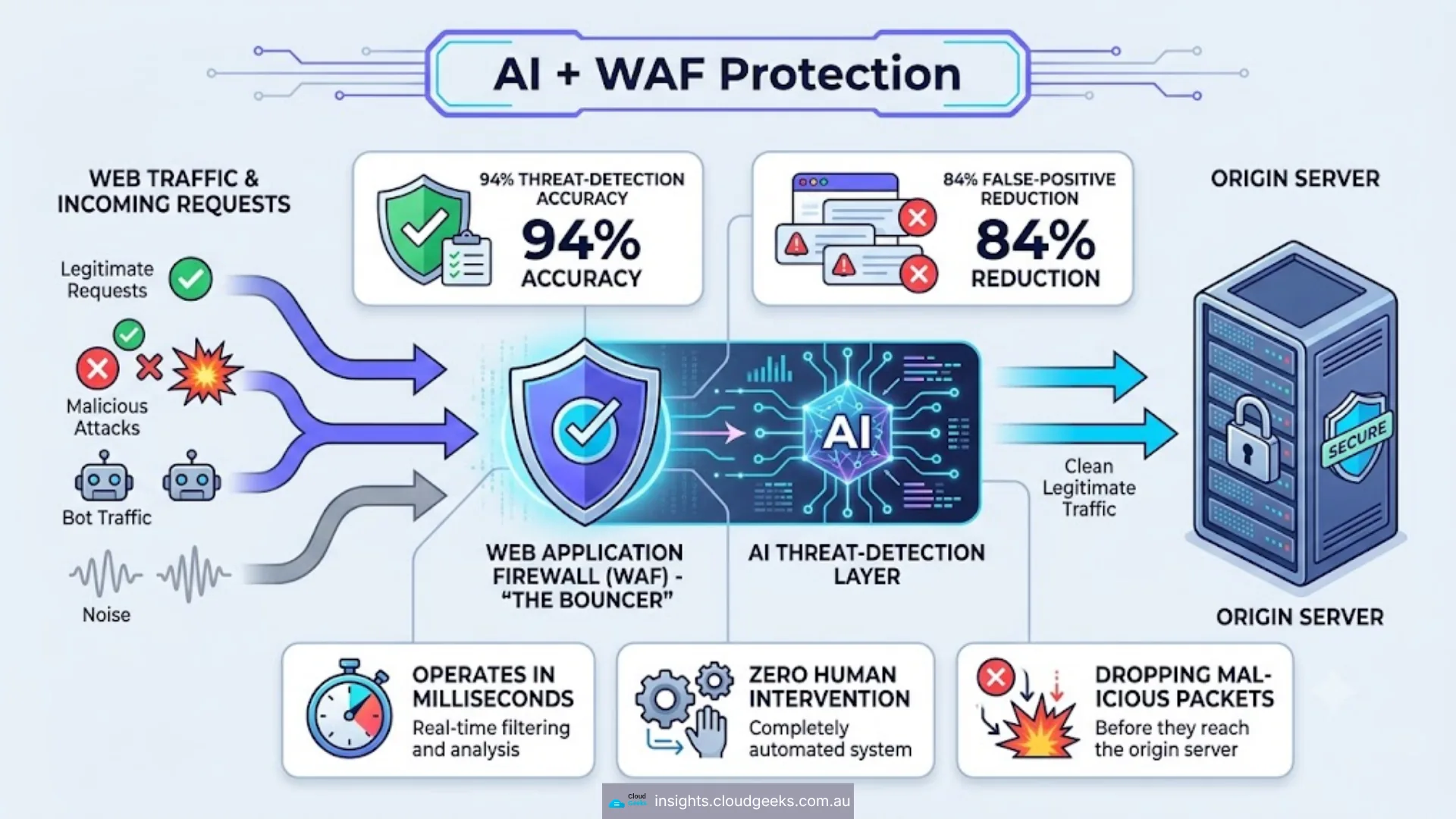
Modern enterprise-grade systems pair a Web Application Firewall (WAF) with an AI threat-detection layer. The AI reads the ocean of anomalies; the WAF is the muscle that actually blocks the attack at the perimeter.
Deployed together (Darktrace + WAF, KPMG’s stack, and similar production systems), the numbers change dramatically:
| Signal | Value |
|---|---|
| Threat-detection accuracy | 94% |
| False-positive reduction | 84% |
| Remaining margin of error | 6% |
| Security alerts autonomously investigated (KPMG global) | 340,000/month |
| KPMG countries covered by this AI-analyst layer | 47 |
That 84% false-positive reduction is what makes the whole thing tolerable for a small team: the AI isn’t just catching more real threats, it’s silencing the junk noise, so the alerts that DO reach your humans are targeted, dangerous, and actionable.
What a WAF actually does — the perimeter bouncer analogy
For a Sydney SMB owner: a WAF is a security service that sits between the internet and your website / application, filtering every incoming request against a maintained ruleset. Think of it as a bouncer at the front door of your network. It checks IDs (headers, IP reputation, request signatures) before letting anything reach your actual server.
The end-to-end sequence when an attack hits, in real time:
- Malicious packet arrives — automated bot attempting SQL injection, brute-force login, or comment-spam vector.
- WAF stands as the first line of defence — request is intercepted before it reaches your origin.
- AI layer analyses traffic anomalies in real time — pattern-matches against known-malicious signatures + behavioural baselines.
- Threat filtered + dropped — attack stopped dead in its tracks.
- Total time: milliseconds, zero human intervention.
That’s the “94%” in operation. It’s not magic — it’s a well-tuned bouncer with a smart clipboard.
The 6% that slips through — your disaster remediation stack
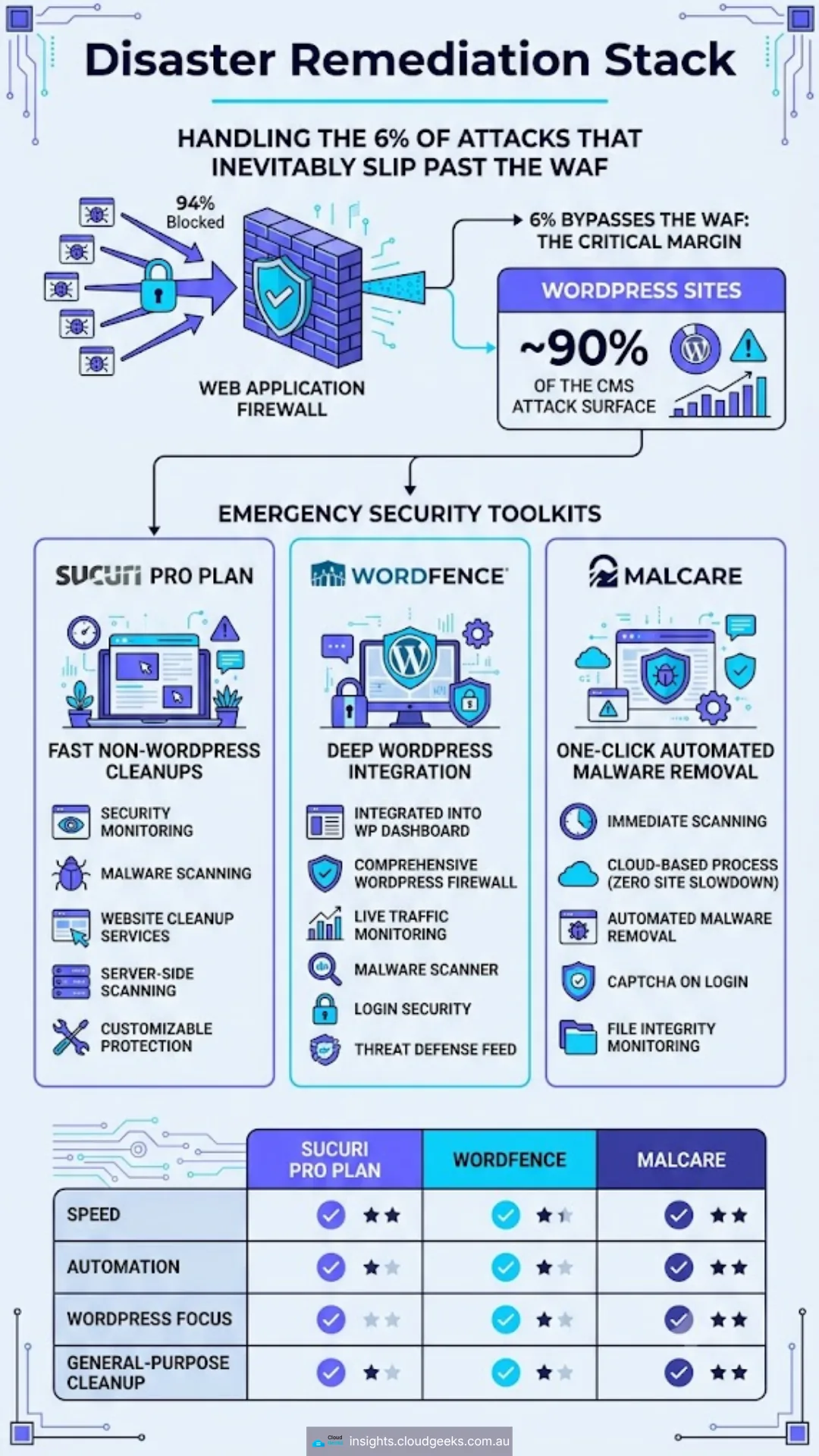
No system is flawless. When the 6% slips past your WAF and reaches your origin — especially on WordPress, which represents ~43% of the web and ~90% of the CMS attack surface — you’re in a panic-buy scenario. Trust is bleeding by the minute. Google’s domain block lists start moving in your direction.
The three vendors your disaster toolkit should already have accounts with:
- Sucuri Pro Plan — widely noted as the fastest non-WordPress-specific option for same-day emergency cleanups. Platform-agnostic; recommended for anything not on WordPress.
- Wordfence — deep integration inside the WordPress ecosystem. If your site IS WordPress, this is the toolkit that speaks its native language.
- MalCare — fantastic automated one-click malware removal for WordPress. Lower operational overhead than Wordfence when you want “just clean it, don’t ask questions.”
Get accounts on at least two of these BEFORE you need them. Nobody thinks clearly during a live compromise.
The Australian foundation: Essential Eight in 20 hours
You don’t want to keep leaning on emergency-response as a strategy. The Australian Cyber Security Centre’s Essential Eight framework is the foundational baseline every Sydney SMB should be running on.
The top two priorities per the ACSC’s own maturity model:
- Application control — only approved applications execute
- Patch applications — known vulnerabilities close inside the vendor’s SLA window
Per the implementation guides, the baseline setup for a small Australian business takes ~20 hours of focused work. Twenty hours to install the discipline that reduces catastrophic-breach risk by the largest margin the ACSC has measured.
Your actionable next steps
- Audit your current alert volume. Look at your existing tooling honestly — what’s coming in per day, and how much of it are your humans actually reading?
- Deploy a WAF — Cloudflare (free tier fine for most SMBs), Sucuri (managed + malware bundle), or the WAF built into your managed hosting stack (Kinsta and Cloudways include one).
- Integrate AI threat detection on top of the WAF. Even the free-tier tooling from your WAF vendor closes most of the 90% gap that pure-human review can’t touch.
- Book the 20 hours to install the Essential Eight baseline. Or engage Cloud Geeks Managed IT to run it for you.
Frequently asked questions
What does the 94% threat-detection number actually cover?
It’s the measured detection accuracy when an AI-powered analysis layer (systems like Darktrace) is paired with a Web Application Firewall in production enterprise deployments. It counts both true-positive attack detection AND the reduction in false alarms that would otherwise consume analyst time. The 6% residual margin is the reason the disaster-remediation stack (Sucuri / Wordfence / MalCare) still matters.
Is a WAF worth it for a small business with a low-traffic site?
For any site that takes user input (comment forms, WooCommerce carts, member logins), yes — automated attacks don’t care about your traffic level. Cloudflare’s free tier plus its WAF Managed Rules gets a typical Sydney SMB most of the way for zero cost. Sucuri and managed-hosting WAFs (Kinsta, Cloudways) add higher-touch policies and malware-cleanup bundles for the businesses that need them.
How is the alert-fatigue problem different for an Australian SMB vs a large healthcare company?
Different in scale, same in shape. An SMB might see 500-2,000 alerts a day rather than 200,000. But if the SMB has one person doing IT part-time, their investigable-alerts number is closer to 20 than 50 — so the ignored-percentage looks similar. The AI-plus-WAF fix (or a Managed IT partner) works the same at both ends of the scale.
Where does the Essential Eight fit versus deploying a WAF?
They’re complementary, not alternatives. The WAF stops external attacks at the perimeter; the Essential Eight hardens what happens INSIDE the network — application control, patching, MFA, backup restoration testing. The 20-hour baseline for the Essential Eight is what you do so you don’t rely on the WAF to be perfect.
What if I’ve already been compromised?
Skip everything above and go directly to the disaster remediation stack. If your site is WordPress: MalCare for automated one-click clean, or Wordfence for hands-on deep clean. If it’s anything else: Sucuri Pro Plan for same-day non-WordPress emergency cleanup. All three vendors offer under-24-hour SLAs on their emergency tiers.
Related reading
- The full Sucuri Website Firewall review — Sucuri vs Cloudflare and Wordfence: honest Australian SMB verdict
- The Essential Eight implementation runbook — Essential Eight Implementation Guide for Australian SMBs
- Cross-brand: Ashganda on the adversarial verification + fail-closed gate pattern — the same “assume-adversarial” discipline applied to AI content pipelines rather than network traffic.
- Book a Managed IT assessment — Cloud Geeks Managed IT to have the Essential Eight baseline installed and the alert-fatigue math handled for you.