
AI Translation vs Human Translation: When to Use Each
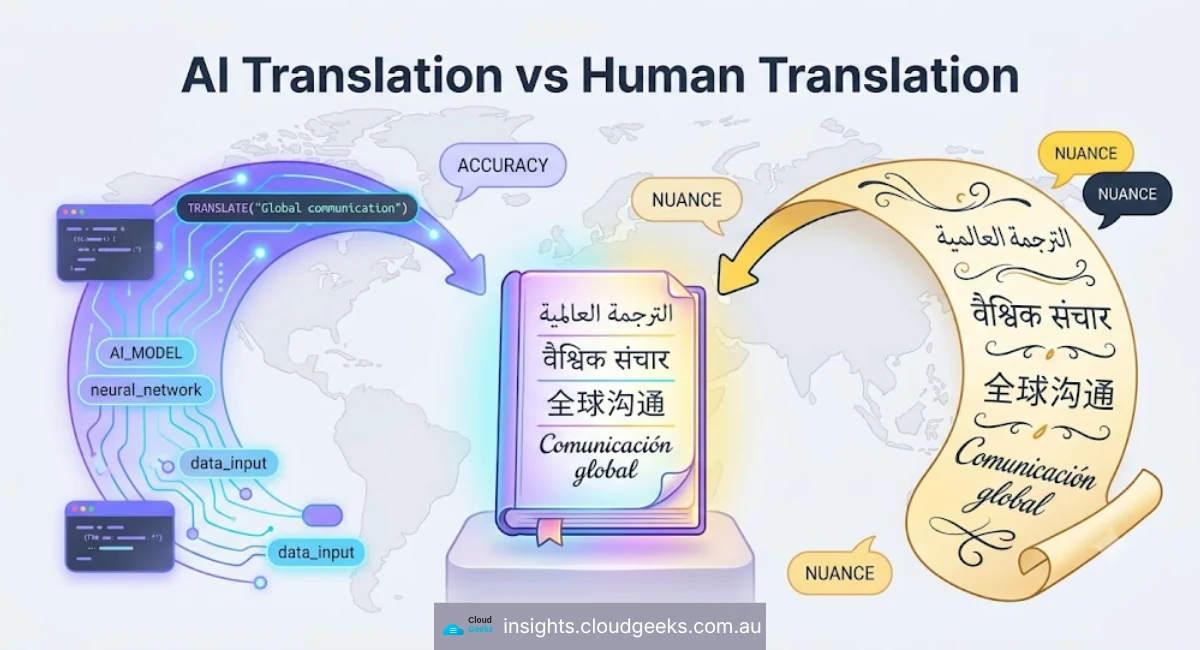
The question facing every business that operates across language barriers is no longer whether to use AI translation — it is knowing when AI translation vs human translation is the right call, and what happens when you get it wrong.
AI translation tools have made remarkable progress. Platforms like DeepL, Google Translate, and Microsoft Translator now produce output that would have seemed impossible five years ago. Yet for every success story, there is a cautionary tale: a product recall notice mistranslated into an embarrassing idiom, or a legal clause that lost its binding force after automated processing.
This guide cuts through the noise. Whether you are entering a new Asian market, serving a multilingual customer base, or localising a software product, you will find a clear framework for choosing the right approach — or the right combination of both.
AI Translation vs Human Translation: A Quick Comparison
AI translation uses neural machine translation (NMT) engines to convert text instantly and at scale. Human translation relies on professional linguists who bring cultural intelligence, domain expertise, and creative judgement that no algorithm can yet fully replicate. Neither approach suits every context — choosing correctly is what protects your brand and your bottom line.
| Factor | AI Translation | Human Translation |
|---|---|---|
| Speed | Minutes to hours | Days to weeks |
| Cost per word | Very low (AU$0.001–AU$0.01) | Higher (AU$0.15–AU$0.35) |
| Accuracy — structured content | Very good | Excellent |
| Accuracy — creative/legal/medical | Inconsistent | Excellent |
| Cultural nuance | Limited | Native-level |
| Scalability | Unlimited | Team-dependent |
| Best for | Volume, internal comms, product data | Brand, legal, medical, UX copy |
According to CSA Research (2023), 76% of online shoppers prefer to buy products with information in their own language — making multilingual content a commercial necessity, not a nice-to-have.
What AI Translation Does Well
Modern neural machine translation engines excel at high-volume, structured, and time-sensitive material where linguistic perfection is less critical than rapid availability.
Speed and Scale
A mid-sized e-commerce catalogue with 50,000 product descriptions would take a team of human translators months to process. An AI engine handles the same volume in hours. For businesses managing large content repositories — help centres, user-generated reviews, internal knowledge bases — AI translation provides a scalability that human workflows simply cannot match.
Amazon uses machine translation to surface customer reviews across language markets in near real-time. The translations are imperfect, but the business value — letting a Japanese shopper read feedback from Australian buyers — is undeniable. A 2024 report by Slator found that the global language services market exceeded US$67 billion, with machine translation driving the fastest-growing segment due to enterprise adoption.
Repetitive and Standardised Content
Technical documentation with consistent terminology, software UI strings, and transactional emails are ideal candidates for AI translation. These content types follow predictable structures and use limited vocabulary, which plays directly to the strengths of neural models trained on parallel corpora.
With a properly configured translation memory and glossary, AI tools can maintain terminology consistency across thousands of strings — something that is genuinely difficult to guarantee even with large human teams.
Internal and Informal Communication
When your Sydney operations team needs to share a briefing with colleagues in Tokyo, a machine translation is perfectly sufficient. The goal is information transfer, not brand representation. Speed matters; literary quality does not.
Where Human Translation Remains Essential
Despite the advances, there are content categories where the cost of a mistranslation — in brand equity, legal liability, or human safety — far outweighs the efficiency gains of automation.
Marketing, Brand, and Creative Content
Language is culture. A tagline that resonates powerfully in English may be flat, confusing, or inadvertently offensive when processed by an AI engine with no understanding of cultural nuance, humour, or local idiom.
Consider the global campaign failures that have become industry cautionary tales: slogans like “Nothing Sucks Like an Electrolux” translating badly across markets, or Pepsi’s China campaign (“Pepsi Brings Your Ancestors Back from the Dead”) — examples that illustrate how disastrously literal machine logic can misfire in creative contexts.
For website copy, advertising campaigns, product launches, and brand storytelling, human translators — ideally native speakers with marketing expertise — are the only reliable option.
Legal, Medical, and Regulatory Documents
Contracts, privacy policies, medical device instructions, and regulatory submissions carry legal weight. A single ambiguous phrase can invalidate a clause, expose a company to liability, or, in medical contexts, put patients at risk.
Australian businesses expanding into markets like Japan, South Korea, or the UAE must comply with local regulatory requirements where document accuracy is legally mandated. In these scenarios, professional translators with domain expertise and formal certification are not optional — they are a compliance requirement.
Customer-Facing Support at Scale
There is a meaningful difference between rough-and-ready internal communication and a conversation with a distressed customer. When your support team is handling a billing dispute, a product safety issue, or a refund request in another language, AI translation introduces a risk of misunderstanding that can escalate rather than resolve the situation.
Human agents supported by AI-assisted tools — rather than pure automation — represent the right balance for sensitive customer interactions.
High-Stakes Multilingual Websites
Your website is your global shopfront. A professionally localised website signals respect for the target market and builds trust. CSA Research found that 40% of consumers will never purchase from websites in languages other than their own.
Machine-translated websites are detectable. They carry a telltale awkwardness that erodes credibility — particularly in markets like Germany, France, and Japan where linguistic precision is closely tied to professional reputation.
The Hybrid Model: Getting the Best of Both
For most businesses, the optimal answer in the AI translation vs human translation debate is not a binary choice — it is a structured combination of machine efficiency and human judgement.
Machine Translation Post-Editing (MTPE)
MTPE is the industry-standard workflow for high-volume professional translation. An AI engine generates the first draft; a professional translator then reviews, corrects, and polishes the output. This approach typically reduces per-word costs by 30–50% compared to pure human translation, while delivering quality that meets professional standards.
Saya’s translation teams routinely apply MTPE to content such as product catalogues, technical manuals, and regulatory summaries — where speed and cost efficiency are priorities but accuracy cannot be compromised.
Tiered Content Classification
A practical framework for any business is to classify content by risk level:
| Content Tier | Risk Level | Recommended Approach |
|---|---|---|
| Internal communications, knowledge base articles | Low | AI translation |
| Product descriptions, help centre articles | Medium | AI + light human review (MTPE) |
| Marketing copy, customer-facing web pages | High | Human translation |
| Legal, medical, compliance documents | Critical | Certified human translation |
Applying this matrix across your content portfolio allows you to allocate translation resources where they create the most value, rather than applying an expensive uniform approach to everything.
Choosing the Right Partner
The technology is only part of the equation. Working with a language services provider that understands your industry, your target markets, and your brand voice is what separates functional translation from genuine localisation.
The distinction matters: translation converts words; localisation adapts meaning, tone, and cultural context for a specific audience. A Japanese website is not simply an English website with different text — it reflects different expectations around formality, visual hierarchy, and the relationship between brand and customer.
When evaluating translation partners, look for demonstrated expertise in your specific industry, native-speaker translators for your target markets, transparent quality assurance processes, and technology infrastructure that supports efficient MTPE workflows.
AI Translation vs Human Translation: Making the Right Decision
AI translation has fundamentally changed what is possible in global communication. It has opened doors for businesses that would previously have found multilingual operations prohibitively expensive.
But it has not replaced human expertise — it has redefined where that expertise is most valuable.
The businesses that navigate international markets most effectively are those that apply AI translation intelligently to appropriate content while investing in professional human localisation for the content that shapes brand perception, legal standing, and customer trust.
If your business is exploring new language markets or looking to improve the quality and efficiency of your current translation programme, the first step is an honest audit of your content portfolio.
Frequently Asked Questions: AI Translation vs Human Translation
What is the main difference between AI translation and human translation?
AI translation uses neural machine translation (NMT) software to convert text instantly and at scale, while human translation relies on professional linguists to accurately convey meaning, tone, and cultural context. AI translation is faster and more cost-effective for high-volume content; human translation is essential for brand, legal, and medical material where precision and cultural nuance are critical.
When should Australian businesses use AI translation?
Australian businesses should use AI translation for internal communications, high-volume product data, knowledge base articles, and time-sensitive content where speed and cost efficiency outweigh the need for linguistic perfection. For any content that represents the brand externally — websites, marketing campaigns, legal documents — professional human translation or a Machine Translation Post-Editing (MTPE) workflow is the recommended approach.
Is AI translation accurate enough for professional use?
AI translation accuracy has improved substantially, with tools like DeepL achieving near-human quality for structured content in high-resource language pairs such as English–Spanish and English–French. However, accuracy drops significantly for creative content, low-resource languages (including many Southeast Asian languages), and domain-specific material in law, medicine, or finance. A hybrid MTPE workflow typically resolves the accuracy gap at 30–50% lower cost than pure human translation.
How much does professional human translation cost compared to AI translation?
Professional human translation in Australia typically costs between AU$0.15 and AU$0.35 per source word, depending on language pair, complexity, and turnaround time. AI translation platforms cost a fraction of that — often under AU$0.01 per word at scale — but require human review for any content above a low-risk threshold. A Machine Translation Post-Editing (MTPE) workflow typically sits at AU$0.07–AU$0.12 per word, offering the strongest cost-to-quality ratio for volume translation projects.
Saya provides professional translation and localisation services for Australian businesses expanding into global markets. Contact our team to discuss a translation strategy tailored to your industry and target markets.
This article is brought to you by Ganda Tech Services — Sydney’s complete digital solutions provider.