
Scaling Content Production: How Agencies Can 10x Output Without Sacrificing Quality
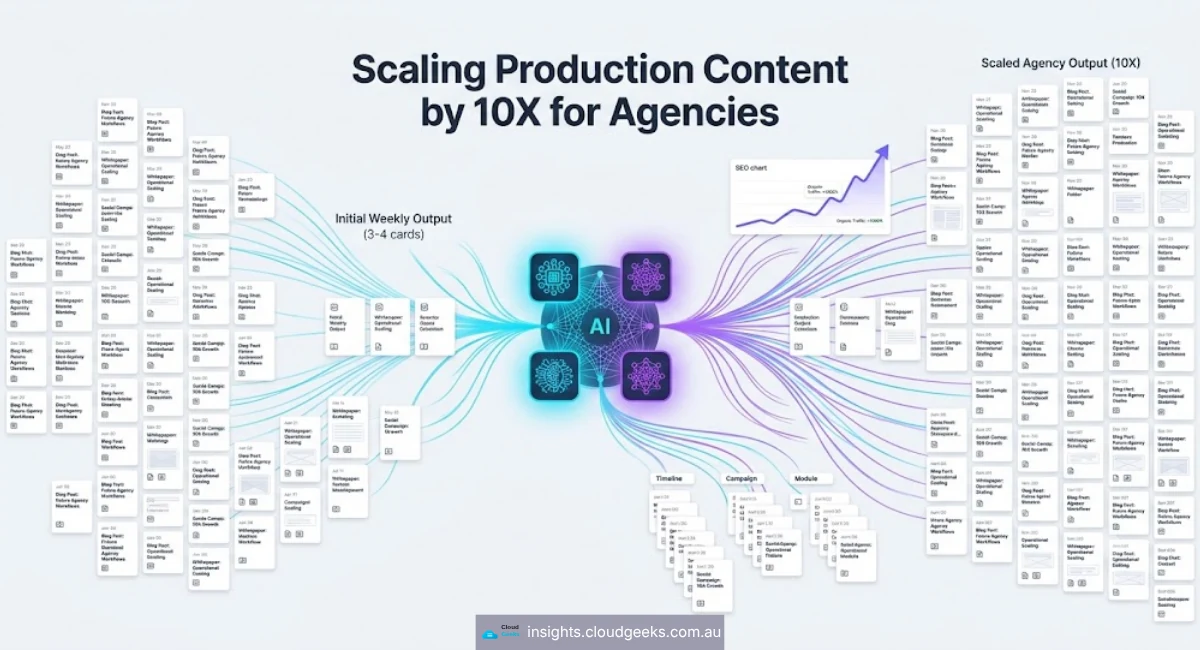
Every agency hits the same wall when scaling content production. A client wants three blog posts a week, another needs daily social copy, and a third just signed on expecting monthly whitepapers. Your team is talented but finite. Quality starts to slip, deadlines get missed, and suddenly you’re in the uncomfortable conversation about whether you can actually deliver what you promised.
The agencies breaking through this ceiling aren’t hiring faster than their competitors—they’re operating smarter. In 2025, the gap between agencies producing 10 pieces of content per week and those producing 100 comes down to systems, not headcount.
Here’s how to build the operational infrastructure that lets your agency scale content production without letting quality become the casualty.
Why Traditional Content Production Scaling Fails
The short answer: Hiring more writers adds overhead almost as fast as it adds capacity. Agencies that spend more than 40% of their time on writer management see diminishing output returns within six months—making workflow redesign a more reliable lever for scaling content production than headcount alone (Content Marketing Institute, 2024).
The instinctive response to growing content demand is to hire more writers. It feels logical: more writers equals more content. But it rarely works out that cleanly.
Each new writer requires onboarding, brand voice training, style guide alignment, and ongoing quality review. Research from the Content Marketing Institute found that agencies spending more than 40% of their time on writer management see diminishing returns on output within six months of a hiring surge. You’re adding overhead almost as fast as you’re adding capacity.
The second failure mode is template fatigue. Agencies deploy rigid templates to create consistency but end up with content that feels mechanical—identical structures, predictable transitions, formulaic calls to action. Readers disengage. Clients notice. Organic performance drops.
True scaling requires a different architecture altogether: one where your best thinking is systematised and your writers spend their cognitive energy where it matters most.
Build a Content Production Operating System
The short answer: A content production operating system tiers your content by effort level (strategic pillars, supporting posts, distribution assets), automates low-value scaffolding with AI, and reserves human effort for editorial judgment. Agencies that implement this architecture consistently report 2–5× output growth within 90 days, without adding headcount.
The agencies consistently hitting high output targets treat content production like a manufacturing process—not because the content should feel manufactured, but because the supporting operations should be frictionless.
Tier Your Content Types
Not all content requires the same effort. A well-run agency categorises content into three tiers:
Tier 1 — Strategic Pillars: Long-form guides, whitepapers, original research. These anchor your client’s authority and require deep research, original data, and heavy editorial investment. Budget 8–12 hours per piece.
Tier 2 — Supporting Content: Blog posts, case studies, email sequences. These drive organic traffic and nurture leads. A well-templated workflow with AI assistance should bring this to 2–4 hours per piece.
Tier 3 — Distribution Content: Social posts, newsletter snippets, ad copy derived from Tier 1 and 2 assets. With the right repurposing workflow, a single Tier 1 piece should yield 15–20 Tier 3 assets with minimal additional effort.
Agencies that fail to make this distinction burn Tier 1 effort on Tier 3 tasks, or—worse—publish Tier 3-quality content in Tier 1 formats.
Design an AI-Augmented Workflow for Content Production
AI writing tools have matured significantly. Used strategically, they compress the time between brief and publish-ready draft without flattening the writing.
The key insight most agencies miss: AI should handle the scaffolding, not the thinking. Your most valuable writers are paid to make editorial judgements, develop angles, and maintain brand voice. They shouldn’t be spending 40 minutes building a content outline that a well-prompted AI can produce in 90 seconds.
A practical workflow for Tier 2 blog content:
- Brief standardisation (10 min): Writer completes a structured brief covering audience, intent, primary keyword, and three key takeaways
- AI outline generation (2 min): AI produces a structured outline based on the brief
- Editorial review (5 min): Writer refines the outline, flags angles AI missed, adjusts structure
- AI first draft (3 min): Draft generated from the approved outline
- Human editing pass (45–60 min): Writer rewrites weak sections, injects client-specific examples, tightens the voice
- SEO and quality check (15 min): Review against keyword targets, readability, and brand standards
Total: approximately 90 minutes for a 1,200-word post—less than a quarter of the industry average of 4+ hours for comparable output (Orbit Media Studios, 2024 Annual Blogger Survey).
Tools worth evaluating for this stack include Jasper, Copy.ai, and Surfer SEO for content briefs. The key is standardising your prompt library so every writer gets consistent AI output to edit from.
Implement Quality Gates, Not Quality Checks
The short answer: Quality gates are prospective checkpoints built into a workflow before work advances to the next stage. Unlike post-draft reviews, gates at the brief, outline, and first-draft stages prevent expensive rework—agencies using this approach report 30–40% less editorial revision time.
The word “check” implies a retrospective activity—something you do after the content is finished to catch problems. By that point, fixing issues is expensive.
Quality gates are prospective. They define what must be true before work advances to the next stage.
Gate 1: Brief Approval
No writer starts drafting until a brief has been approved by a senior editor or account manager. The brief must include: target keyword and search intent, audience segment, desired outcome (what should the reader do or believe after reading), and three non-negotiable facts or data points to include.
This gate eliminates the most common source of rework—content that misses the point entirely.
Gate 2: Outline Sign-Off
For Tier 1 and Tier 2 content, the outline is reviewed before drafting begins. A 10-minute outline review catches structural problems that would otherwise require full rewrites.
Gate 3: First Draft Checklist
Before editorial review, writers self-assess against a standardised checklist: Does the opening hook deliver on the headline’s promise? Are there at least three specific examples or data points? Does the conclusion include a clear next step? Is the word count within 10% of target?
Checklists sound basic. Agencies that implement them consistently report a 30–40% reduction in editorial revision time.
Repurpose Systematically, Not Opportunistically
Most agencies know they should repurpose content. Few do it systematically because they treat it as an afterthought—something that happens if someone has spare time.
Build repurposing into the production schedule at the brief stage. Every Tier 1 or Tier 2 asset should have a defined distribution plan before a single word is written.
For a 2,000-word pillar post, the repurposing matrix might look like:
- 5 LinkedIn posts (one per major section)
- 3 email newsletter segments
- 8–10 social media quote cards
- 1 short-form video script (for client Reels or TikTok)
- 3 outbound email sequences for lead nurture
The writing effort for these Tier 3 assets drops dramatically when the source material already exists. An hour of repurposing produces content that would take three hours to create from scratch.
Measure What Actually Matters for Scaled Content Production
The short answer: Four metrics define a healthy scaled content operation: output velocity (pieces per writer per week), first-pass approval rate (target ≥70%), content performance rate (pieces hitting 90-day traffic goals), and repurpose ratio (distribution assets per core piece). Track all four monthly—if velocity rises while performance drops, stop scaling and investigate.
Scaling output without tracking quality is pointless. You’ll produce more content that performs worse, and your clients will eventually notice.
The metrics that matter for a scaled content operation:
Output velocity: pieces published per writer per week, trended over time. You want this rising without quality metrics falling.
First-pass approval rate: what percentage of drafts pass editorial review without requiring major revision? Below 70% signals a brief or training problem.
Content performance rate: what percentage of published pieces hit their 90-day traffic or engagement targets? This is your ultimate quality proxy.
Repurpose ratio: how many distribution assets does each core piece generate? A low ratio means you’re leaving reach on the table.
Review these metrics monthly with your production team. When velocity rises but performance drops, slow down and investigate before scaling further.
The Agencies Winning in 2025
The content agencies outperforming their peers share a common characteristic: they’ve made the operational investment before it became urgent. They built their content operating system during a growth phase, not a crisis.
If your current approach to scaling is hiring more writers or pushing your existing team harder, you’re one or two client wins away from a quality collapse. The 10x agencies aren’t working harder—they’ve built the infrastructure that makes 10x output the natural result of a well-designed system.
Start with the tier framework. Map your current content to Tier 1, 2, and 3. You’ll almost certainly find Tier 1 effort going into Tier 3 work. Fixing that misalignment alone will reclaim hours every week.
Frequently Asked Questions About Scaling Content Production
How can agencies scale content production without sacrificing quality?
Agencies scale content production without sacrificing quality by implementing three interlocking systems: a tiered content model that separates strategic pillars from supporting posts and distribution assets, an AI-augmented workflow that handles structural scaffolding while human editors focus on voice and angle, and prospective quality gates at the brief, outline, and first-draft stages—long before expensive rework becomes necessary.
What AI tools help agencies produce more content efficiently?
The most effective AI tools for agency content production in 2025 include Jasper and Copy.ai for draft generation, Surfer SEO for brief creation and keyword integration, and standardised prompt libraries built around large language models for outline consistency. The key principle is to use AI for high-volume structural tasks—outlines, first drafts, repurposed social snippets—while reserving human effort for editorial judgment, factual accuracy, and brand voice.
How long does it take to produce a 1,200-word blog post using an AI-augmented workflow?
With a structured AI-augmented workflow, a 1,200-word blog post takes approximately 90 minutes: 10 minutes for brief standardisation, 5 minutes for AI outline generation and editorial review, 3 minutes for AI first draft generation, and 60 minutes for human editing and SEO review. This compares to an industry average of 4+ hours using a traditional manual process, according to the Orbit Media Studios 2024 Annual Blogger Survey.
What metrics should agencies track to measure content production performance?
Agencies should track four core metrics for scaled content production: output velocity (pieces published per writer per week), first-pass approval rate (target above 70%—below this signals a brief or onboarding problem), content performance rate (percentage of pieces hitting 90-day traffic or engagement targets), and repurpose ratio (number of distribution assets generated per core piece). Review all four together monthly—a rising velocity alongside falling performance is a signal to pause scaling and audit process inputs.
ContentSage helps marketing agencies build content operations that scale. Explore our resources on AI-assisted workflows, content calendars, and production systems at write-gts.com.au.
This article is brought to you by Ganda Tech Services — Sydney’s complete digital solutions provider.