
Building a Content Calendar That Actually Works: A Step-by-Step Guide
Most content calendars die within six weeks. Teams build them with the best of intentions — colour-coded spreadsheets, shared Notion boards, elaborate Airtable setups — and then reality intervenes. Deadlines slip, priorities shift, and the content calendar quietly becomes a historical artefact rather than a living workflow tool.
That’s not a technology problem. It’s a process problem. The good news? It’s entirely solvable.
This guide walks you through how to build a content calendar that your team will actually use — one that reduces last-minute scrambles, eliminates duplicate efforts, and connects every piece of content to a measurable business outcome.
Why Most Content Calendars Fail (And What to Do Instead)
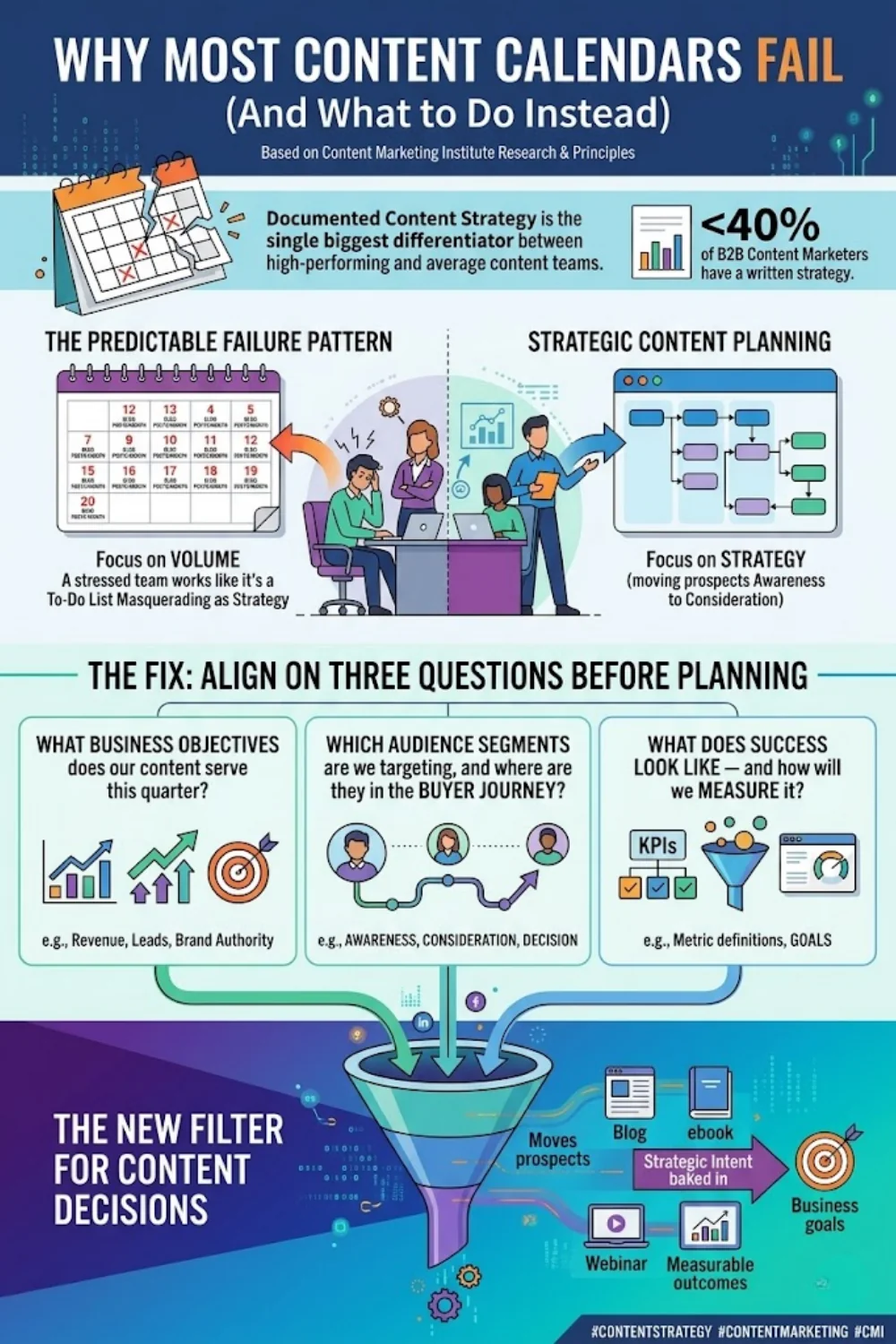
Research from the Content Marketing Institute consistently shows that documented content strategy is the single biggest differentiator between high-performing and average content teams. Yet fewer than 40% of B2B content marketers have a written strategy.
The failure pattern is predictable: teams build calendars around volume (“we need 12 blog posts a month”) rather than strategy (“we need content that moves prospects from awareness to consideration”). Without strategic intent baked in at the planning stage, a content calendar becomes a to-do list masquerading as a strategy.
The fix: Before touching any tool or template, align your team on three questions:
- What business objectives does our content serve this quarter?
- Which audience segments are we targeting, and where are they in the buyer journey?
- What does success look like — and how will we measure it?
These answers become the filter for every content decision that follows.
Step 1: Audit What You Already Have
The fastest way to waste effort is to create content you’ve already created. Start with a content audit before planning anything new.
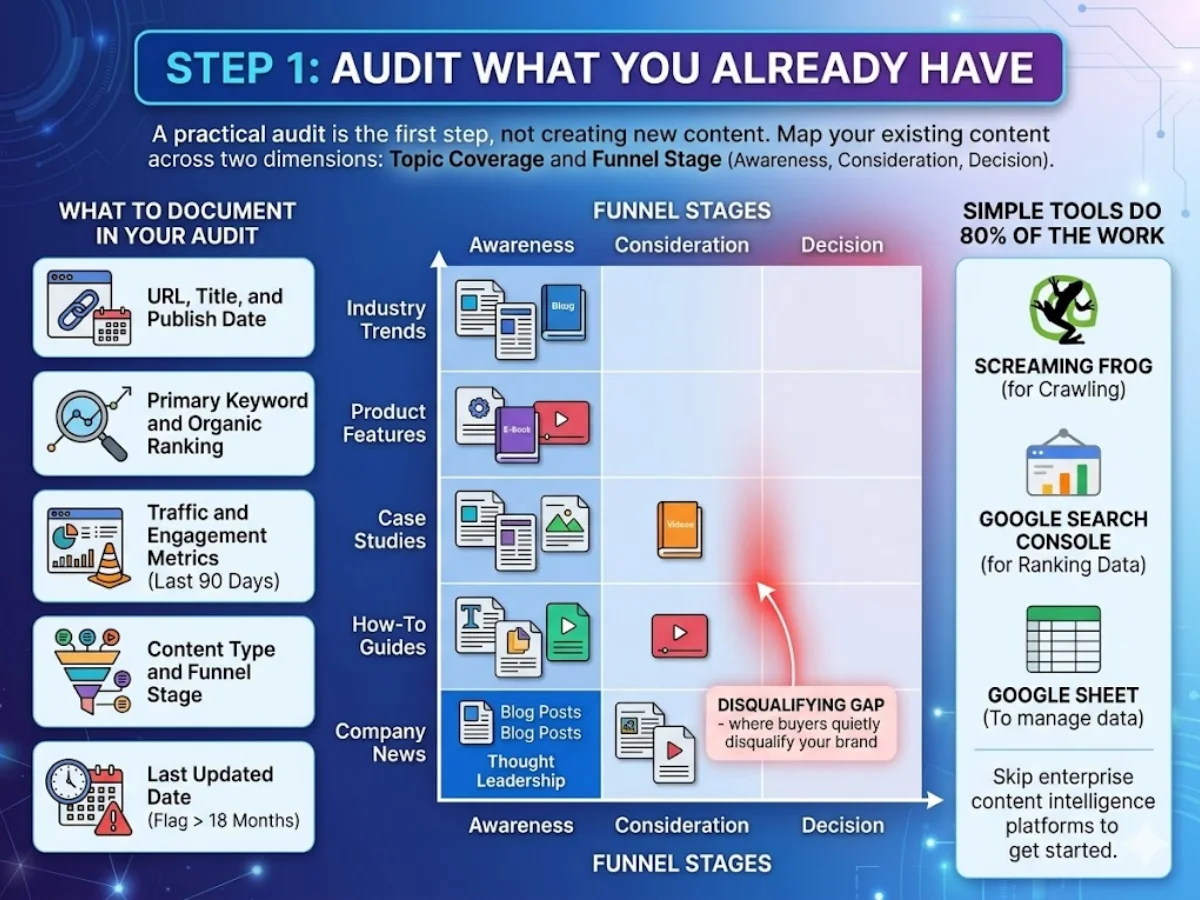
A practical audit doesn’t require weeks of work. Map your existing content across two dimensions: topic coverage (what subjects have you addressed?) and funnel stage (awareness, consideration, decision). Plot them in a simple matrix.
Most teams discover the same pattern: a heavy concentration of awareness-stage content (blog posts, thought leadership) and a glaring gap at the consideration and decision stages. That gap is where buyers are quietly disqualifying your brand.
What to document in your audit:
- URL, title, and publish date
- Primary keyword and current organic ranking
- Traffic and engagement metrics (last 90 days)
- Content type and funnel stage
- Last updated date (flag anything older than 18 months)
Tools like Screaming Frog (for crawling), Google Search Console (for ranking data), and a simple Google Sheet can handle 80% of this work. You don’t need an enterprise content intelligence platform to get started.
Step 2: Define Your Content Pillars
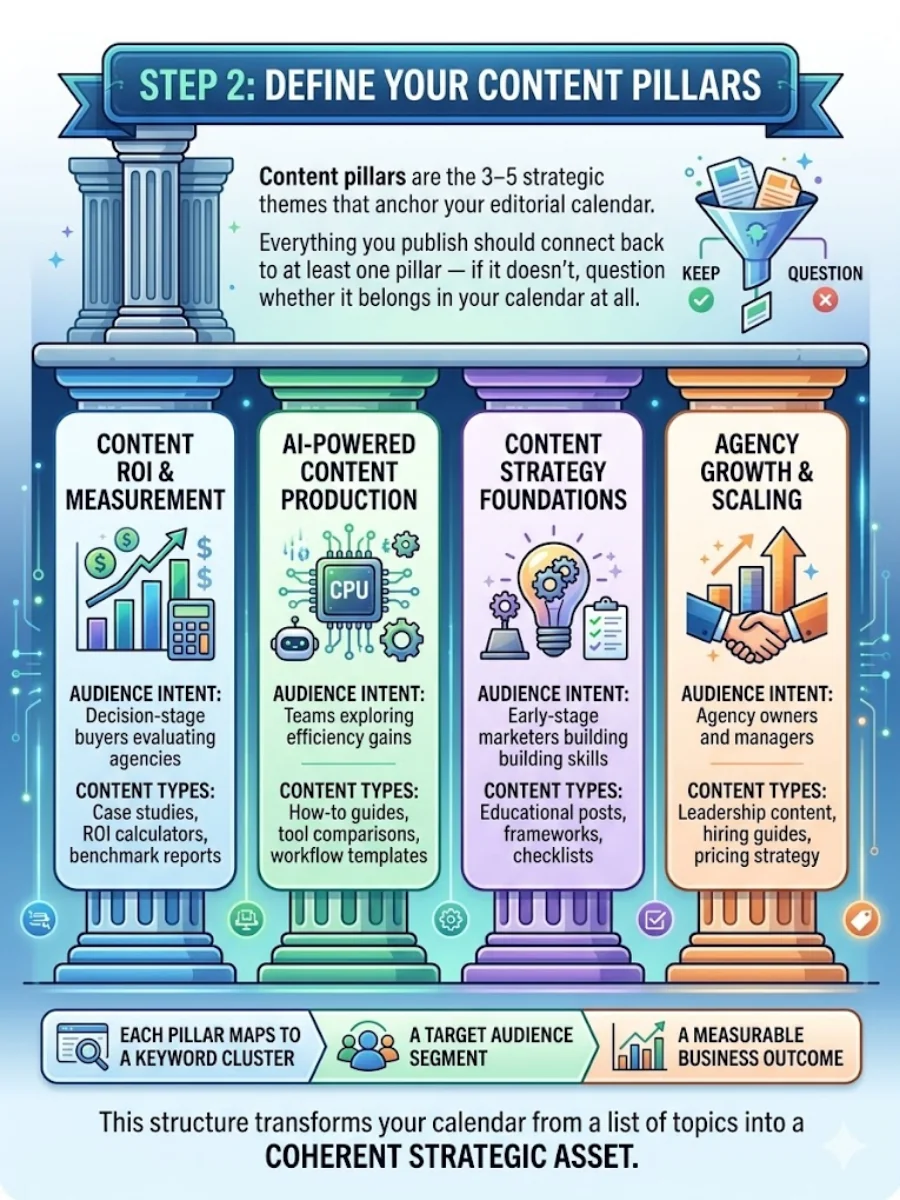
Content pillars are the 3–5 strategic themes that anchor your editorial calendar. Everything you publish should connect back to at least one pillar — if it doesn’t, question whether it belongs in your calendar at all.
For a content marketing agency, pillars might look like:
| Pillar | Audience Intent | Content Types |
|---|---|---|
| Content ROI & Measurement | Decision-stage buyers evaluating agencies | Case studies, ROI calculators, benchmark reports |
| AI-Powered Content Production | Teams exploring efficiency gains | How-to guides, tool comparisons, workflow templates |
| Content Strategy Foundations | Early-stage marketers building skills | Educational posts, frameworks, checklists |
| Agency Growth & Scaling | Agency owners and managers | Leadership content, hiring guides, pricing strategy |
Each pillar should map to a keyword cluster, a target audience segment, and a measurable business outcome. This structure transforms your calendar from a list of topics into a coherent strategic asset.
Step 3: Build Your Publishing Cadence (Realistically)
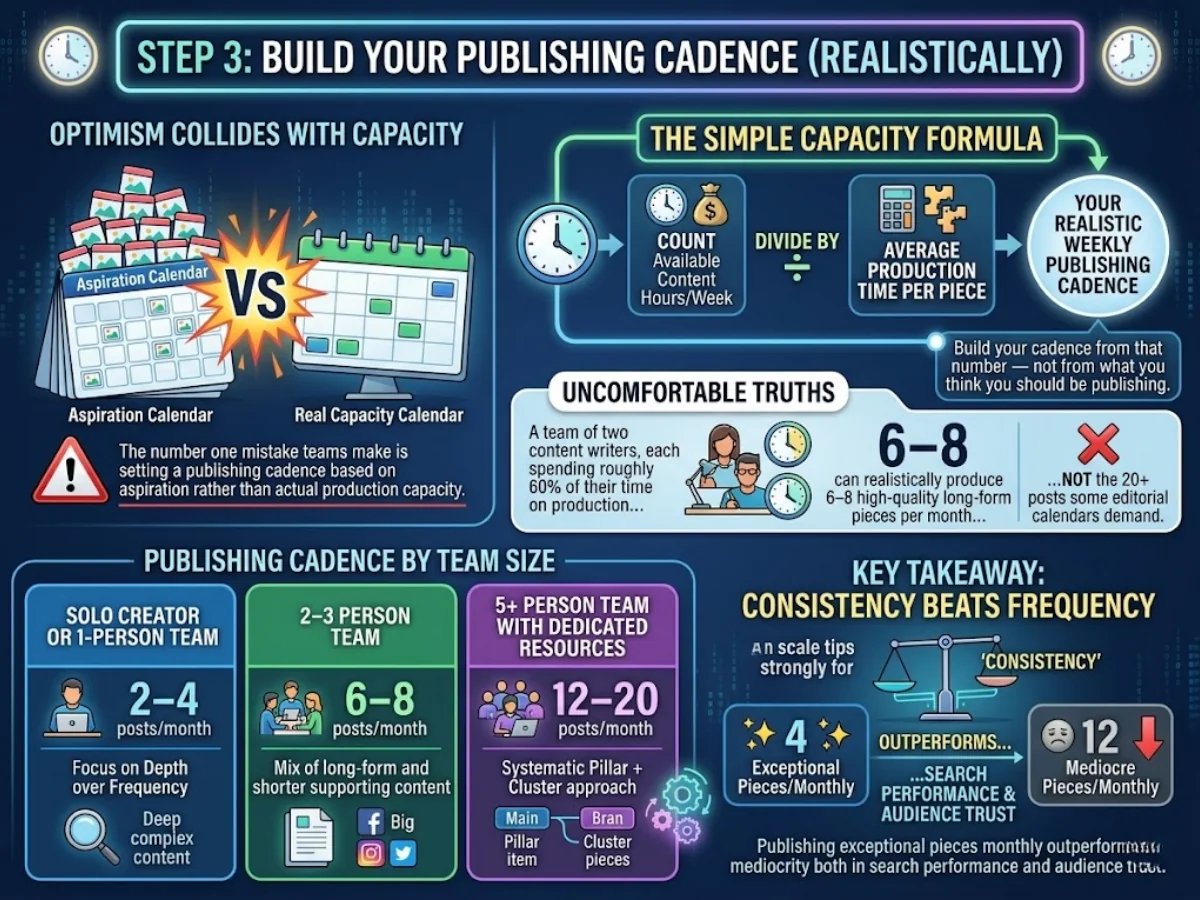
This is where optimism collides with capacity. The number one mistake teams make is setting a publishing cadence based on aspiration rather than actual production capacity.
A simple formula: count the hours your team genuinely has available for content each week, divide by your average production time per piece, and build your cadence from that number — not from what you think you should be publishing.
For most content teams, that calculation reveals uncomfortable truths. A team of two content writers, each spending roughly 60% of their time on production, can realistically produce 6–8 high-quality long-form pieces per month — not the 20+ posts some editorial calendars demand.
Publishing Cadence by Team Size
- Solo creator or 1-person team: 2–4 posts/month, focus on depth over frequency
- 2–3 person team: 6–8 posts/month, mix of long-form and shorter supporting content
- 5+ person team with dedicated resources: 12–20 posts/month, systematic pillar + cluster approach
Consistency beats frequency every time. A team publishing four exceptional pieces monthly will outperform one publishing 12 mediocre pieces — both in search performance and audience trust.
Step 4: Structure Your Content Calendar Template
Your content calendar template needs to capture more than just “what to publish and when.” Here’s the minimum viable information for each calendar entry:
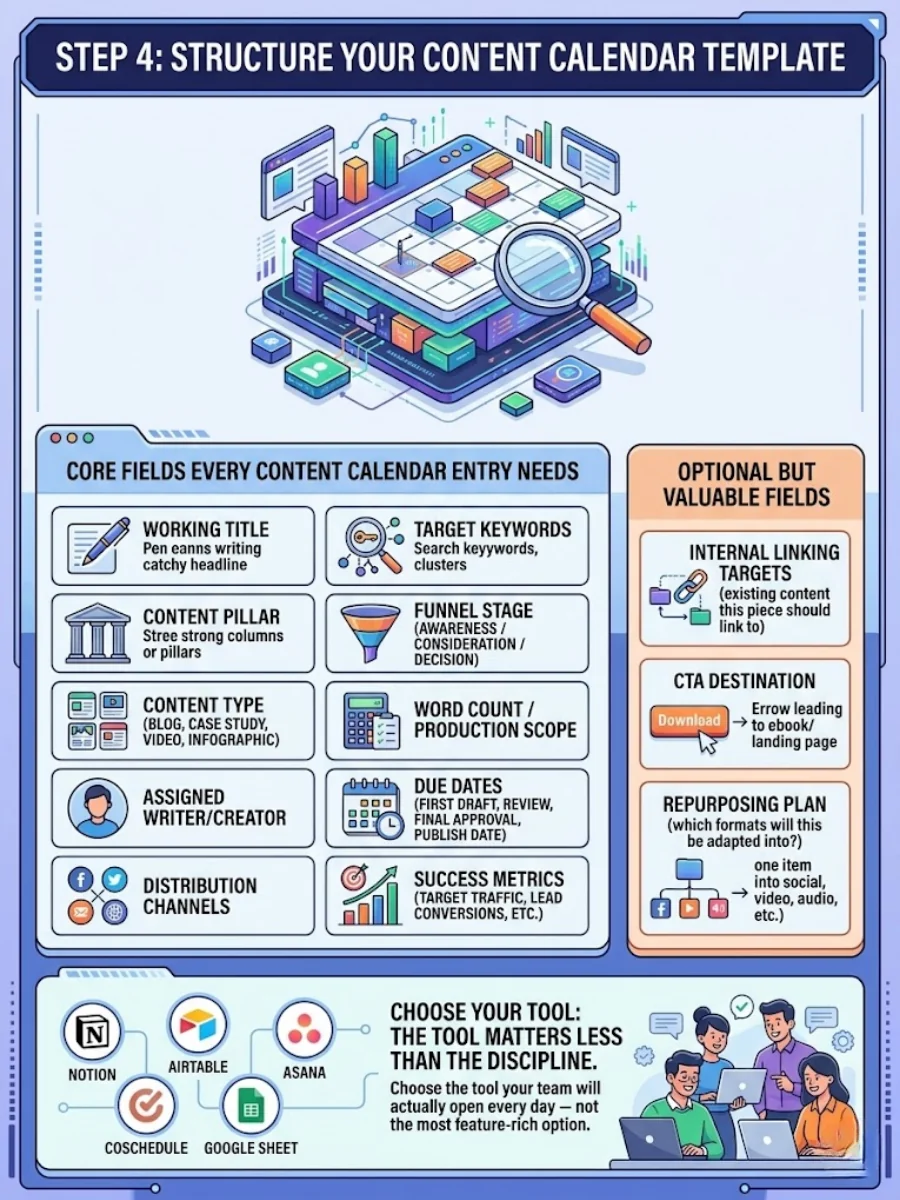
Core Fields Every Content Calendar Entry Needs
- Working title
- Target keyword (primary + 2–3 secondary)
- Content pillar
- Funnel stage (awareness / consideration / decision)
- Content type (blog, case study, video, infographic)
- Target word count or production scope
- Assigned writer/creator
- Due dates: first draft, review, final approval, publish date
- Distribution channels
- Success metrics (target traffic, lead conversions, etc.)
Optional but Valuable Fields
- Internal linking targets (existing content this piece should link to)
- CTA destination
- Repurposing plan (which formats will this be adapted into?)
The tool matters less than the discipline. Notion, Airtable, Asana, CoSchedule, or even a well-structured Google Sheet can all work. Choose the tool your team will actually open every day — not the most feature-rich option.
Step 5: Build in Review and Optimisation Loops
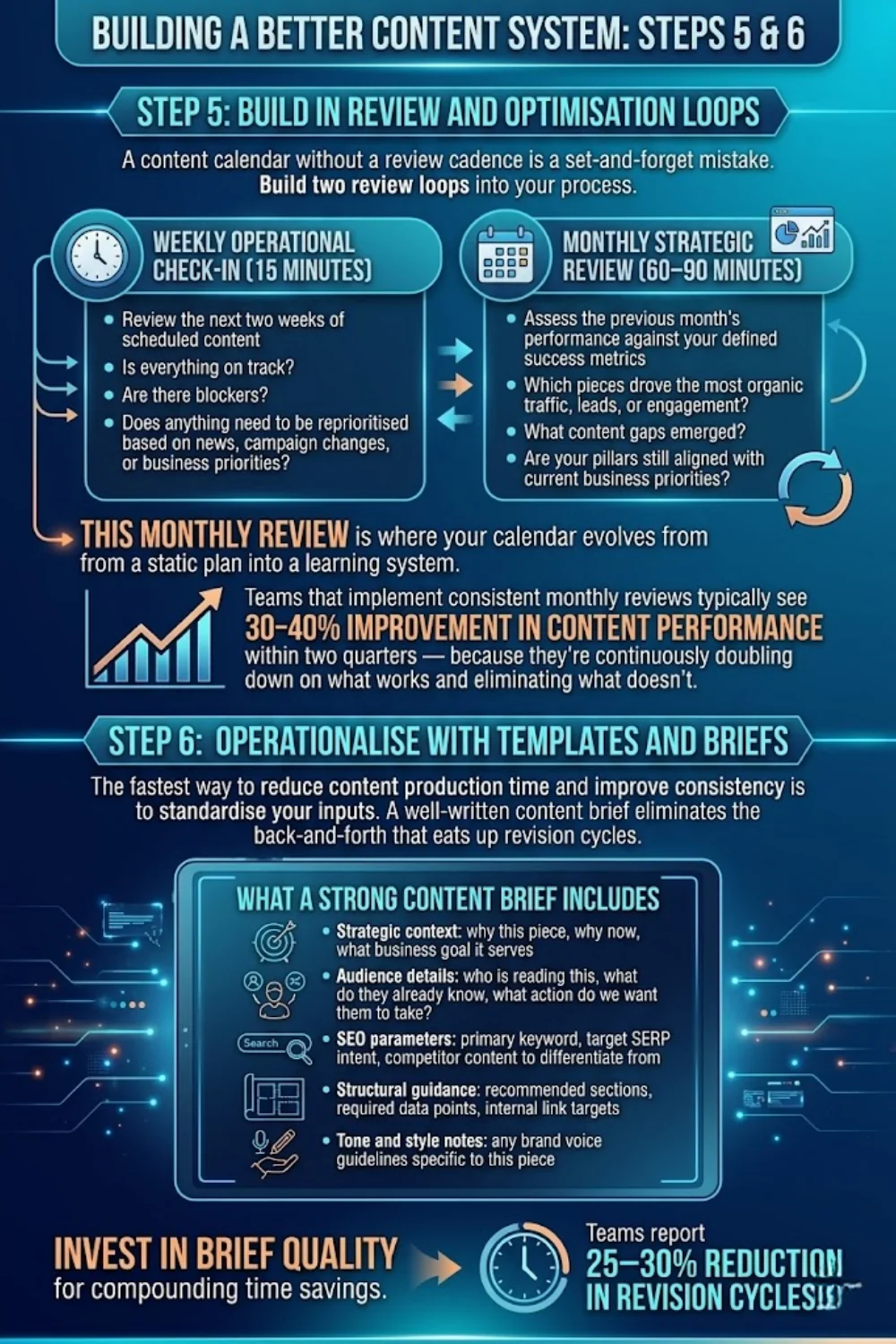
A content calendar without a review cadence is a set-and-forget mistake. Build two review loops into your process:
Weekly Operational Check-In (15 Minutes)
Review the next two weeks of scheduled content. Is everything on track? Are there blockers? Does anything need to be reprioritised based on news, campaign changes, or business priorities?
Monthly Strategic Review (60–90 Minutes)
Assess the previous month’s performance against your defined success metrics. Which pieces drove the most organic traffic, leads, or engagement? What content gaps emerged? Are your pillars still aligned with current business priorities?
This monthly review is where your calendar evolves from a static plan into a learning system. Teams that implement consistent monthly reviews typically see 30–40% improvement in content performance within two quarters — because they’re continuously doubling down on what works and eliminating what doesn’t.
Step 6: Operationalise With Templates and Briefs
The fastest way to reduce content production time and improve consistency is to standardise your inputs. A well-written content brief eliminates the back-and-forth that eats up revision cycles.
What a Strong Content Brief Includes
A strong brief includes:
- Strategic context: why this piece, why now, what business goal it serves
- Audience details: who is reading this, what do they already know, what action do we want them to take?
- SEO parameters: primary keyword, target SERP intent, competitor content to differentiate from
- Structural guidance: recommended sections, required data points, internal link targets
- Tone and style notes: any brand voice guidelines specific to this piece
Teams that invest in brief quality consistently report 25–30% reduction in revision cycles. That time saving compounds significantly over a full year of content production.
Practical Takeaways
Implementing everything above at once is a recipe for overwhelm. Here’s a sequenced 30-day action plan:
Week 1: Complete your content audit and document existing assets in a spreadsheet.
Week 2: Define your 3–5 content pillars and map them to your keyword strategy and funnel stages.
Week 3: Calculate your realistic production capacity and set your publishing cadence. Build your content calendar template.
Week 4: Populate the next 8 weeks of content entries with full briefs. Schedule your first monthly review.
The teams that build content calendars that last aren’t the ones with the most sophisticated tools — they’re the ones who treat planning as a discipline, review performance honestly, and remain willing to adapt when the data demands it.
Your content calendar should be the most-used document in your marketing stack. Build it with the same rigour you’d bring to a media buy or a product launch, and it will return that investment many times over.
Frequently Asked Questions About Content Calendars
How often should you update your content calendar?
A content calendar should be reviewed weekly (15-minute operational check-in) and monthly (60–90-minute strategic review). The weekly check catches blockers and reprioritisations in real time; the monthly review aligns performance data with forward planning. Teams running consistent monthly reviews typically see 30–40% improvement in content performance within two quarters.
What should a content calendar template include?
At minimum, every entry in your content calendar should capture: working title, primary keyword, content pillar, funnel stage, content type, word count target, assigned creator, draft and publish due dates, distribution channels, and success metrics. Optional fields — internal linking targets, CTA destination, and a repurposing plan — add meaningful production value without overcomplicating the workflow.
How many content pillars should a content calendar have?
Most content teams work best with 3–5 pillars. Each pillar should map to a keyword cluster, an audience segment, and a measurable business outcome. Fewer than three pillars risks narrow editorial scope; more than five dilutes topical focus and makes it harder to build search authority in any single area.
What is a realistic publishing cadence for a small content team?
For a solo creator: 2–4 posts per month, focused on depth. A 2–3 person team can sustainably target 6–8 posts per month. Teams of five or more with dedicated resources can manage 12–20 posts per month using a pillar-and-cluster approach. The rule of thumb: consistency beats frequency. Four exceptional monthly pieces will outperform 12 mediocre ones in both organic rankings and audience trust.
ContentSage helps marketing agencies and content teams build scalable content systems. Explore our content strategy resources or get in touch to discuss how we can help systematise your content operations.
Part of the Ganda Tech Services family, ContentSage delivers specialist content strategy and AI writing solutions.