
The $110,000 Hallucination: Why Citing Fake Sources Just Became Your Brand's Biggest Risk
Editor’s note (May 2026): An earlier version of this post listed two source titles that paraphrased — rather than copied — the actual published titles. They’ve been corrected to match the journals’ records exactly. We’re flagging the change because the failure mode (an LLM paraphrasing a citation title during summarisation, while the URL and authors stay correct) is itself the class of hallucination this post argues for solving. Catching it required exactly the discipline the article calls for: fetching each cited URL and matching the source’s metadata one-to-one.
In April 2026, an Oregon judge fined two lawyers a combined $110,000 for submitting an AI-written legal brief with 40 fabricated case citations. The cases looked real. The court reporters looked real. Even the case numbers followed correct formatting conventions. None of them existed.
It was the costliest sanction yet in what’s now a fast-growing list of professional disasters. HEC Paris researcher Damien Charlotin’s public hallucination case database is tracking more than 1,200 court cases worldwide where AI-fabricated citations made it into actual filings. A Sullivan & Cromwell partner submitted 40+ fabricated citations in a federal filing. Nebraska just issued its first-ever indefinite license suspension over AI-fabricated case law.
The pattern is the same every time: a busy professional asked an AI tool to draft something, the AI obliged with confident, plausible-looking output, the human didn’t verify each citation, and the lie showed up in a court record where someone actually checked.
This is happening in law because lawyers are scrutinised. It’s already happening in marketing — we just haven’t been audited yet.
What the research actually says
The “ChatGPT cites papers that don’t exist” pattern isn’t anecdotal. It’s measured. Repeatedly. By people who don’t have a product to sell.
A peer-reviewed study published in Nature’s Scientific Reports found that 55% of citations generated by GPT-3.5 and 18% by GPT-4 were entirely fabricated — and of the citations that referred to real papers, 43% (GPT-3.5) and 24% (GPT-4) contained substantive errors (Walters & Wilder, 2023). Their sample: 636 citations across 84 AI-generated literature reviews on 42 multidisciplinary topics.
A 2025 study in JMIR Mental Health tested GPT-4o specifically — the model behind most current premium AI content tools — and found that 19.9% of citations were entirely fabricated, and another 45.4% of the real citations contained errors. Net result: roughly two-thirds of citations the model produced were fabricated or inaccurate (Linardon et al., 2025). The fabrication rate climbed with topic obscurity: 6% on common conditions, 28-29% on niche ones — exactly the long-tail terrain SEO content lives in.
The largest-scale study to date is “GhostCite” (Xu et al., 2026), which tested 13 frontier LLMs across 40 research domains and audited 2.2 million citations in 56,381 published papers between 2020 and 2025. Hallucination rates ranged from 14% to 95% depending on model and domain. Their finding for 2025 specifically: an 80.9% year-over-year jump in published papers containing fabricated citations.
The most damaging finding for the AI-content industry, though, comes from Stanford HAI. Their “AI on Trial” benchmark (Magesh et al., 2024) tested the legal industry’s flagship “RAG-grounded” commercial tools — Lexis+ AI and Thomson Reuters’ Ask Practical Law AI — and found they produced incorrect information more than 17% of the time. Westlaw AI-Assisted Research did worse.
This matters because the standard defence from AI content companies is: “yes, base models hallucinate, but our tool uses retrieval-augmented generation (RAG), so we ground answers in real documents.” The Stanford data shows that’s not enough. RAG-grounded commercial tools, optimised for accuracy, with full vendor support, still hallucinate one-in-six queries.
If that’s the rate when professional lawyers are paying $200/month for “verified” legal AI, the rate inside an unlimited-articles-for-$29/month marketing tool — where there’s no verification layer at all — is structurally worse.
Why this matters more for your brand than for a law firm
Lawyers caught with fake citations get sanctioned and disbarred. The damage is contained to them.
A marketing team caught publishing fake citations creates a different kind of incident:
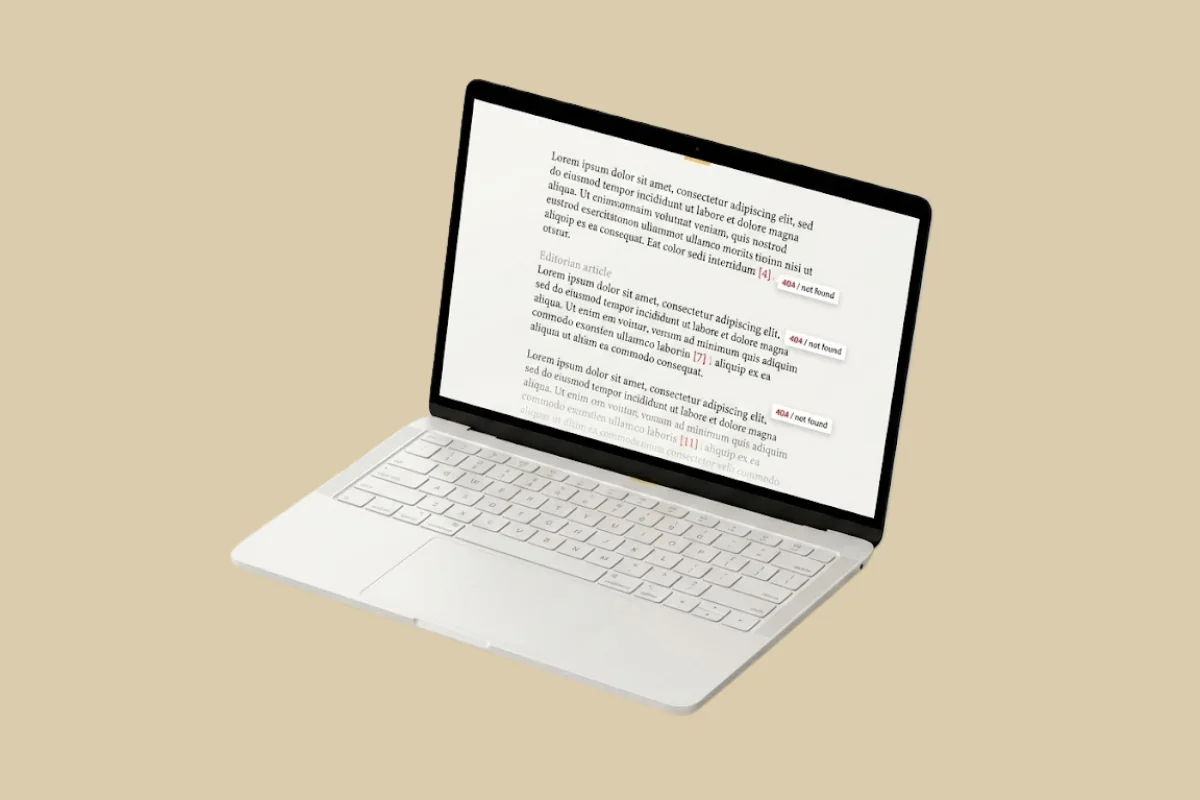
- Reputation: every reader who clicks a dead source link learns that your blog is unreliable. Trust compounds in both directions.
- Defamation risk: an AI confidently quotes a fake person saying something positive about a real company. Or worse, negative about a real competitor. Both are publishable defamation depending on jurisdiction.
- Regulatory: the FTC’s current advertising guidance treats unsupported scientific or medical claims as deceptive trade practice — full stop. You don’t get to point at the AI and say it made the citation up. You published it.
- Penalty in search: Google’s August 2025 helpful-content update is now decidedly punishing the “scaled content abuse” pattern. Sites that publish AI content at volume without an obvious editorial signal are losing significant organic traffic in single-update windows.

So far the rest of the AI content market has responded with a shrug and a tooltip: “AI may produce inaccurate information, please verify before publishing.” That’s the equivalent of a knife company shipping every blade with a note: “Sharp. Cut at your own risk.”
What “verification” actually has to mean
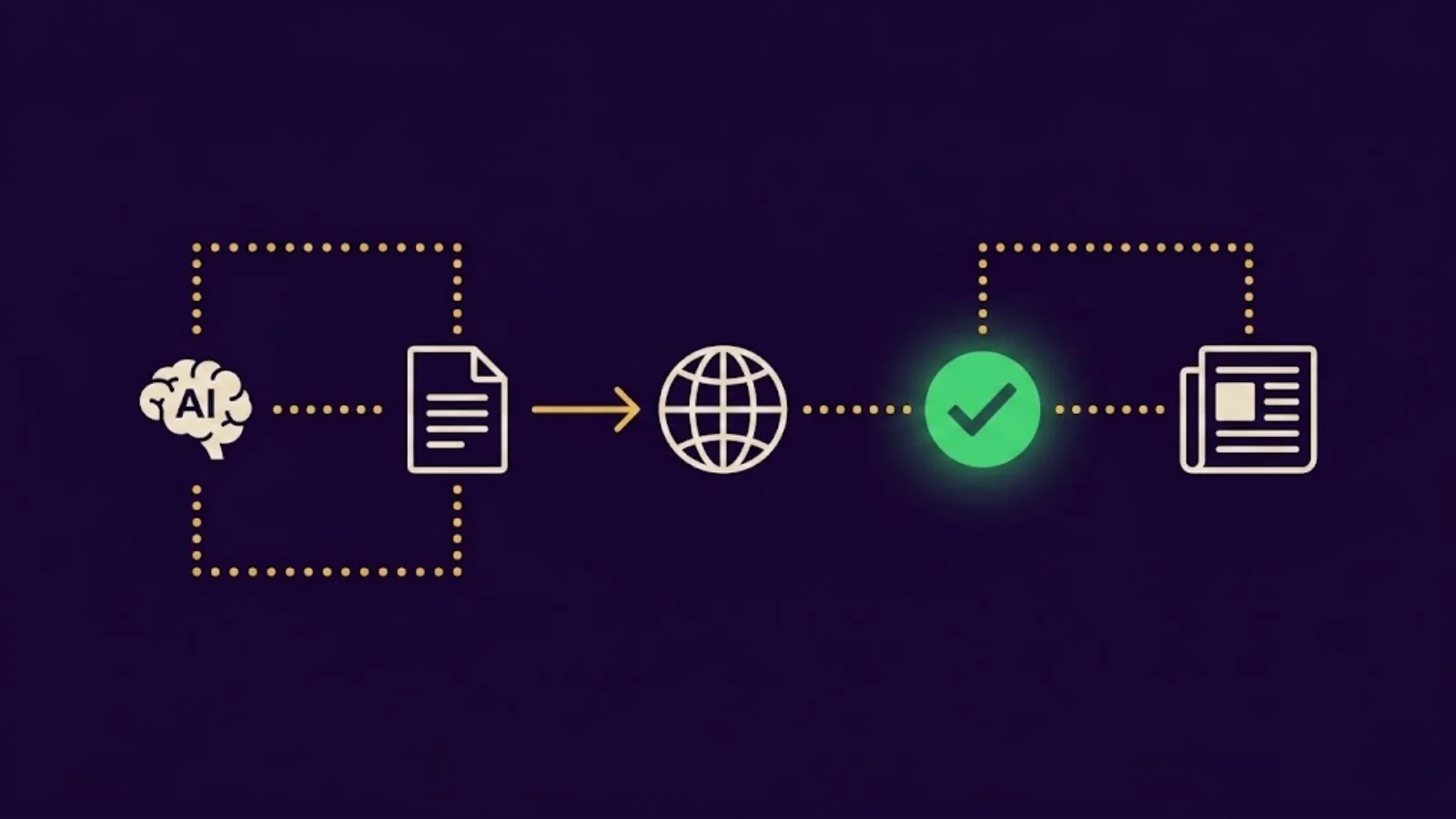
The defence everyone wants is also the defence almost no one is shipping: at the moment a citation is generated, the system reaches out to the actual URL, fetches the page, and confirms two things — the source exists and the page contains text that supports the claim being cited.
That’s the only definition of “verification” that survives a courtroom or a regulator audit. Anything less — confidence scores, “trust signals,” LLM-generated summaries of the source, RAG retrieval without semantic post-check — collapses the moment someone presses on it. Stanford’s findings on RAG-grounded legal tools are the most public proof of that collapse.
The architectural cost is non-trivial. You have to:
- Generate the claim and the candidate citation in one structured pass.
- Open the claimed source URL in real time, with appropriate retry and timeout.
- Run a separate semantic check on the fetched content to confirm it supports the claim — not just contains keywords.
- Reject and regenerate when verification fails (which it will, frequently — see the Walters & Wilder rates above).
- Surface the verification result to the human author, with a one-click bypass for cases where the human knows better than the verifier.
This is not the cheapest content workflow. It costs more in tokens because of the regeneration loops. It costs more in latency because every claim becomes a small RAG query plus a separate verification pass. And it pushes against the dominant pricing model in AI content — unlimited articles for $X/month — because the unit cost varies widely with verification depth.
Almost every AI content tool you’ve heard of decided that ratio wasn’t worth it.
What we built differently
ContentSage refuses to ship a citation it can’t verify lives at a real URL right now. That’s not a feature — it’s the architecture choice we made on day one and built the rest of the product around.
Concretely:
- Every fact-bearing sentence in a generated post is mapped to a candidate source.
- The source URL is fetched live during generation — not from a stale embedding, not from the model’s training memory.
- The fetched content is semantically checked against the claim by a separate model run.
- If verification fails, the citation is regenerated up to three times. If it still fails, the claim is rewritten or removed.
- The published post carries a citation verification badge — visible to the reader, linkable to the actual source, and timestamped.

You pay slightly more per long-form post than the unlimited-token competitors charge. In return, the post that arrives in your CMS does not contain a single source that doesn’t actually exist.
You can call this paranoid engineering. We call it the only architecture that makes the rest of the marketing automation defensible.
What you should do this week
- Audit your last 10 AI-written posts. Click every citation. Note the dead-link rate. Note the misattributed-quote rate. This number is your honest baseline brand risk.
- Decide your verification policy. Is it human-in-the-loop on every citation? AI-verified at publish time? Manual spot check at scale? Whatever you choose, document it — your future regulator-defence is the existence of a documented policy, not the per-post outcome.
- Update your in-house brand guidelines to require source-link verification before any AI post goes live. Cheaper than a settlement.
- Track the legal cases. Damien Charlotin’s database is a free, ongoing reality check. The marketing-side analogue will arrive within 12 months — there’s no reason brands will be the exception when the same models are causing the same fictions.
The cost of a fabricated citation in a blog post is currently low. It will not stay that way.
Sources
- Walters, W. H., & Wilder, E. I. (2023). Fabrication and errors in the bibliographic citations generated by ChatGPT. Scientific Reports (Nature), 13.
- Linardon, J., Jarman, H. K., McClure, Z., Anderson, C., Liu, C., & Messer, M. (2025). Influence of Topic Familiarity and Prompt Specificity on Citation Fabrication in Mental Health Research Using Large Language Models: Experimental Study. JMIR Mental Health.
- Xu, et al. (2026). GhostCite: A Large-Scale Analysis of Citation Validity in the Age of Large Language Models. arXiv:2602.06718.
- Dahl, M., Magesh, V., Suzgun, M., & Ho, D. E. (2024). Large Legal Fictions: Profiling Legal Hallucinations in Large Language Models. Journal of Legal Analysis (Oxford).
- Magesh, V., Surani, F., Dahl, M., Suzgun, M., Manning, C., & Ho, D. E. (2024). AI on Trial: Legal Models Hallucinate in 1 out of 6 (or More) Benchmarking Queries. Stanford HAI.
- Charlotin, D. (ongoing). AI Hallucination Cases Database. HEC Paris.
Sources listed above are real, linked, and were live at the time of publication.