
Salesforce for Australian SMBs: Is It Worth the Investment?

You’re looking at Salesforce for your Australian small business, and the pricing makes you pause. The sales rep promises transformation, but the numbers on the proposal don’t include implementation, training, or the consultant fees everyone seems to need. Before you sign that contract, let’s talk honestly about what Salesforce actually costs Australian SMBs—and whether it’s the right choice for your business.
The Real Cost of Salesforce for Australian SMBs
Salesforce pricing starts at what looks reasonable on paper, but the total cost of ownership tells a different story. Here’s what Australian businesses actually pay.
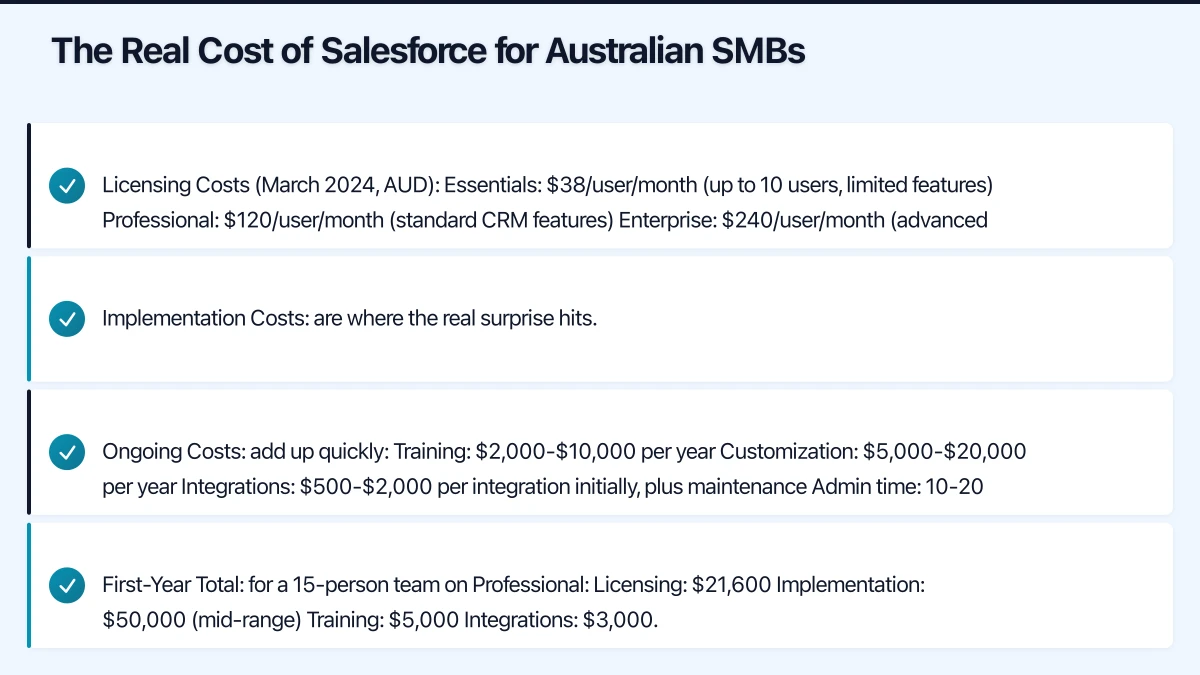
Licensing Costs (March 2024, AUD):
- Essentials: $38/user/month (up to 10 users, limited features)
- Professional: $120/user/month (standard CRM features)
- Enterprise: $240/user/month (advanced customization)
- Unlimited: $480/user/month (full platform access)
For a typical 15-person sales team on the Professional plan, that’s $21,600 per year in licensing alone. But that’s just the beginning.
Implementation Costs are where the real surprise hits. Salesforce partners in Australia typically charge:
- Basic setup (Professional edition): $15,000-$30,000
- Custom implementation (Enterprise edition): $50,000-$150,000
- Complex integration: $100,000-$300,000+
A Melbourne manufacturing company I worked with recently spent $85,000 on implementation for a $36,000 annual license. Their consultant explained this was “fairly standard” for Salesforce.
Ongoing Costs add up quickly:
- Training: $2,000-$10,000 per year
- Customization: $5,000-$20,000 per year
- Integrations: $500-$2,000 per integration initially, plus maintenance
- Admin time: 10-20 hours per week for basic maintenance
- Consultant retainer: $2,000-$5,000 per month (common for SMBs without dedicated admins)
First-Year Total for a 15-person team on Professional:
- Licensing: $21,600
- Implementation: $50,000 (mid-range)
- Training: $5,000
- Integrations: $3,000
- Total: $79,600
That’s significantly more than the $21,600 advertised, and subsequent years still include licensing, training, customization, and consultant costs. For many Australian SMBs, this represents a substantial technology investment.
What You Actually Get with Salesforce
Let’s be clear about what makes Salesforce powerful—and what it doesn’t do out of the box.
Strengths:
- Comprehensive CRM platform: Lead management, opportunity tracking, contact management, and sales pipeline visibility in one system
- Customization capability: Can adapt to complex sales processes and unique business requirements
- AppExchange ecosystem: 5,000+ third-party apps for extending functionality
- Automation: Workflow rules and process automation for reducing manual tasks
- Reporting: Robust analytics and customizable dashboards
- Mobile access: Full-featured mobile apps for field sales teams
- Scale: Grows with your business from 10 to 10,000 users
Limitations for SMBs:
- Complexity: Steep learning curve for non-technical users
- Customization required: Out-of-the-box setup rarely meets specific business needs
- Admin burden: Requires dedicated Salesforce admin skills (not just general IT knowledge)
- Integration challenges: Connecting to accounting systems, marketing tools, and other platforms often requires paid middleware or custom development
- Over-engineering: Many features Australian SMBs never use
A Sydney professional services firm told me they use about 30% of Salesforce’s features after 18 months. The rest sits unused while they continue paying for Enterprise licenses their consultant recommended.
When Salesforce Makes Sense for Australian SMBs
Salesforce isn’t always the wrong choice. It makes sense in specific situations:
You should consider Salesforce if:
- You have complex sales processes that simpler CRMs can’t handle (long sales cycles, multiple approvals, intricate quoting)
- Your team is already growing past 20-30 people and you need enterprise-grade scalability
- You require extensive customization specific to your industry that existing solutions don’t offer
- You’re in a regulated industry (financial services, healthcare) where Salesforce’s compliance features justify the cost
- You have dedicated budget for both implementation and ongoing customization
- You can commit resources to proper training and change management
- Your business has growth plans that will scale into Salesforce’s strengths within 2-3 years
Example: A Brisbane financial services company with 35 advisors needed to track complex client relationships across multiple service lines, integrate with Australian regulatory reporting systems (ASIC), and provide detailed audit trails. Salesforce Financial Services Cloud, despite the $180,000 first-year cost, made sense because no alternative offered their compliance requirements.
You should probably look elsewhere if:
- Your sales process is straightforward (mostly transactional sales)
- You’re a small team (under 15 people) with limited IT resources
- Your budget is tight and you need ROI within 6-12 months
- You need quick implementation without extensive customization
- Your team prefers simple, intuitive tools over powerful but complex platforms
Salesforce Alternatives for Australian SMBs
Several excellent alternatives serve Australian small businesses better than Salesforce in many scenarios.
HubSpot CRM (Free - $1,350/month AUD):
- Best for: Small to medium teams wanting integrated marketing and sales
- Strengths: Free tier genuinely useful, intuitive interface, good Australian support
- Limitations: Less customizable than Salesforce, can get expensive as you add features
- Sweet spot: 5-50 person companies with straightforward sales processes
Pipedrive ($19-$129/user/month AUD):
- Best for: Sales-focused teams wanting simplicity
- Strengths: Extremely intuitive, fast setup (days not months), mobile-first
- Limitations: Basic reporting, limited customization
- Sweet spot: Sales teams of 5-30 people who prioritize usability
Zoho CRM ($23-$75/user/month AUD):
- Best for: Budget-conscious SMBs needing good features
- Strengths: Strong feature set at lower cost, decent customization
- Limitations: Less polished interface, smaller Australian partner ecosystem
- Sweet spot: Cost-sensitive businesses needing solid CRM without premium pricing
Microsoft Dynamics 365 ($95-$240/user/month AUD):
- Best for: Australian businesses already using Microsoft 365
- Strengths: Excellent Microsoft integration, familiar interface, growing in Australia
- Limitations: Still requires implementation investment, smaller app ecosystem than Salesforce
- Sweet spot: Microsoft-centric businesses needing CRM that works seamlessly with Outlook, Teams, and SharePoint
Australian-Specific Consideration: Several Australian CRM providers like Firmwater and local Zoho partners offer better local support and understand Australian business practices, compliance requirements, and integration with local accounting systems (Xero, MYOB).
ROI Timeline: When Does Salesforce Pay Off?
Let’s look at realistic ROI expectations for Australian SMBs implementing Salesforce.
Year 1: Negative ROI for most SMBs. You’re investing heavily in implementation and training while your team adjusts to new processes. Expect productivity dips during transition.
Year 2: Break-even or modest positive ROI. If implementation went well and your team adopted the system, you start seeing benefits:
- Improved sales visibility reduces lost opportunities (5-10% revenue impact)
- Better forecasting enables improved inventory and resource planning
- Automated workflows save 5-10 hours per week across the team
Year 3+: Positive ROI if you’re in the right scenario. Salesforce’s value grows as:
- Your team becomes proficient with the platform
- Customizations mature and align with your processes
- Scale benefits emerge as you add users
Example ROI Calculation for a 15-person team generating $5M annual revenue:
Investment:
- Year 1: $79,600 (implementation + licensing)
- Year 2-3: $30,000/year (licensing + maintenance)
Expected Benefits:
- Revenue improvement: 7% (better pipeline management) = $350,000 additional revenue
- Gross margin: 30% = $105,000 additional profit
- Efficiency gains: 8 hours/week saved × 15 people × $50/hour × 50 weeks = $300,000 value
ROI: Positive by Year 2, but requires achieving those benefit targets. Many SMBs don’t because of poor adoption or over-scoped implementation.
Making Your Salesforce Decision
Here’s a practical framework for Australian SMBs evaluating Salesforce:
Step 1: Assess Your Needs
- Document your current sales process in detail
- Identify specific problems you need to solve
- Determine must-have vs. nice-to-have features
- Calculate your realistic budget (3x the licensing cost for first year)
Step 2: Evaluate Alternatives
- Try free tiers of HubSpot, Zoho, and Pipedrive first
- Can they solve 80% of your needs at 30% of the cost?
- Talk to other Australian SMBs in your industry about their CRM choices
Step 3: If Considering Salesforce
- Get implementation quotes from 3 Australian Salesforce partners
- Ask for references from similar-sized Australian businesses
- Request a detailed implementation timeline and what’s included
- Understand ongoing costs beyond licensing (admin time, consultants, training)
- Calculate break-even point based on realistic adoption assumptions
Step 4: Factor in Change Management
- How tech-savvy is your team?
- Do you have internal champions to drive adoption?
- Can you commit time for proper training?
- What’s your backup plan if adoption fails?
Step 5: Start Small or Elsewhere
- Consider starting with a simpler CRM and migrating to Salesforce later if needed
- Most CRMs export data reasonably well for future migrations
- Growing into Salesforce is less risky than over-investing early
Australian-Specific Considerations
Several factors matter specifically for Australian businesses evaluating Salesforce:
Data Sovereignty: Salesforce offers Australian data residency through their Sydney data center. This matters for Privacy Act compliance and some industry regulations. Ensure your contract specifies Australian data storage if this concerns your business.
Local Support: Salesforce has a significant Australian presence, but most implementation and support comes through partner ecosystem. Verify your implementation partner has local staff, not offshore teams unfamiliar with Australian business practices.
Integration with Australian Systems: Connecting Salesforce to Xero, MYOB, or local industry-specific software often requires paid middleware (Zapier, Workato) or custom development. Budget $2,000-$10,000 for Australian-specific integrations.
Australian Partner Quality: Salesforce partner quality varies significantly. Look for partners with Australian business references, not just technical certifications. Ask detailed questions about their implementation methodology and support model.
Financial Year Alignment: Salesforce contracts are typically annual. Try to align your contract start date with your financial year to simplify budgeting and avoid mid-year surprises.
The Honest Answer
Is Salesforce worth it for Australian SMBs? It depends on where you are and where you’re going.
Salesforce is likely worth it if you’re a growing business (20+ people) with complex sales processes, budget for proper implementation, commitment to change management, and plans to scale significantly over the next 3-5 years. In these scenarios, Salesforce’s power and scalability justify the investment.
Salesforce is probably not worth it if you’re a small team (under 15 people) with straightforward sales, limited IT resources, tight budget, or need for quick implementation. You’ll likely get better ROI from simpler alternatives like HubSpot, Pipedrive, or Zoho.
The mistake most Australian SMBs make isn’t choosing Salesforce—it’s choosing Salesforce for the wrong reasons (competitor has it, sales rep was convincing, assumed they’d “grow into it”) without honestly assessing fit, budget, and commitment required.
Start with your needs, not the platform. If Salesforce genuinely addresses problems costing your business more than $100,000+ annually in lost revenue or inefficiency, investigate further. If you’re looking for “a CRM,” start simpler.
Your CRM decision shapes how your team works for years. Choose based on where your business is today, not where you hope to be someday.
Need help evaluating CRM options for your Australian business? Contact our team for an objective assessment based on your specific needs and budget.
Need mobile access to your cloud systems? Our app development team at Awesome Apps builds iOS and Android apps for Australian businesses.
Ganda Tech Services brings together cloud infrastructure, web development, and mobile app expertise to help Australian businesses thrive in the digital economy.