
Managed Detection and Response Services for Australian SMBs
Managed Detection and Response Services for Australian SMBs
The cybersecurity landscape for Australian businesses has shifted dramatically. The Optus breach affecting nearly 10 million Australians, the Medibank attack exposing sensitive health data, and a string of smaller incidents throughout 2022 have made one thing clear: no business is too small to be targeted.
For Australian SMBs, the challenge is not whether to invest in cybersecurity but how to do so effectively with limited budgets and personnel. You cannot hire a full security operations centre (SOC) team. You cannot monitor threats 24/7 with a single IT person. And you cannot afford to wait until a breach occurs to take action.
This is where Managed Detection and Response (MDR) services come in. MDR provides outsourced cybersecurity monitoring, detection, and response capabilities that would otherwise require a team of six to ten specialists to deliver in-house.
What Is MDR?
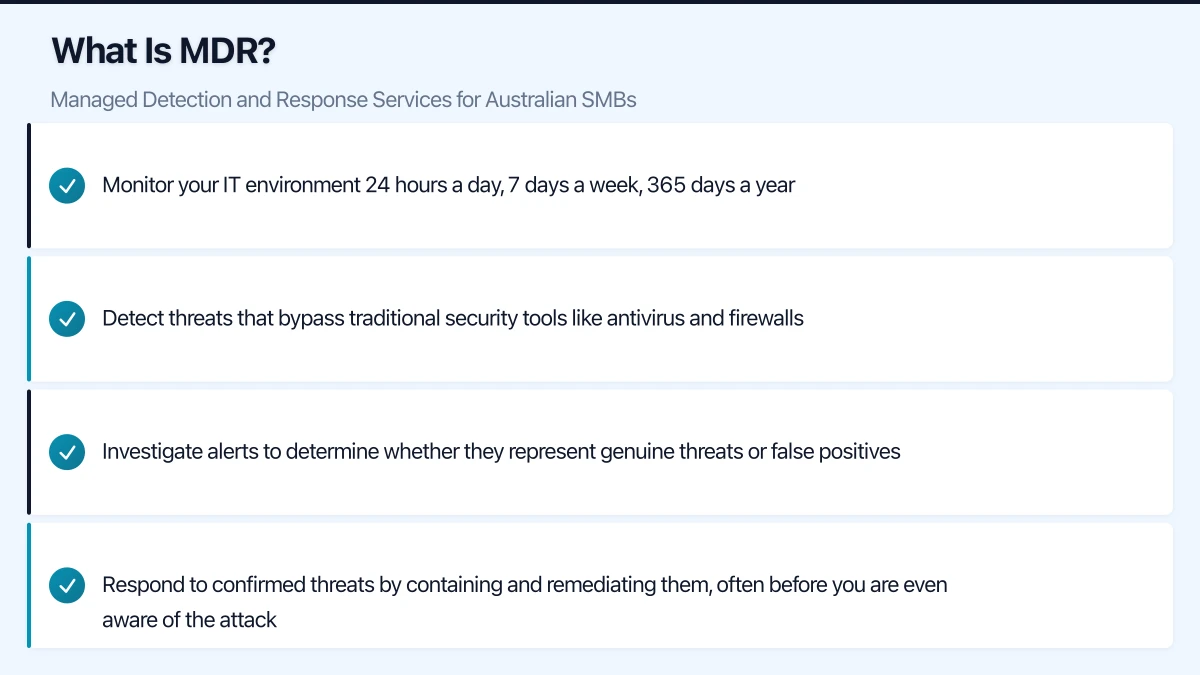
Managed Detection and Response is a cybersecurity service that combines technology, people, and processes to:
- Monitor your IT environment 24 hours a day, 7 days a week, 365 days a year
- Detect threats that bypass traditional security tools like antivirus and firewalls
- Investigate alerts to determine whether they represent genuine threats or false positives
- Respond to confirmed threats by containing and remediating them, often before you are even aware of the attack
MDR goes beyond traditional managed security services (MSS) by actively investigating and responding to threats rather than simply forwarding alerts to your IT team.
Why Australian SMBs Need MDR
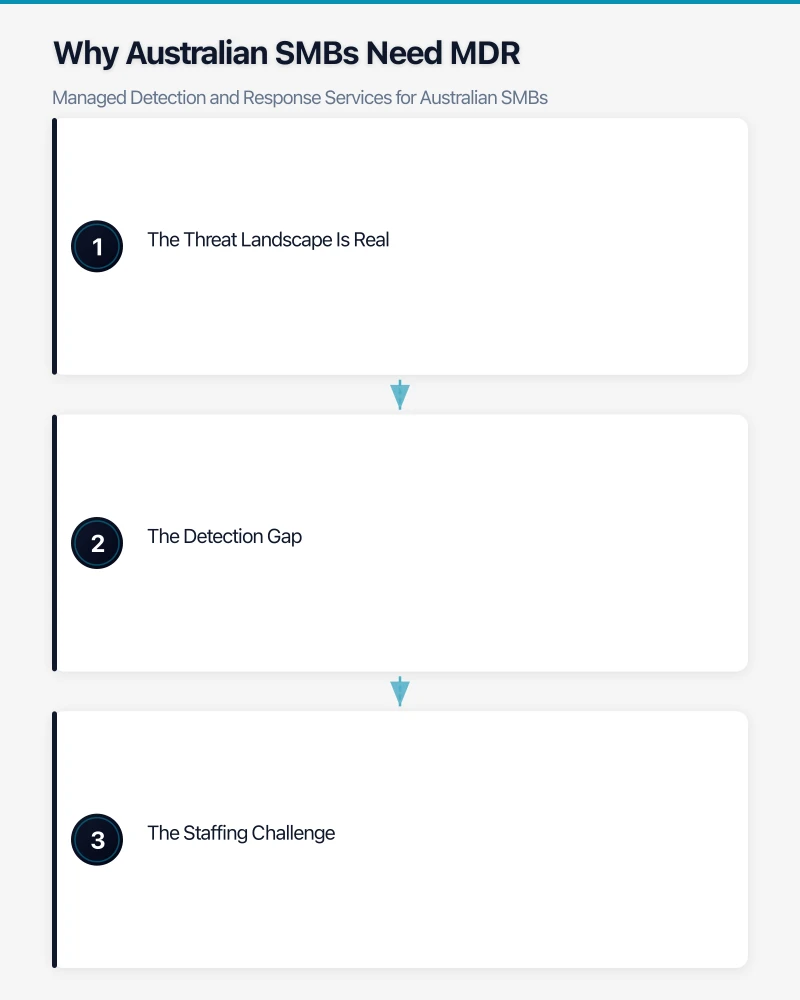
The Threat Landscape Is Real
The ACSC’s Annual Cyber Threat Report for 2021-2022 reported over 76,000 cybercrime reports, up nearly 13 percent from the previous year. The average cost of cybercrime per report was over AUD 39,000 for small businesses.
Common threats targeting Australian SMBs include:
- Ransomware: Encrypts your data and demands payment for the decryption key. Ransomware groups increasingly target SMBs because they are more likely to pay.
- Business Email Compromise (BEC): Attackers impersonate executives or suppliers to trick employees into transferring funds or sharing sensitive data.
- Credential theft: Stolen usernames and passwords used to access cloud services, particularly Microsoft 365.
- Supply chain attacks: Compromising a software vendor or service provider to gain access to their customers.
The Detection Gap
Traditional security tools (antivirus, firewalls, email filters) are necessary but insufficient. They block known threats but struggle with:
- Novel malware and zero-day exploits
- Sophisticated phishing that passes email filters
- Attackers using legitimate tools and credentials
- Insider threats
- Multi-stage attacks that unfold over days or weeks
MDR fills this gap by having human analysts actively hunting for suspicious behaviour, not just waiting for automated alerts.
The Staffing Challenge
Building an in-house security operations capability requires:
- Security analysts (at least two for basic coverage, six or more for 24/7)
- Security information and event management (SIEM) platform
- Endpoint detection and response (EDR) tools
- Threat intelligence feeds
- Incident response procedures and playbooks
- Ongoing training and skill development
For an Australian SMB, the annual cost of even a basic in-house SOC would exceed AUD 500,000 in salaries alone. MDR services deliver comparable capabilities for a fraction of that cost.
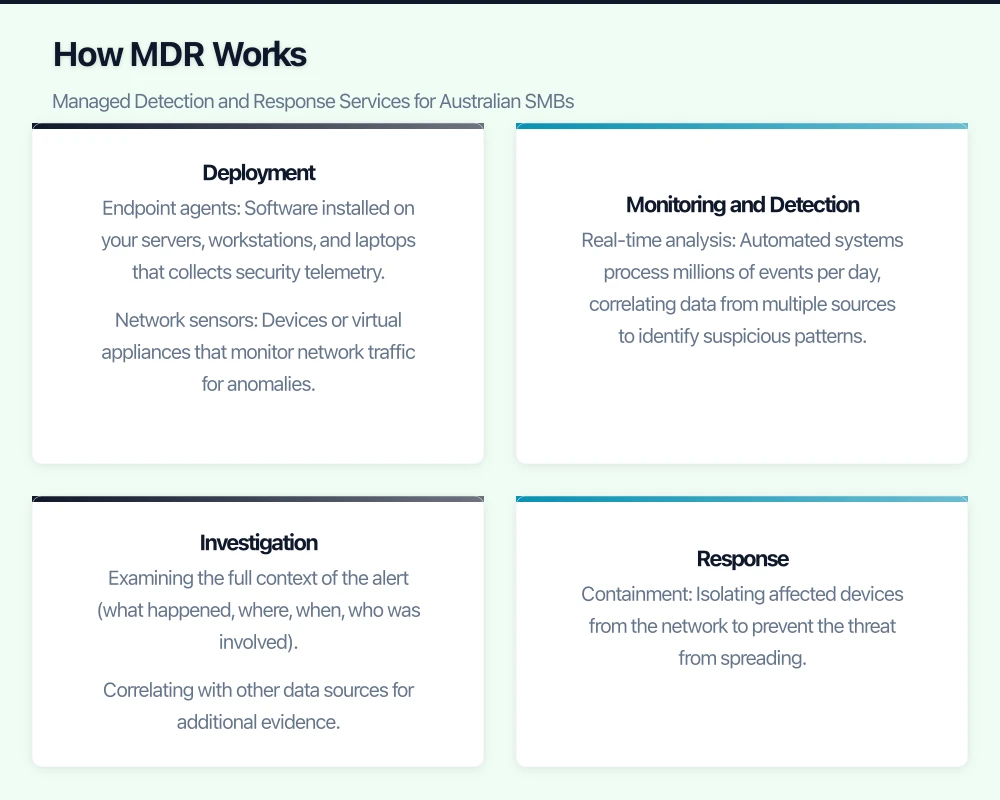
How MDR Works
Deployment
MDR providers deploy their technology into your environment, typically including:
- Endpoint agents: Software installed on your servers, workstations, and laptops that collects security telemetry.
- Network sensors: Devices or virtual appliances that monitor network traffic for anomalies.
- Cloud connectors: Integrations with Microsoft 365, Azure AD, and other cloud platforms to monitor cloud activity.
- Log collection: Aggregation of logs from firewalls, servers, and applications for analysis.
Deployment is typically non-disruptive and can be completed within days to weeks depending on the size of your environment.
Monitoring and Detection
Once deployed, the MDR provider’s security operations centre monitors your environment continuously:
- Real-time analysis: Automated systems process millions of events per day, correlating data from multiple sources to identify suspicious patterns.
- Threat intelligence: Known indicators of compromise (malicious IP addresses, file hashes, domain names) are cross-referenced against your traffic and activity.
- Behavioural analytics: Machine learning models establish baselines of normal activity and flag deviations.
- Human analysis: When automated systems flag a potential threat, experienced security analysts investigate to determine whether it is genuine.
Investigation
Not every alert is a real threat. MDR analysts triage and investigate alerts to separate genuine threats from false positives. This investigation process involves:
- Examining the full context of the alert (what happened, where, when, who was involved)
- Correlating with other data sources for additional evidence
- Determining the severity and potential impact
- Documenting findings and evidence
This is where human expertise is critical. Automated tools generate noise. Skilled analysts determine what matters.
Response
When a genuine threat is confirmed, MDR providers take action:
- Containment: Isolating affected devices from the network to prevent the threat from spreading.
- Remediation: Removing malware, blocking malicious processes, and restoring affected systems.
- Communication: Alerting your IT team or management about the incident with clear recommendations.
- Documentation: Providing a detailed incident report for compliance and improvement purposes.
The level of response varies by provider. Some MDR services are “detect and notify,” meaning they alert you but expect your team to act. Others are “detect and respond,” meaning they take containment and remediation actions on your behalf. For SMBs without dedicated security staff, the latter is far more valuable.
Choosing an MDR Provider for Australian Business
Key Evaluation Criteria
Response capability: Does the provider take active response actions, or do they just send alerts? For SMBs, you want a provider that can contain threats on your behalf.
24/7 coverage: Threats do not wait for business hours. Ensure the provider offers genuine around-the-clock monitoring with human analysts, not just automated alerts outside hours.
Australian context: Does the provider understand Australian compliance requirements (Privacy Act, NDB scheme, ACSC Essential Eight)? Do they have analysts in Australian time zones?
Technology platform: What EDR and SIEM technology does the provider use? Leading platforms include CrowdStrike, SentinelOne, Microsoft Defender for Endpoint, and Carbon Black. The technology should cover your operating systems and cloud platforms.
Integration with your environment: Can the provider monitor your Microsoft 365 tenant, Azure infrastructure, and on-premises systems?
Reporting: Does the provider deliver regular reports on threats detected, incidents handled, and security posture?
Incident support: If a major incident occurs, does the provider offer full incident response support, or are you on your own once they detect the threat?
Pricing
MDR pricing for Australian SMBs typically falls into these ranges:
- Per endpoint per month: AUD 15 to 50 per endpoint (workstation, server, or device)
- Per user per month: AUD 20 to 60 per user (covering all their devices)
- Flat monthly fee: Some providers offer packages for small businesses starting at AUD 2,000 to 5,000 per month
For a 30-person business with 40 endpoints, expect to pay approximately AUD 1,500 to 4,000 per month for a quality MDR service.
This is a significant investment, but compare it to:
- The average cost of a cybercrime incident for small businesses (over AUD 39,000)
- The cost of a ransomware attack (often AUD 100,000 or more including downtime and recovery)
- The reputational and regulatory impact of a data breach
Leading MDR Providers in the Australian Market
Several MDR providers serve the Australian SMB market:
- CrowdStrike Falcon Complete: Premium MDR built on the CrowdStrike platform. Strong detection and response capabilities.
- Arctic Wolf: Purpose-built MDR platform with 24/7 monitoring and concierge security team.
- Huntress: Focused on SMBs, particularly those served by managed service providers. Strong value proposition for smaller businesses.
- Microsoft Defender for Business with MDR: Microsoft’s endpoint protection with optional managed response capabilities. Good integration with the Microsoft ecosystem.
- Local Australian MSSPs: Several Australian managed security service providers offer MDR capabilities. Engaging a local provider can offer advantages in understanding Australian regulations and time zones.
MDR vs Other Security Services
MDR vs Managed Firewall
A managed firewall service monitors and maintains your firewall. It protects the perimeter but does not monitor endpoints, cloud services, or user behaviour. MDR provides deeper, broader visibility.
MDR vs Antivirus
Antivirus blocks known malware using signature-based detection. MDR uses behavioural analysis, threat intelligence, and human investigation to detect threats that antivirus misses. MDR typically includes EDR technology that subsumes traditional antivirus.
MDR vs SIEM
A Security Information and Event Management (SIEM) platform collects and correlates log data. It is a technology tool that still requires skilled analysts to operate. MDR provides the technology and the analysts as a service.
MDR vs In-House SOC
An in-house SOC provides the same capabilities as MDR but with dedicated internal staff. For most Australian SMBs, the cost of an in-house SOC (AUD 500,000 or more per year) far exceeds the cost of MDR.
Getting Started with MDR
Preparation
Before engaging an MDR provider:
- Inventory your environment: Know how many endpoints, servers, and cloud services you have. This determines pricing.
- Understand your current security posture: What tools do you already have (antivirus, firewall, Microsoft 365 security features)? MDR builds on this foundation.
- Define your expectations: What response actions should the provider take autonomously? What requires your approval?
- Identify compliance requirements: If you are in a regulated industry, ensure the MDR provider can support your compliance obligations.
Deployment Checklist
- EDR agents deployed on all endpoints
- Network monitoring configured
- Microsoft 365 and cloud platform integrations enabled
- Communication channels established (how will the provider reach you during an incident?)
- Escalation procedures documented
- Baseline period completed (typically 2 to 4 weeks for the provider to learn your environment)
Measuring Value
Track these metrics to assess your MDR provider’s value:
- Number of threats detected and prevented
- Mean time to detect (MTTD) and mean time to respond (MTTR)
- False positive rate (lower is better)
- Compliance support and reporting quality
- Communication quality during incidents
The Bottom Line
For Australian SMBs that cannot justify a full in-house security team, MDR is the most effective way to achieve enterprise-grade threat detection and response. It provides the expertise, technology, and round-the-clock coverage that modern cyber threats demand, at a price point that is accessible for growing businesses.
In a threat landscape where Australian businesses are being targeted with increasing frequency and sophistication, MDR is not a luxury. It is a practical necessity.
Pairing cloud infrastructure with a professional website amplifies your online presence. Cosmos Web Tech builds high-performance sites that make the most of solid hosting foundations.
Cloud Geeks operates under the Ganda Tech Services umbrella, delivering end-to-end technology solutions for Australian businesses.