
IT Security Awareness Training: Building a Human Firewall in Your Australian Business
Introduction
Every Australian business investing in firewalls, endpoint protection, and email filtering faces an uncomfortable truth: the most sophisticated security technology can be bypassed by a single employee clicking the wrong link.
The Australian Cyber Security Centre’s latest reporting shows that business email compromise and phishing remain among the top threats facing Australian organisations. These attacks don’t exploit software vulnerabilities—they exploit human psychology. And no amount of technical spending addresses that risk.
Security awareness training has evolved from annual compliance tick-boxes to ongoing programs designed to genuinely change behaviour. For Australian SMBs, the question isn’t whether to train employees, but how to do it effectively without consuming resources you don’t have.
Why Traditional Training Fails
Before examining what works, let’s understand why many awareness programs deliver disappointing results.
The Annual Slideshow Problem
Many organisations approach security training as an annual event. Employees sit through a presentation, click through some slides, pass a quiz, and promptly forget everything. Research consistently shows this approach produces minimal behaviour change.
Why? Human memory doesn’t work that way. A one-hour session covers too much material, provides no opportunity for practice, and lacks reinforcement. Three months later, employees face a convincing phishing email and their training is a distant memory.
Fear-Based Messaging
“You’ll get hacked!” “Criminals are everywhere!” Fear-based training creates anxiety but rarely changes behaviour. Worse, it can backfire—employees become so fearful of making mistakes that they avoid reporting suspicious activity altogether.
Effective training builds confidence rather than fear. Employees should feel equipped to identify threats, not paralysed by them.
Generic Content
Training that discusses abstract threats without connecting to employees’ actual work feels irrelevant. A payroll officer faces different risks than a sales representative. Generic content gets generic engagement.
Blame Culture
When training focuses on punishing mistakes rather than learning from them, employees hide security incidents rather than reporting them. The goal is a culture where people feel comfortable saying “I clicked something suspicious”—early reporting dramatically reduces incident impact.
Principles of Effective Security Training
Research into adult learning and behaviour change suggests several principles for effective programs.
Frequent, Short Modules
Rather than annual marathons, deliver training in short bursts—5 to 10 minutes maximum—spread throughout the year. This “microlearning” approach aligns with how memory actually works. Regular exposure reinforces concepts better than single intense sessions.
A reasonable cadence for most SMBs: monthly modules covering specific topics, plus immediate response to emerging threats when relevant.
Simulation-Based Learning
You can tell employees about phishing all day, but nothing beats experiencing it safely. Simulated phishing campaigns send realistic-looking suspicious emails to employees. Those who click receive immediate training; those who report correctly receive recognition.
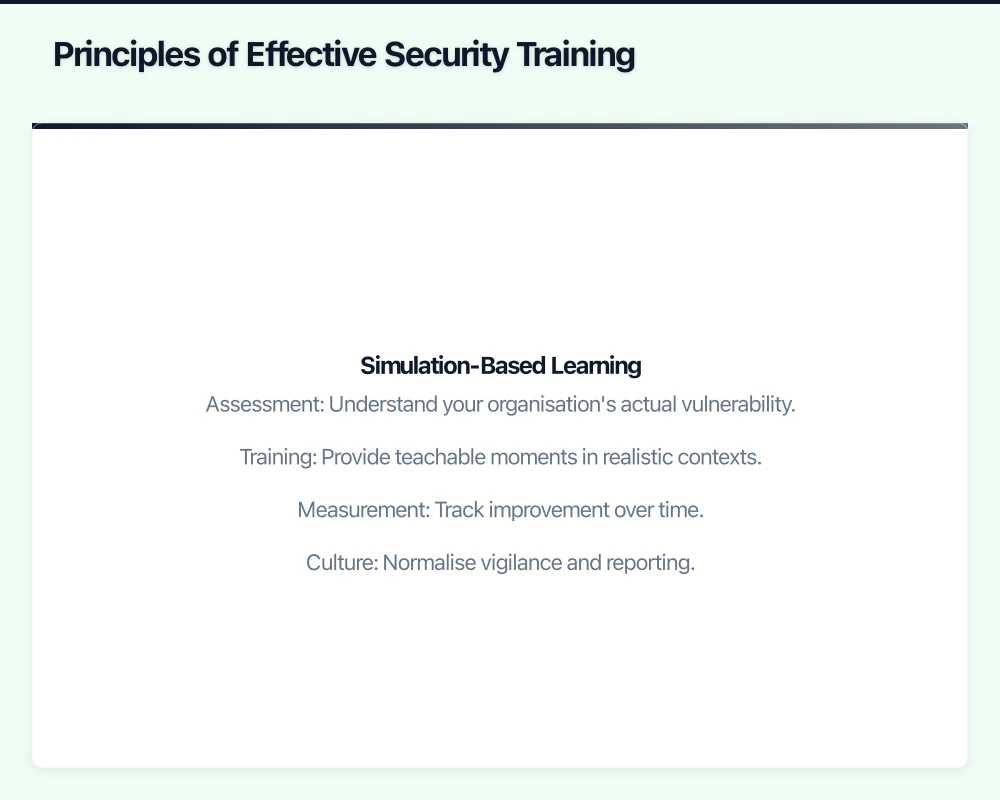
Simulations serve multiple purposes:
- Assessment: Understand your organisation’s actual vulnerability
- Training: Provide teachable moments in realistic contexts
- Measurement: Track improvement over time
- Culture: Normalise vigilance and reporting
Role-Specific Content
Tailor training to actual job functions. Finance staff need emphasis on invoice fraud and business email compromise. Executives require training on targeted attacks (they’re prime targets). Customer-facing staff need guidance on social engineering via phone and chat.
Generic awareness provides a baseline; role-specific modules address elevated risks.
Positive Reinforcement
Recognise employees who report suspicious emails, even if they turn out to be legitimate. You want people erring on the side of caution. Some organisations gamify this with leaderboards, recognition programs, or small rewards.
The psychology matters: reporting threats should feel valued, not burdensome.
Building Your Training Program
For Australian SMBs, here’s a practical approach to implementing effective security awareness.
Step 1: Assess Current State
Before launching training, understand your baseline:
- Simulated phishing test: How many employees click? How many report?
- Knowledge survey: What do staff actually understand about security?
- Incident history: What types of security events have you experienced?
- Policy review: Are current policies clear and accessible?
This assessment shapes your training priorities and provides benchmarks for measuring improvement.
Step 2: Select Core Topics
Essential topics for Australian SMBs include:
Phishing and Email Security
- Identifying suspicious emails
- Verifying sender authenticity
- Safe handling of attachments and links
- Reporting procedures
Password and Authentication
- Strong password creation
- Password manager usage
- Multi-factor authentication
- Avoiding password reuse
Social Engineering
- Phone-based attacks (vishing)
- In-person social engineering
- Pretexting and impersonation
- Verification procedures
Data Handling
- Classification of sensitive information
- Secure sharing practices
- Privacy obligations under Australian law
- Clean desk and screen policies
Remote and Mobile Security
- Public WiFi risks
- Device physical security
- Home network considerations
- BYOD policies
Incident Reporting
- What to report
- How to report
- No-blame culture emphasis
- Early reporting benefits
Step 3: Choose Delivery Method
Australian SMBs have several options for delivering training:
Managed Security Awareness Platforms
Commercial platforms like KnowBe4, Proofpoint Security Awareness, and Mimecast Awareness Training provide:
- Pre-built content libraries
- Phishing simulation tools
- Progress tracking and reporting
- Automated campaign management
Pricing typically runs $20-50 per user annually, making them accessible for most SMBs. These platforms significantly reduce the effort required to run effective programs.
Microsoft 365 Built-In Options
If you’re running Microsoft 365, Attack Simulation Training (available in Defender for Office 365 Plan 2) provides basic phishing simulation capabilities. While less comprehensive than dedicated platforms, it’s included in licenses many SMBs already hold.
Australian-Focused Providers
Several Australian providers offer localised content:
- AUSCERT: Non-profit with Australian-specific awareness resources
- Cyber.gov.au: Free resources from the Australian Cyber Security Centre
- Local MSPs: Many managed service providers include awareness training in their offerings
DIY Approach
Smaller organisations can build basic programs using:
- Free resources from ACSC and Stay Smart Online
- Internal lunch-and-learn sessions
- Email newsletters highlighting current threats
- Manual phishing simulations (more effort but possible)
Step 4: Implement Phishing Simulations
Simulated phishing is the cornerstone of effective awareness. Here’s how to do it well:
Start Baseline Testing Run an initial simulation without prior warning to understand actual vulnerability. Don’t use the results punitively—they’re diagnostic.
Communicate the Program After baseline testing, announce that regular simulations will occur. Transparency about the program (though not timing of specific tests) builds trust.
Vary Difficulty Start with obvious phishing attempts, gradually increasing sophistication. This builds skills progressively rather than creating frustration.
Immediate Feedback When employees click simulated phishing, show them immediately what they missed. This teachable moment is more powerful than abstract training.
Recognise Reporters Celebrate employees who report suspicious emails. Some organisations send thank-you messages; others use recognition programs.
Track Metrics Key metrics include:
- Click rate (percentage who click malicious links)
- Report rate (percentage who report suspicious emails)
- Time to report (faster is better)
- Repeat clickers (identify who needs additional support)
Step 5: Create Supporting Resources
Training works best with ongoing reinforcement:
- Quick reference guides: One-page documents on key topics
- Reporting procedures: Clear, simple process for flagging concerns
- Regular communications: Monthly security tips via email or intranet
- Incident alerts: When real threats emerge, communicate promptly
Step 6: Measure and Improve
Effective programs track progress and adapt:
- Monthly phishing simulation results
- Quarterly training completion rates
- Annual knowledge assessments
- Incident trends over time
Share progress with leadership and staff. Demonstrating improvement reinforces the program’s value.
Addressing Common Objections
IT managers often face pushback when proposing awareness programs.
”We Don’t Have Time”
Modern microlearning platforms require 5-10 minutes monthly per employee. Compare this to the hours or days consumed by a successful phishing attack. Frame training as time investment, not time cost.
”Our Employees Will Resent It”
Positioned correctly, security training demonstrates that you value employees enough to protect them—at work and in their personal lives. Skills learned for work apply at home too.
”It’s the IT Department’s Job”
Technical controls matter, but they can’t stop every attack. When employees understand this, they become partners in security rather than passive beneficiaries.
”We Can’t Afford It”
Basic programs using free ACSC resources cost nothing but time. Commercial platforms at $20-50/user/year are far cheaper than incident response. Many cyber insurance policies now require awareness training—non-compliance may affect coverage.
The Australian Regulatory Context
Australian businesses operate under increasing regulatory expectations for security awareness.
Privacy Act Implications
The Australian Privacy Act requires organisations to take reasonable steps to protect personal information. The Office of the Australian Information Commissioner (OAIC) has indicated that staff training is a component of reasonable security measures.
Industry-Specific Requirements
Certain sectors face explicit training requirements:
- Financial Services: APRA CPS 234 requires security awareness for staff
- Healthcare: Various state regulations address staff security training
- Government Contractors: Often face contractual security requirements
Cyber Insurance
Insurers increasingly ask about security awareness programs during underwriting. Documented training can improve both eligibility and premiums.
Building Long-Term Culture
Training alone doesn’t create security culture—it’s one component of broader organisational change.
Leadership Involvement
When executives visibly participate in training and discuss security, it signals organisational priority. Leaders who exempt themselves from awareness programs undermine the entire effort.
Incident Response Integration
How you respond to security incidents shapes culture. Blame and punishment drive reporting underground. Support and learning create improvement.
Security Champions
Identify security-interested employees in each department. These champions provide peer support, early threat detection, and grassroots culture building.
Regular Communication
Security shouldn’t be invisible until something goes wrong. Regular updates—current threats, near misses, industry news—keep awareness elevated.
Getting Started This Month
If you’re ready to improve security awareness:
- Run a baseline phishing simulation to understand current vulnerability
- Review free ACSC resources at cyber.gov.au
- Evaluate one commercial platform with a free trial
- Draft a 12-month training calendar with monthly topics
- Brief leadership on the program and expected time requirements
Security awareness isn’t a project with an end date—it’s an ongoing practice. But every organisation has to start somewhere. The attacks targeting Australian businesses today won’t wait while you perfect your program.
Start simple, measure progress, and improve continuously. Your employees can become your strongest security asset—with the right training to get them there.
Cloud Geeks helps Australian SMBs implement security awareness programs that actually work. Contact us for a free assessment of your current security posture.
For a strategic perspective on how cloud technology fits into your broader digital transformation, read Ash Ganda’s insights on technology leadership.
Cloud Geeks is the IT infrastructure division of Ganda Tech Services, providing managed cloud and cybersecurity solutions to Australian businesses.