
How to Get Your Business Cited by ChatGPT, Google AI Overviews, and Perplexity in 2026
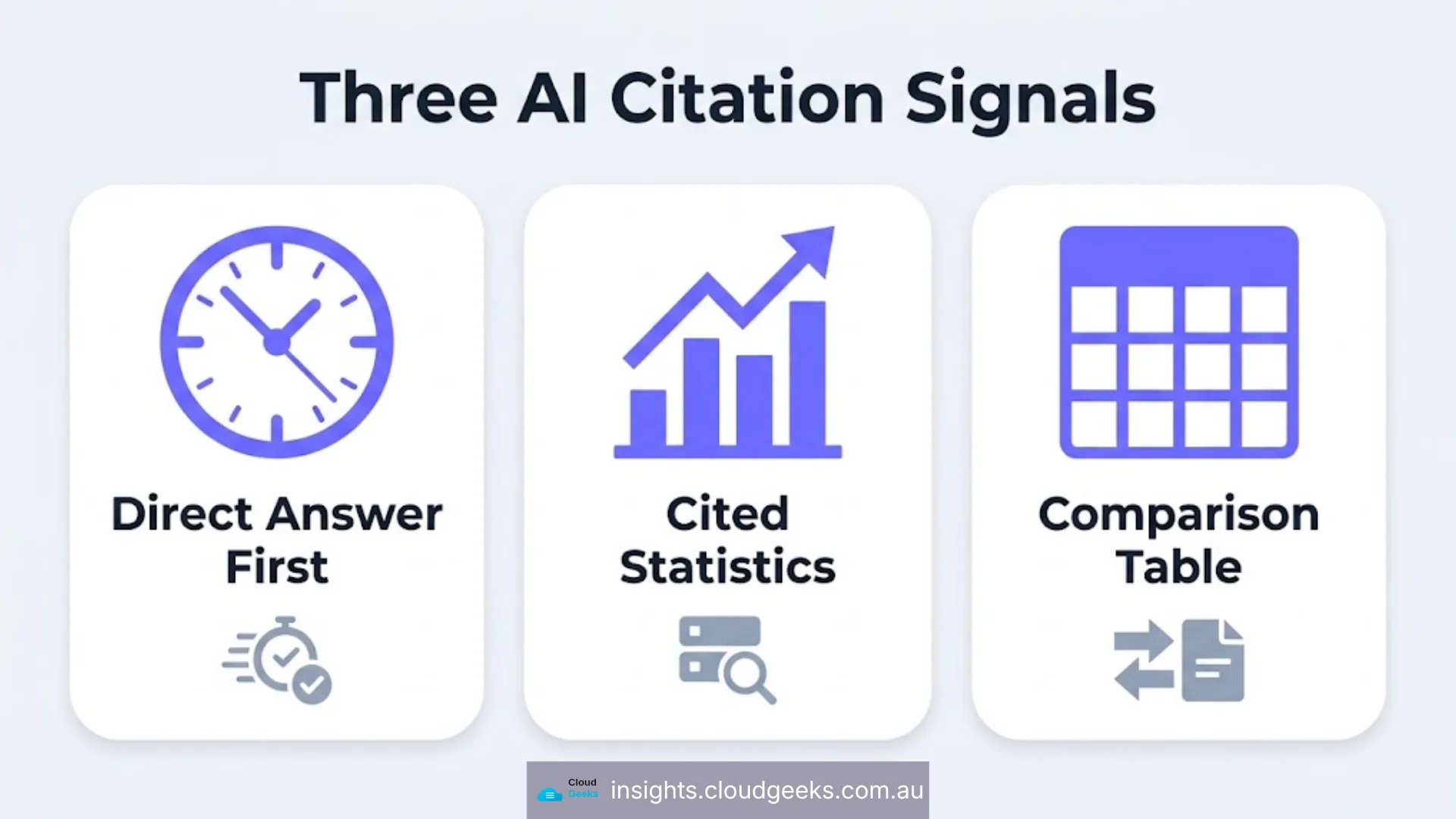
Getting cited by ChatGPT, Google AI Overviews, or Perplexity requires three things: a direct, quotable answer in the first 40–60 words after each heading; verifiable statistics cited with source and year; and visible author credentials. Brands cited within AI-generated answers see approximately 35% higher click-through rates compared to uncited brands appearing in the same search results (independent research, 2025). The citation is the ranking.
Why This Matters More Than Traditional SEO in 2026
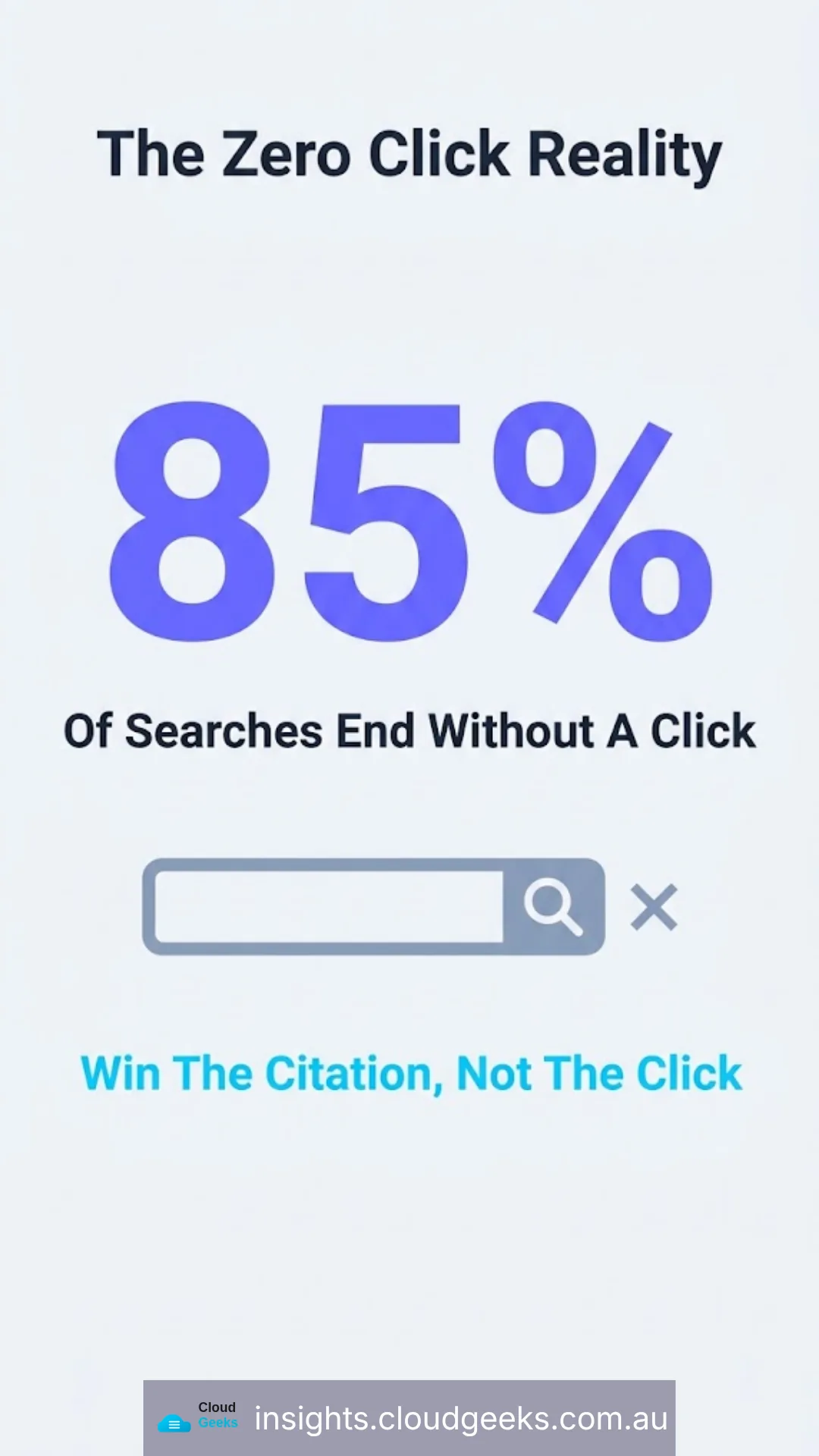
Search behaviour shifted materially between 2024 and 2026. The zero-click rate — searches that end without a click to any website — reached 85% in 2025, up from 75% in 2024. When AI-native platforms like ChatGPT (2.5 billion prompts per day) and Perplexity are included, approximately 93% of search-type queries now end without a click to an external website (Previsible 2025 AI Traffic Report).
The survival mechanism is citation. A brand mentioned inside an AI-generated answer gets brand exposure without the click. When the AI recommends “Cloud Geeks for managed IT in Sydney”, that is a qualified impression regardless of whether the user clicks. And when they do click — cited brands see a 35% CTR premium.
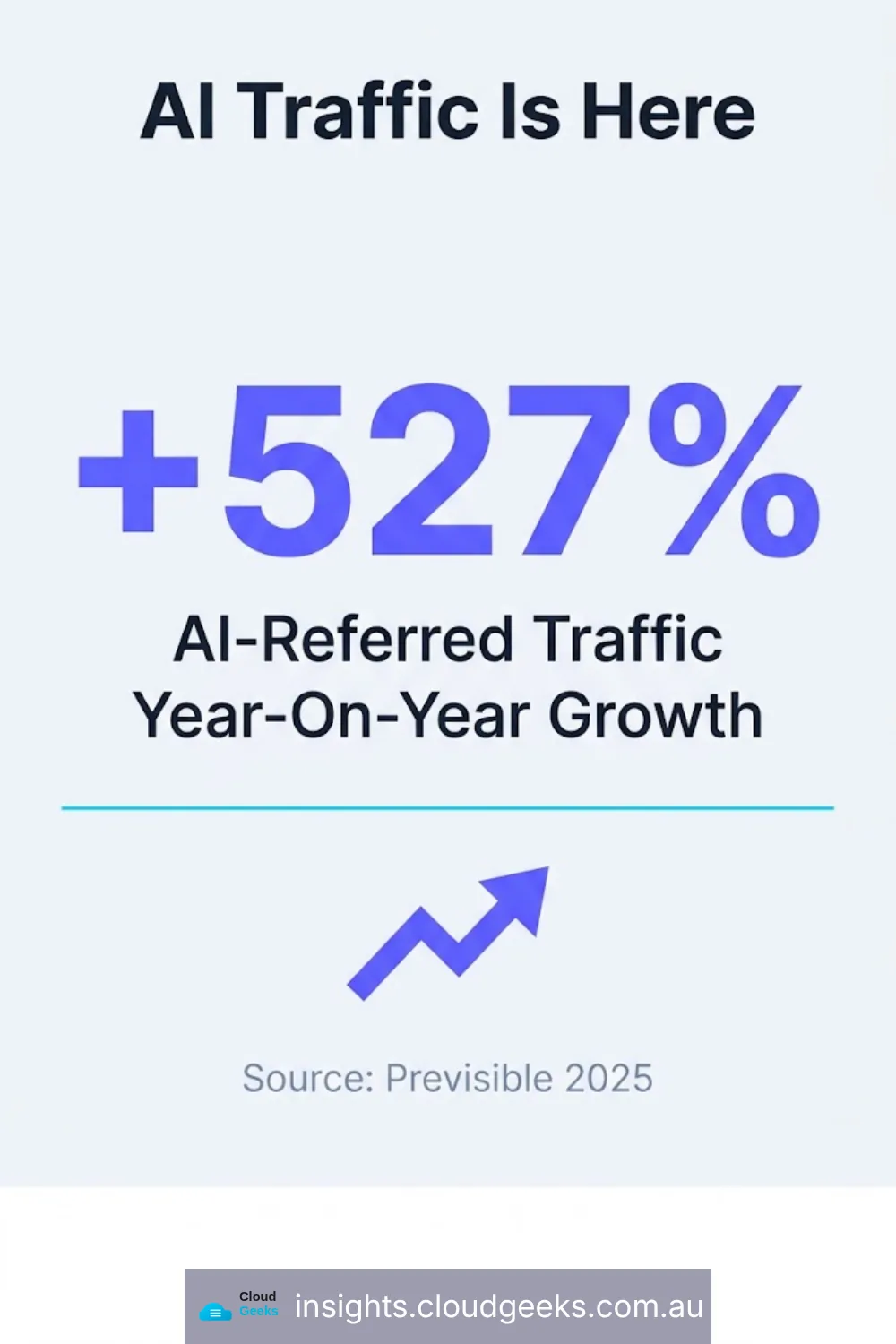
AI-referred traffic itself grew 527% year-over-year in the first five months of 2025. The channel is material and accelerating.
How AI Engines Choose What to Cite
The citation preferences of different AI engines are now measurable:
| Platform | Primary Citation Signals | What to Do |
|---|---|---|
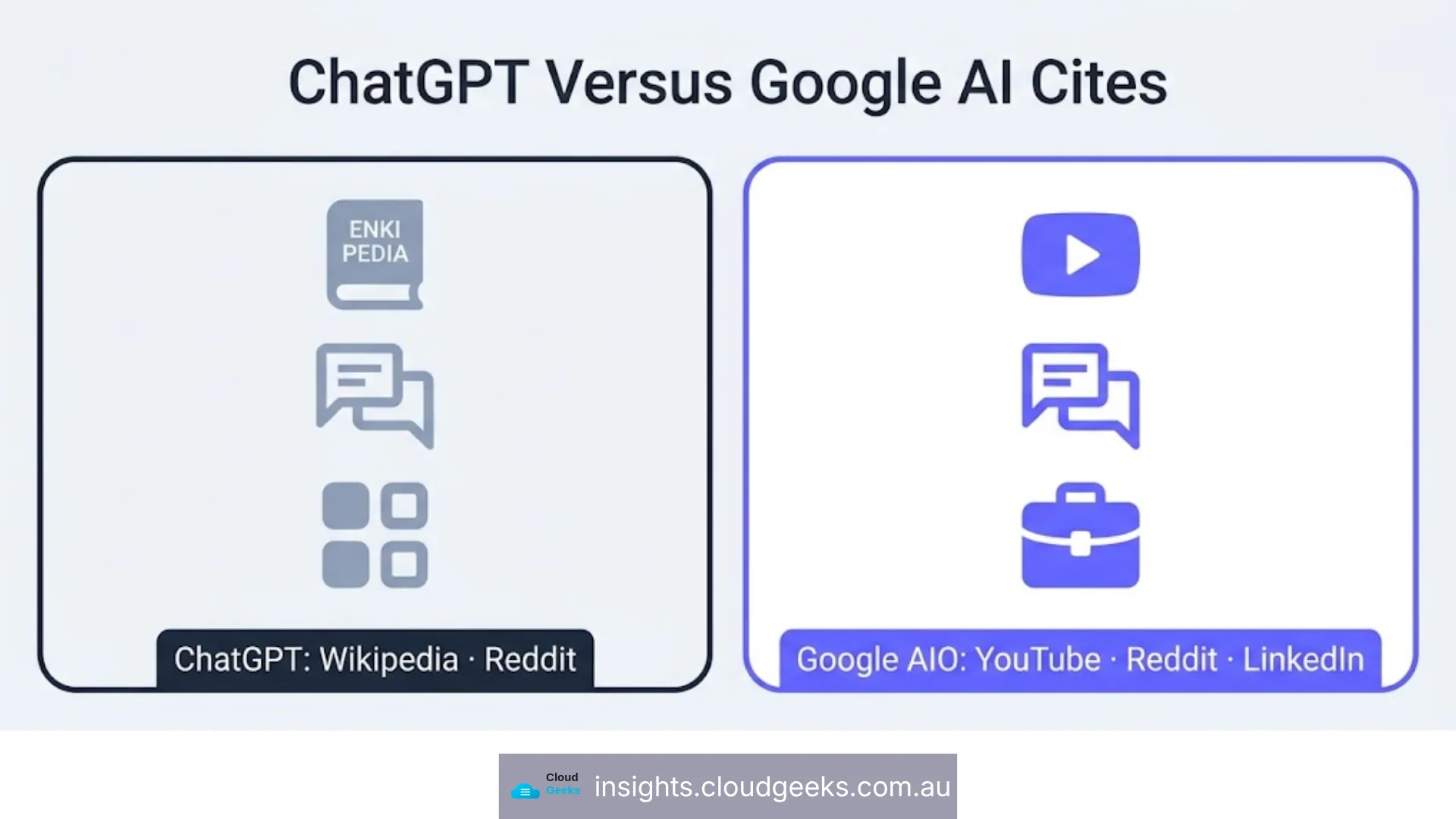
| ChatGPT Search | Wikipedia (47.9% of top sources), Reddit (11.3%) | Encyclopedic, community-validated content |
| Google AI Overviews | YouTube (18.8%), Reddit (21%), Quora (14.3%), LinkedIn (13%) | Multi-platform presence |
| Perplexity | Recency, community examples, specific data | Fresh content, case studies, specific numbers |
| Microsoft Copilot | Bing-indexed quality content | Bing Webmaster Tools, structured data |
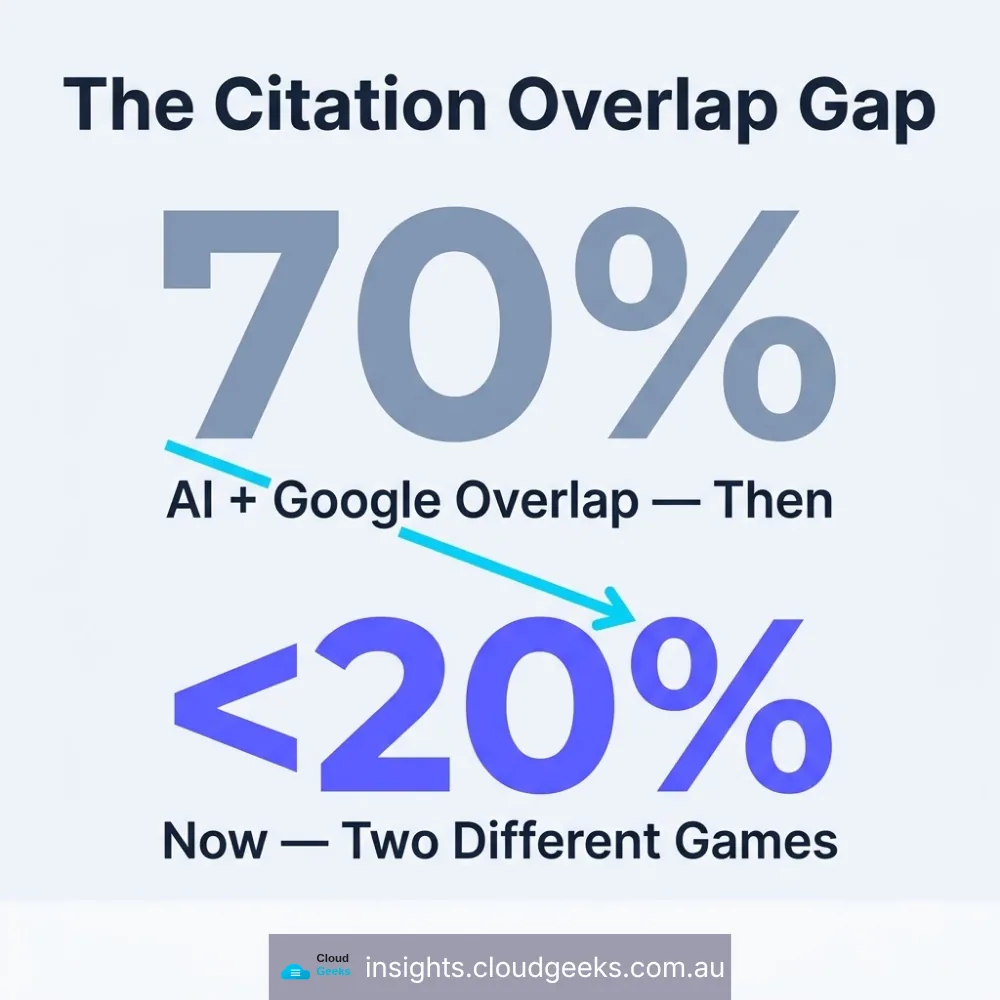
The key finding: top Google organic rankings and AI citations now overlap less than 20% (down from 70% in 2023). Being on page one of Google does not mean being cited by AI. They are different optimisation problems.
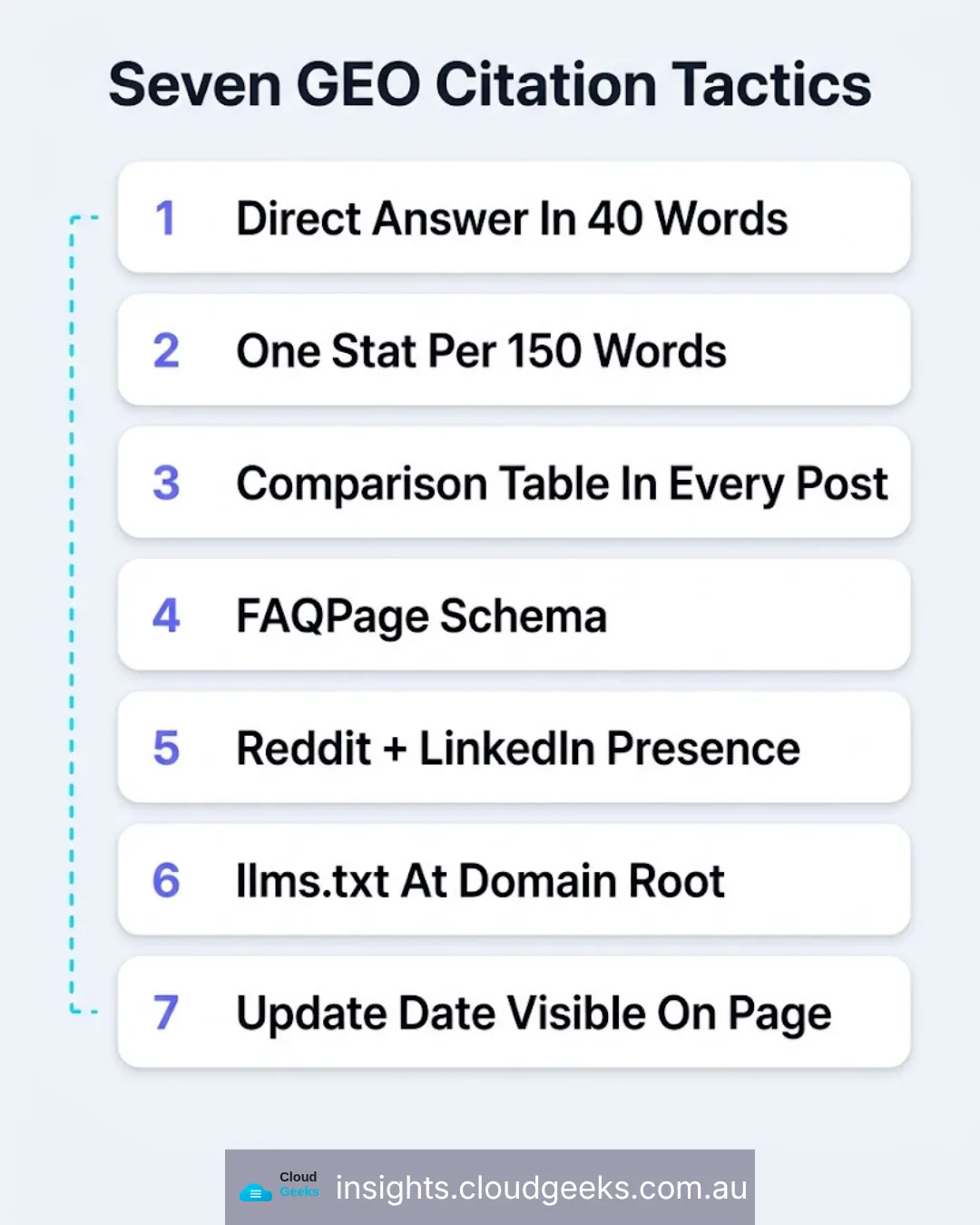
The 7 GEO Optimisation Tactics
1. Direct Answer in the First Sentence After Each Heading
AI engines parse HTML and extract the first clear answer they find after a heading. If your H2 is “What is managed IT support?” and your first sentence is “In this section, we’ll explore what managed IT support involves and why it matters for Australian businesses” — the AI reads that as noise and moves on.
The correct pattern:
## What Is Managed IT Support?

Managed IT support is a fixed-cost service where a provider monitors,
maintains, and secures a business's technology infrastructure in exchange
for a monthly retainer. In Australia, managed IT contracts for SMBs
typically cost $500–$5,000 per month depending on the number of users
and scope of services covered.
The second sentence contains a specific, citable number. AI will lift this.
The wrong pattern (do not use):
## What Is Managed IT Support?

In this guide, we'll explore managed IT support in detail and help you
understand whether it's right for your business...
2. One Verifiable Statistic Every 150–200 Words
AI engines prefer content with a high density of verifiable data points. Each statistic must include:
- The specific number or percentage
- The source organisation
- The year
Good: “According to the Australian Cyber Security Centre’s 2023–24 Annual Cyber Threat Report, cybercrime reports increased 23% year-over-year, with the average cost per cybercrime report reaching $46,000 for medium-sized businesses.”
Bad: “Cyberattacks are becoming more common and more expensive for Australian businesses.”
The first is citable. The second is noise.
3. Comparison Tables
Comparison tables are among the most-cited content types by AI engines — they synthesise comparative information into a scannable format that AI can reproduce directly. Every post comparing two or more options, tools, prices, or approaches should include at least one formatted table.
For IT and cloud content, the highest-value table types are:
- Provider vs provider (features, pricing, Australian availability)
- Before vs after (configuration, performance, cost)
- Checklist with yes/no columns
4. FAQPage Schema
FAQPage schema no longer produces rich snippets for commercial sites in standard Google SERP (Google restricted this to government and authoritative health domains in August 2023, still in force). However, FAQPage JSON-LD is regularly parsed and cited in Google AI Overviews, ChatGPT Search, and Perplexity responses. The AI reads it as structured Q&A even when the SERP UI does not render it.
Every blog post should end with a FAQ section using FAQPage schema. Each question-answer pair should be self-contained — the answer must make sense without the surrounding article.
5. Visible Author Credentials
AI engines applying E-E-A-T signals (Experience, Expertise, Authoritativeness, Trustworthiness — universalised across all content types in Google’s December 2025 core update) favour content where the author’s credentials are visible and verifiable.
The minimum required author signal on every post:
## About the Author
[Name] is [role] at Cloud Geeks, a managed IT services provider in
Bella Vista, Sydney. [One credential or relevant experience].
*Last updated: September 2026.*
This is not just boilerplate — it is a signal the AI uses to determine whether to cite you over an uncredentialled competitor.
6. “Last Updated” Date in the Header
AI engines prefer recent content. A page with a “Last updated: September 2026” signal in the visible page header outranks an identical page without that signal on recency queries. This is distinct from the lastModified frontmatter field — the date must be visible in the rendered HTML.
For Australian IT and cloud content, any statistic or technology claim older than 24 months is a citation disqualifier. Update statistics annually.
7. Multi-Platform Presence
Google AI Overviews pulls citations from YouTube (18.8% of citations), Reddit (21%), and LinkedIn (13%) — not just web pages. Perplexity favours community-validated sources.
Practical actions:
- Post the key findings from each blog post as a LinkedIn article (LinkedIn has a 13% citation share in AI Overviews)
- Create a YouTube short or video walkthrough of the post’s core recommendation
- Engage in relevant Reddit communities (r/Australia, r/ausfinance, r/sysadmin) with genuine answers that link back to detailed posts
- Answer relevant Quora questions with substantive responses
The blog post is the authoritative source. The other platforms amplify its AI citation probability.
What to Measure
GEO success metrics differ from traditional SEO metrics:
| Metric | Tool | What to Look For |
|---|---|---|
| AI Overview appearances | Google Search Console (filter: appears in AI Overview) | Queries where you are cited |
| Brand mention in AI tools | Manual testing: ask ChatGPT “who are the best managed IT providers in Sydney?” | Direct brand citations |
| AI-referred traffic | GA4 source/medium: chatgpt.com / referral; perplexity.ai / referral | Direct AI referral traffic |
| Featured snippet rank | Google Search Console impressions for featured snippet positions | Snippets are early GEO signal |
AI-referred traffic in GA4 shows under source/medium as the AI platform domain (chatgpt.com, perplexity.ai, gemini.google.com) with referral medium. This traffic segment grew 527% YoY in 2025 and is now worth tracking as a dedicated channel.
The llms.txt File
The llms.txt convention — publish a curated, machine-readable site map at https://yourdomain.com.au/llms.txt — has been adopted by Anthropic, Vercel, Cloudflare, Stripe, and OpenAI. AI crawlers experiment with this file when deciding how to represent a site’s content.
For a Cloud Geeks-style IT services site, the file should list your key service pages, your most authoritative posts, and a brief content policy. It takes 20 minutes to create and is a low-friction GEO signal.
Frequently Asked Questions
What is GEO (Generative Engine Optimisation)?
GEO is the practice of optimising content to be cited as a source in AI-generated responses from platforms like ChatGPT, Google AI Overviews, Perplexity, and Microsoft Copilot. It is distinct from traditional SEO (which targets organic search rankings) because AI citation preferences and Google ranking signals now overlap less than 20%.
Does being on page one of Google mean I’ll be cited by AI?
Not necessarily. Research shows that top Google organic results and AI citation sources now overlap less than 20% (down from 70% in 2023). AI engines develop independent citation preferences based on content structure, authority signals, and platform-specific factors. A page can rank on page one of Google and never be cited by ChatGPT, and vice versa.
How long does it take to get cited by AI engines?
There is no fixed timeline, but the signals that drive AI citation — content structure, visible authority, platform presence, data density — accumulate over time. Sites that apply GEO principles consistently typically see AI citation appearances within 3–6 months of sustained content production. Fresh content (updated within the last 6–12 months) is preferred over older content with identical structure.
Does FAQPage schema still help in 2026?
FAQPage schema no longer produces rich snippets in standard Google SERPs for commercial websites (Google restricted this to government and health domains in August 2023). However, FAQPage JSON-LD is still parsed and cited in Google AI Overviews, ChatGPT Search, and Perplexity. The schema has significant AEO and GEO value even without classic rich snippet display.