
AWS Lambda for Australian SMBs: Serverless Computing Made Simple
For Australian small businesses exploring cloud computing, the term “serverless” can seem like a contradiction. How can you run applications without servers? The answer lies in AWS Lambda, a service that’s transforming how SMBs approach application development and infrastructure management. Rather than managing physical or virtual servers, Lambda lets you run code in response to events while AWS handles all the infrastructure complexity behind the scenes.
The appeal for Australian businesses is compelling: pay only for the compute time you actually use, scale automatically from zero to thousands of requests, and eliminate server maintenance entirely. But serverless computing isn’t just about technology—it’s about fundamentally rethinking how SMBs allocate their limited IT resources and budget.
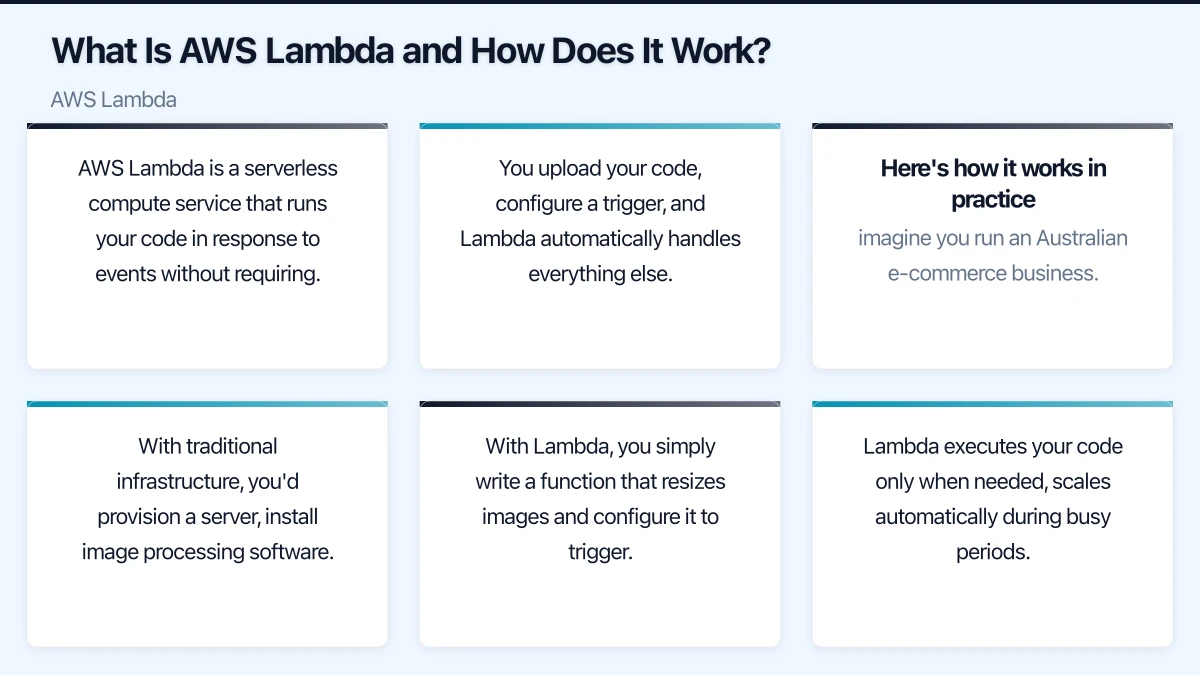
What Is AWS Lambda and How Does It Work?
AWS Lambda is a serverless compute service that runs your code in response to events without requiring you to provision or manage servers. You upload your code, configure a trigger, and Lambda automatically handles everything else—from capacity provisioning and scaling to patching and monitoring.
Here’s how it works in practice: imagine you run an Australian e-commerce business and need to resize product images when they’re uploaded. With traditional infrastructure, you’d provision a server, install image processing software, write code to monitor for uploads, and maintain the entire system. With Lambda, you simply write a function that resizes images and configure it to trigger when a file hits your S3 bucket. Lambda executes your code only when needed, scales automatically during busy periods, and you pay only for the milliseconds of compute time used.
Lambda functions run in the AWS Sydney (ap-southeast-2) region, ensuring low latency for Australian users and keeping your data within Australian jurisdiction—an important consideration for businesses concerned about data sovereignty. Each function can run for up to 15 minutes and has access to up to 10GB of memory, making it suitable for a wide range of business applications beyond simple tasks.
The service supports multiple programming languages including Python, Node.js, Java, .NET, Go, and Ruby, meaning your development team can work with familiar tools. You can also bring custom runtimes if you need support for other languages. Lambda integrates seamlessly with over 200 AWS services, from databases like DynamoDB to notification services like SNS, creating powerful workflows without managing infrastructure.
Real-World Use Cases for Australian SMBs
Australian small businesses are using Lambda to solve practical problems without expanding their IT infrastructure. Here are scenarios where serverless computing delivers immediate value.
Automated data processing is one of the most common applications. A Melbourne-based logistics company uses Lambda to process shipping manifests uploaded by customers. When a CSV file arrives in S3, Lambda automatically validates the data, checks addresses against Australia Post databases, calculates shipping costs, and generates customer invoices—all without human intervention. What previously took administrative staff hours now happens in seconds, and the company pays only when files are processed.
API backends for mobile and web applications represent another strong use case. A Sydney startup building a customer feedback app uses Lambda with API Gateway to handle all backend operations. Each API endpoint—submitting feedback, retrieving analytics, sending notifications—runs as a separate Lambda function. During quiet periods, costs drop to nearly zero. When a client campaign drives thousands of responses, Lambda scales automatically without performance degradation. The startup’s monthly AWS bill averages AUD $45 compared to the AUD $200+ they’d spend maintaining dedicated servers.
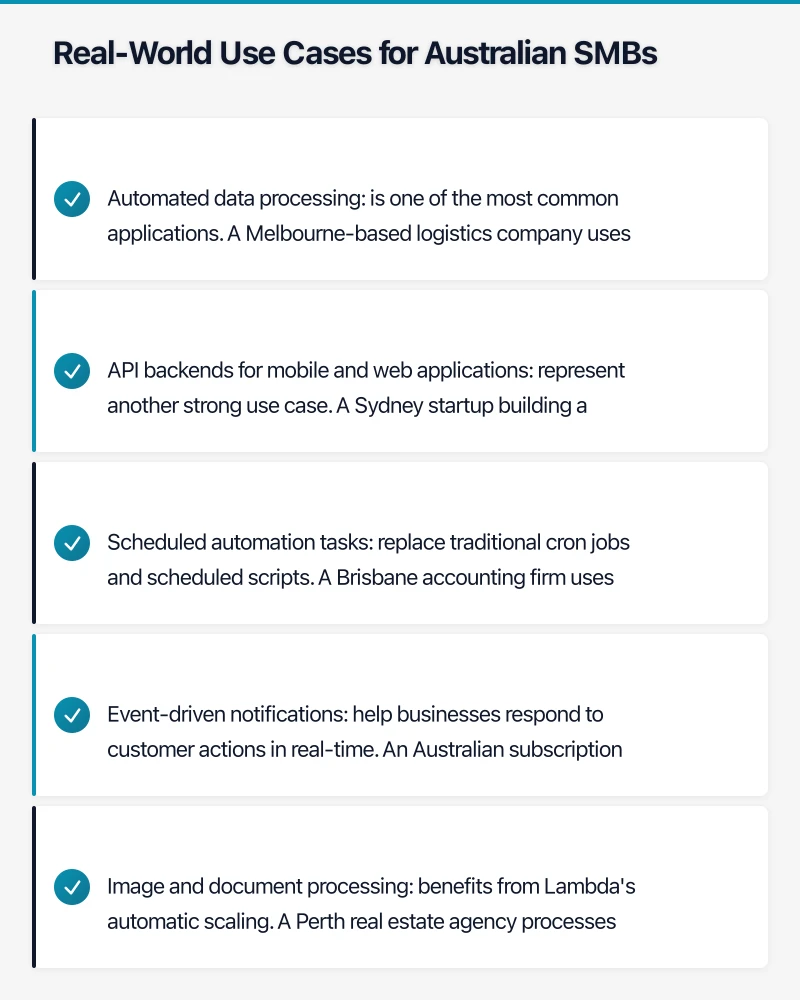
Scheduled automation tasks replace traditional cron jobs and scheduled scripts. A Brisbane accounting firm uses Lambda functions triggered by EventBridge to generate client reports every weeknight, send billing reminders on the first of each month, and back up critical data daily to S3 Glacier. These functions run reliably without maintaining always-on servers, and the firm’s finance director appreciates the predictable monthly costs.
Event-driven notifications help businesses respond to customer actions in real-time. An Australian subscription box company triggers Lambda functions when customers sign up, modify subscriptions, or process payments. These functions send personalized welcome emails, update inventory systems, notify warehouse staff, and log events for analytics—creating a seamless customer experience while reducing manual administrative work by 60%.
Image and document processing benefits from Lambda’s automatic scaling. A Perth real estate agency processes property photos uploaded by agents, automatically resizing them for web and mobile, applying watermarks, and generating thumbnails. During peak listing season, hundreds of images might arrive simultaneously—Lambda handles the load without configuration changes or performance issues.
Getting Started: Your First Lambda Function
Setting up AWS Lambda is straightforward for Australian SMBs, even without deep technical expertise. Here’s a practical guide to creating your first function.
Step 1: Set up your AWS account if you don’t already have one. Visit aws.amazon.com and create an account. AWS offers a generous free tier that includes 1 million free Lambda requests per month and 400,000 GB-seconds of compute time—enough for most SMBs to experiment extensively without cost. When creating your account, select the Sydney region (ap-southeast-2) to ensure your functions run close to your customers.
Step 2: Navigate to Lambda in the AWS Console. Once logged in, search for “Lambda” in the services menu. Click “Create function” and you’ll see three options: author from scratch, use a blueprint, or browse the serverless application repository. For learning, start with “Author from scratch.”
Step 3: Configure your function basics. Give your function a descriptive name like “process-customer-order” or “resize-product-image.” Select your runtime—Python 3.12 and Node.js 20 are currently popular choices with good documentation. For permissions, select “Create a new role with basic Lambda permissions” which gives your function permission to write logs to CloudWatch for monitoring.
Step 4: Write your function code. The console provides an inline code editor suitable for simple functions. Here’s a basic Python example that processes customer form submissions:
import json

def lambda_handler(event, context):
    # Extract customer data from the event
    customer_name = event.get('name', 'Unknown')
    customer_email = event.get('email', '')

    # Your business logic here
    print(f"Processing order for {customer_name}")

    # Return a response
    return {
        'statusCode': 200,
        'body': json.dumps({
            'message': f'Thanks {customer_name}, we received your order!',
            'email': customer_email
        })
    }
Step 5: Configure a trigger. Lambda functions respond to events from other AWS services. Common triggers for SMBs include API Gateway (for web/mobile apps), S3 (for file processing), EventBridge (for scheduled tasks), or SQS (for queued work). Click “Add trigger” and select the appropriate service. For a web form, you’d choose API Gateway and create a REST API endpoint.
Step 6: Test your function. Lambda provides a built-in test feature. Click “Test,” create a test event with sample data, and execute it. You’ll see execution results, logs, and any errors immediately. This rapid feedback loop makes development efficient—you can iterate on your code and test changes in seconds.
Step 7: Monitor and refine. Once deployed, use CloudWatch Logs to monitor function executions, errors, and performance. Lambda automatically logs function starts, ends, and any print statements in your code. For Australian businesses subject to compliance requirements, these logs provide valuable audit trails.
For more complex applications, consider using the AWS Serverless Application Model (SAM) or AWS Cloud Development Kit (CDK) to manage your functions as code, enabling version control and team collaboration.
Understanding Lambda Pricing for Australian SMBs
Lambda’s pricing model differs fundamentally from traditional server costs, and understanding it helps Australian businesses make informed decisions and control expenses.
How you’re charged: Lambda bills based on two factors—the number of requests and the compute duration. You pay AUD $0.20 per million requests (approximately AUD $0.0000002 per request). Compute duration is calculated from when your code begins executing until it returns or terminates, rounded up to the nearest millisecond. Pricing depends on the amount of memory allocated, starting at AUD $0.0000166667 per GB-second.
The free tier advantage: AWS provides 1 million free requests and 400,000 GB-seconds of compute time per month, permanently—not just for the first year. For context, if you allocate 512MB of memory to your function (suitable for most business applications), you get 800,000 seconds of free compute time monthly. That’s enough to run a function for 1 second, 800,000 times per month, completely free.
Real-world Australian business costs: A typical SMB running modest workloads often stays within the free tier. For example, a business processing 500,000 API requests per month with an average execution time of 200ms at 512MB memory allocation would incur approximately:
- Requests: 500,000 requests = AUD $0.10
- Compute: (500,000 × 0.2 seconds × 0.5 GB) = 50,000 GB-seconds = AUD $0.83
- Total monthly cost: AUD $0.93
Even businesses exceeding the free tier dramatically see minimal costs compared to maintaining dedicated infrastructure. A busy e-commerce site processing 5 million requests monthly with 500ms average execution time at 1GB memory might pay around AUD $75 monthly—far less than the AUD $150-300 for even a small EC2 instance running 24/7.
Cost optimization strategies can further reduce expenses:
- Right-size memory allocation: Start with 512MB and adjust based on performance metrics. Over-provisioning wastes money.
- Optimize execution time: Faster functions cost less. Profile your code to eliminate bottlenecks.
- Use Lambda Layers: Share common code across functions to reduce package sizes and cold start times.
- Consider Reserved Concurrency carefully: While it guarantees capacity, you pay for reserved capacity even when idle—defeating serverless economics.
Hidden cost savings extend beyond the Lambda bill itself. You eliminate costs for server maintenance, security patching, capacity planning, and idle time. For Australian SMBs without dedicated DevOps staff, these operational savings often exceed the direct cost differences.
When Serverless Makes Sense (and When It Doesn’t)
Lambda isn’t the right solution for every workload, and Australian SMBs should evaluate their specific needs before committing to serverless architecture.
Lambda excels for these scenarios:
Unpredictable or variable workloads benefit enormously from automatic scaling. If your application experiences traffic spikes—like a retail site during sales events or a booking system at promotion launches—Lambda scales automatically without pre-provisioning capacity. You pay only for actual usage rather than maintaining capacity for peak loads.
Event-driven processing aligns perfectly with Lambda’s execution model. File uploads, database changes, queue messages, IoT sensor data, or scheduled tasks all trigger Lambda efficiently. The service waits idle (costing nothing) until events occur, then processes them immediately.
Microservices and API backends work well when each Lambda function handles a specific business capability. This architectural approach enables teams to develop, deploy, and scale components independently. An order processing system might have separate functions for inventory checks, payment processing, and notification sending—each optimized and scaled independently.
Prototyping and MVPs accelerate development for Australian startups. Launch applications without infrastructure setup, validate business models quickly, and scale if successful—all without upfront infrastructure investment. Many successful Australian tech companies started with Lambda and graduated to mixed architectures as they grew.
Consider alternatives when:
Long-running processes exceed Lambda’s 15-minute execution limit. Video transcoding, large-scale data analysis, or complex simulations might need EC2 instances, ECS containers, or batch processing services. You could architect some workflows to chain Lambda functions together, but traditional compute might be simpler.
Consistent heavy loads running 24/7 might cost less on dedicated infrastructure. If your workload runs continuously at predictable capacity, paying for constant Lambda execution could exceed the cost of an EC2 reserved instance. Calculate actual costs before deciding.
Stateful applications requiring persistent connections challenge serverless architecture. WebSocket connections, long-polling applications, or systems maintaining in-memory state work better with always-on servers. Lambda functions are stateless by design—they start fresh with each invocation.
Applications with strict cold start requirements might struggle with Lambda’s initialization time. When a function hasn’t run recently, AWS provisions a new execution environment (a “cold start”), adding 100-1000ms latency. For most business applications this is negligible, but latency-critical systems might need always-warm alternatives. You can mitigate cold starts with provisioned concurrency, but that adds costs.
Existing monolithic applications might not justify a serverless refactor. If you’re running a stable, traditional application on existing infrastructure, migrating to Lambda requires architectural changes. Focus serverless adoption on new features or greenfield projects rather than forcing rewrites.
The ideal approach for many Australian SMBs combines serverless and traditional infrastructure. Use Lambda for event-driven components, APIs, and automation while maintaining databases on RDS and running legacy applications on EC2. This hybrid approach delivers serverless benefits where they make sense without forcing architectural compromises.
Australian-Specific Considerations
Operating Lambda in Australia involves specific considerations around data sovereignty, compliance, support, and regional services.
Data sovereignty and compliance: Australian businesses handling personal information under the Privacy Act 1988 should ensure Lambda functions run in the Sydney (ap-southeast-2) region. This keeps data within Australian jurisdiction, simplifying compliance. When creating functions, explicitly select ap-southeast-2 rather than accepting defaults that might route to Singapore or other Asia-Pacific regions. Lambda integrations with other AWS services (S3, DynamoDB, RDS) should similarly run in Sydney to maintain data locality.
For businesses subject to industry-specific regulations—healthcare providers under My Health Records legislation, financial services under APRA requirements, or government contractors with security clearances—Lambda supports the compliance frameworks you need. AWS holds ISO 27001, SOC 2, and PCI DSS certifications applicable to Lambda, and the service aligns with the Australian Government’s Essential Eight strategies when properly configured.
AWS support in Australia: Australian SMBs have access to AWS support through multiple channels. The basic support plan includes documentation, whitepapers, and community forums at no cost. For production workloads, the Developer plan (USD $29/month) provides technical support during business hours, while the Business plan (starting at USD $100/month) offers 24/7 support with faster response times—valuable for Australian businesses operating outside standard global business hours.
AWS also maintains a strong partner network in Australia. Numerous consulting firms and managed service providers across Sydney, Melbourne, Brisbane, and Perth specialize in serverless architecture, offering local expertise and support in Australian time zones. These partners can accelerate Lambda adoption for SMBs without in-house cloud expertise.
Pricing in Australian dollars: While AWS bills in US dollars, understanding approximate Australian dollar costs helps budgeting. Exchange rates fluctuate, but at current rates (early 2024), Lambda’s pricing translates to roughly AUD $0.20 per million requests and AUD $0.0000166667 per GB-second. Australian businesses should monitor exchange rates when budgeting for cloud services and consider how currency movements affect ongoing costs.
Local integration opportunities: Lambda integrates well with Australian business services and systems. You can trigger functions from Australia Post tracking updates, ASIC database queries, BOM weather data, or ATO systems. Australian payment gateways, accounting software (Xero, MYOB), and CRM systems often provide webhooks or APIs that Lambda can consume, enabling powerful automation workflows specific to Australian business operations.
Network latency considerations: The Sydney region provides excellent latency for Australian users—typically 5-20ms for east coast businesses and 30-50ms from Perth. For applications serving international customers, consider multi-region architectures using Lambda@Edge or CloudFront with Lambda functions to deliver low latency globally while maintaining your primary operations in Australia.
Next Steps for Australian SMBs
Getting started with AWS Lambda doesn’t require wholesale infrastructure changes or massive investment. Here’s a practical roadmap for Australian small businesses exploring serverless computing.
Start with a pilot project: Choose a self-contained, low-risk use case for your first Lambda implementation. Good candidates include automated report generation, file processing, or simple API endpoints. Success with a modest pilot builds team confidence and provides lessons before tackling critical systems.
Invest in team education: AWS offers free training through AWS Skill Builder, including serverless-specific learning paths. For Australian businesses, consider local training providers or AWS-sponsored events in Sydney and Melbourne. Many Australian consultancies offer serverless workshops tailored to SMB needs and budgets.
Use infrastructure-as-code from the start: Even for simple functions, adopt AWS SAM or the Serverless Framework to manage your Lambda deployments as code. This practice enables version control, team collaboration, and repeatable deployments—essential as your serverless usage grows.
Monitor costs carefully initially: Enable AWS Cost Explorer and set up billing alerts to track Lambda spending as you learn the service. Understanding your usage patterns early helps optimize functions and prevent surprise bills.
Connect with the Australian serverless community: Serverless Sydney and Melbourne AWS User Groups host regular meetups where you can learn from other Australian businesses implementing Lambda. These communities provide practical insights into challenges specific to Australian operations.
Consider partnering with experts: If your team lacks cloud expertise, engaging an Australian AWS partner for initial architecture and implementation accelerates adoption and avoids common pitfalls. Many partners offer fixed-price packages for serverless pilots suitable for SMB budgets.
Lambda represents a fundamental shift in how Australian small businesses can approach application development and infrastructure. By eliminating server management, providing automatic scaling, and charging only for actual usage, serverless computing democratizes capabilities previously available only to enterprises with substantial IT resources. For SMBs willing to embrace event-driven architecture, Lambda offers a path to greater agility, reduced operational overhead, and more efficient use of limited IT budgets.
The question isn’t whether serverless will play a role in Australian SMB technology strategies—it’s how quickly your business can identify opportunities and capture the benefits.
Need help getting started with AWS Lambda or evaluating whether serverless makes sense for your business? Contact our team for a free consultation on cloud architecture for Australian SMBs.
Want your team to manage cloud operations from their phones? Awesome Apps creates mobile dashboards and management tools for Australian SMBs.
Ashish Ganda is the founder of Ganda Tech Services, a Sydney-based technology consultancy helping Australian businesses grow through cloud, web, and mobile solutions.