
AI-Powered Customer Insights for Australian SMBs: Practical Analytics That Drive Revenue
Introduction
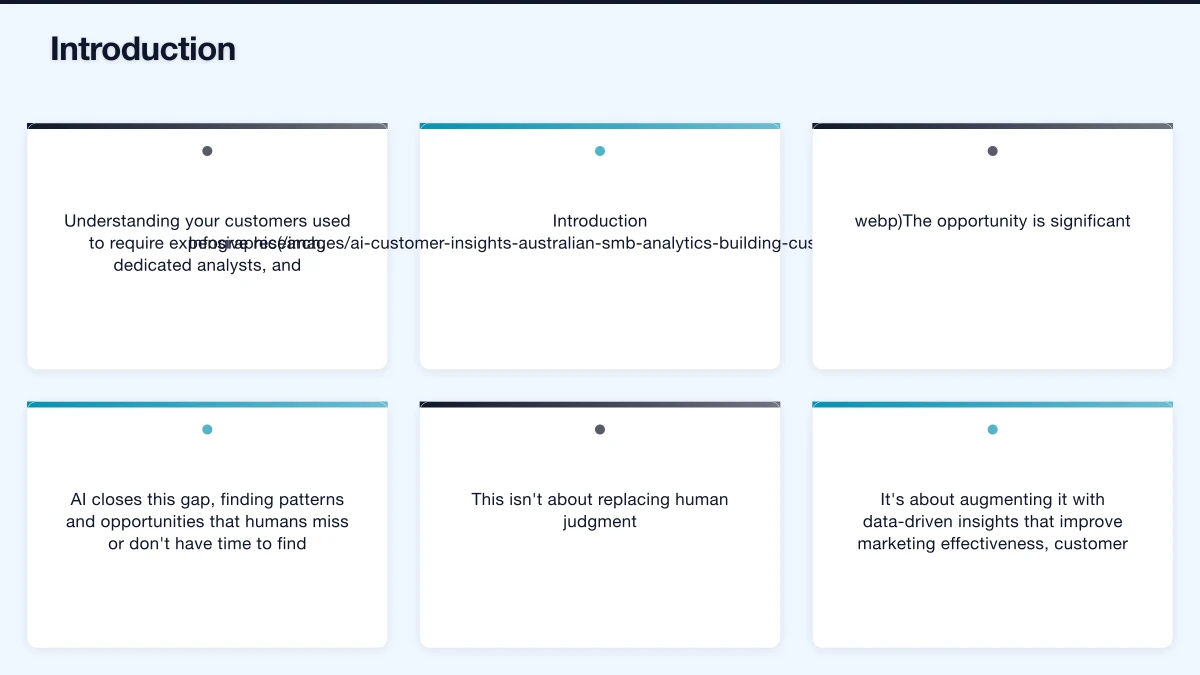
Understanding your customers used to require expensive research, dedicated analysts, and enterprise-grade tools. That’s changed. AI-powered analytics tools have become accessible for Australian small and medium businesses, making it possible to derive customer insights that previously required dedicated data science teams.
The opportunity is significant. Australian SMBs sit on valuable customer data—transaction histories, website behaviour, support interactions, email engagement—but most don’t have the means to extract actionable insights from it. AI closes this gap, finding patterns and opportunities that humans miss or don’t have time to find.
This isn’t about replacing human judgment. It’s about augmenting it with data-driven insights that improve marketing effectiveness, customer retention, and revenue growth.
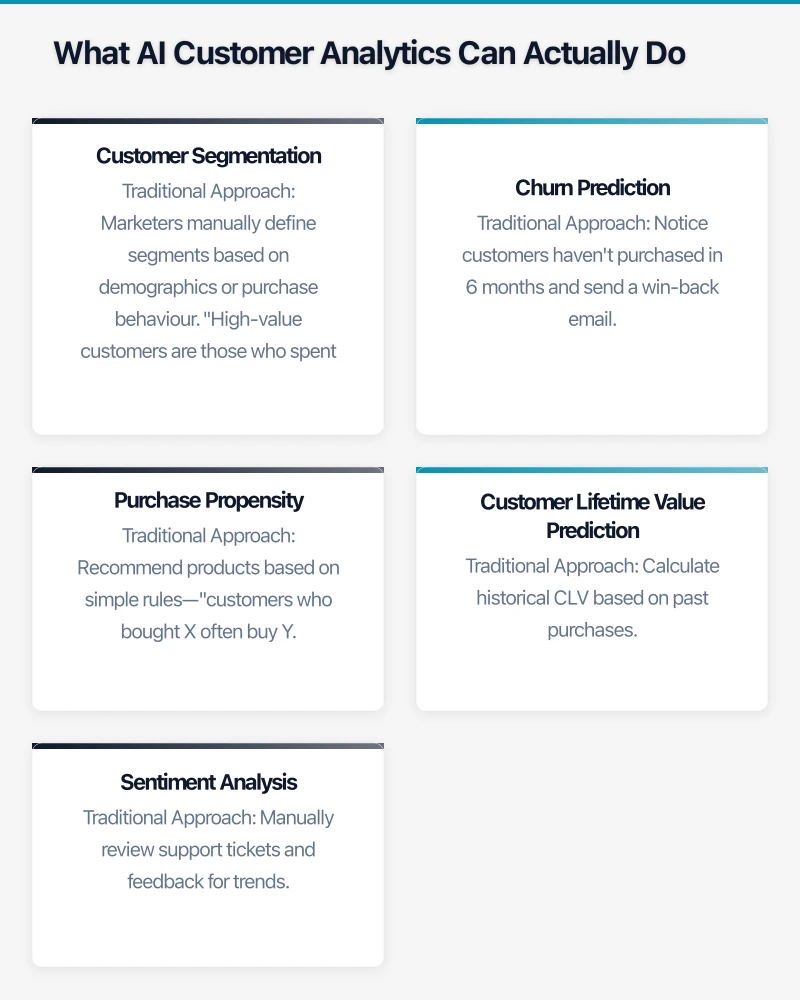
What AI Customer Analytics Can Actually Do
Let’s be specific about current capabilities and limitations.
Customer Segmentation
Traditional Approach: Marketers manually define segments based on demographics or purchase behaviour. “High-value customers are those who spent over A$5,000 last year.”
AI Approach: Machine learning identifies natural segments in your customer base based on multiple factors—purchase patterns, engagement behaviour, support interactions, timing preferences. Segments emerge from data rather than assumptions.
Practical Example: An e-commerce business discovered their “best” customers weren’t high spenders but consistent monthly purchasers with low return rates and high email engagement. This segment had better lifetime value despite lower individual transactions.
Churn Prediction
Traditional Approach: Notice customers haven’t purchased in 6 months and send a win-back email.
AI Approach: Identify customers likely to churn before they stop purchasing, based on engagement decline patterns, support ticket sentiment, reduced email opens, and purchase frequency changes.
Practical Example: A subscription service identifies customers at 60% churn risk 45 days before typical churn. Targeted retention offers to this group achieve 35% save rate vs 12% for generic win-back campaigns.
Purchase Propensity
Traditional Approach: Recommend products based on simple rules—“customers who bought X often buy Y.”
AI Approach: Predict what individual customers are likely to buy next based on their behaviour, similar customer patterns, and timing factors.
Practical Example: A retail business sends personalised product recommendations based on AI predictions. Email click-through rates increase from 2.1% to 5.8%, conversion rates from 1.2% to 2.9%.
Customer Lifetime Value Prediction
Traditional Approach: Calculate historical CLV based on past purchases.
AI Approach: Predict future lifetime value for each customer, enabling investment decisions based on expected future value rather than just past behaviour.
Practical Example: A professional services firm identifies that small initial engagements from tech startups have 4x the predicted lifetime value of larger initial engagements from traditional businesses. They adjust sales focus accordingly.
Sentiment Analysis
Traditional Approach: Manually review support tickets and feedback for trends.
AI Approach: Automatically analyse support interactions, reviews, and social mentions to identify sentiment trends, emerging issues, and improvement opportunities.
Practical Example: A hospitality business detects increasing negative sentiment around booking experience two weeks after a website update. They identify and fix the issue before it impacts ratings.
Practical Tools for Australian SMBs
The tools landscape has matured significantly. Here are options appropriate for SMB budgets and capabilities.
All-in-One Platforms
HubSpot (with AI Features)
- Customer segmentation and predictive lead scoring
- Email engagement analytics and send-time optimisation
- Website behaviour analysis
- From A$0 (basic) to A$1,200/month (full features)
- Best for businesses already using HubSpot CRM
Klaviyo
- E-commerce focused with strong predictive analytics
- Churn prediction and CLV calculation
- Automated segmentation based on behaviour
- From A$30/month based on contacts
- Best for D2C and e-commerce
Zoho Analytics with Zia
- AI-powered business intelligence
- Natural language queries
- Automated insights and anomaly detection
- From A$40/month
- Best for businesses using Zoho ecosystem
Dedicated Analytics Tools
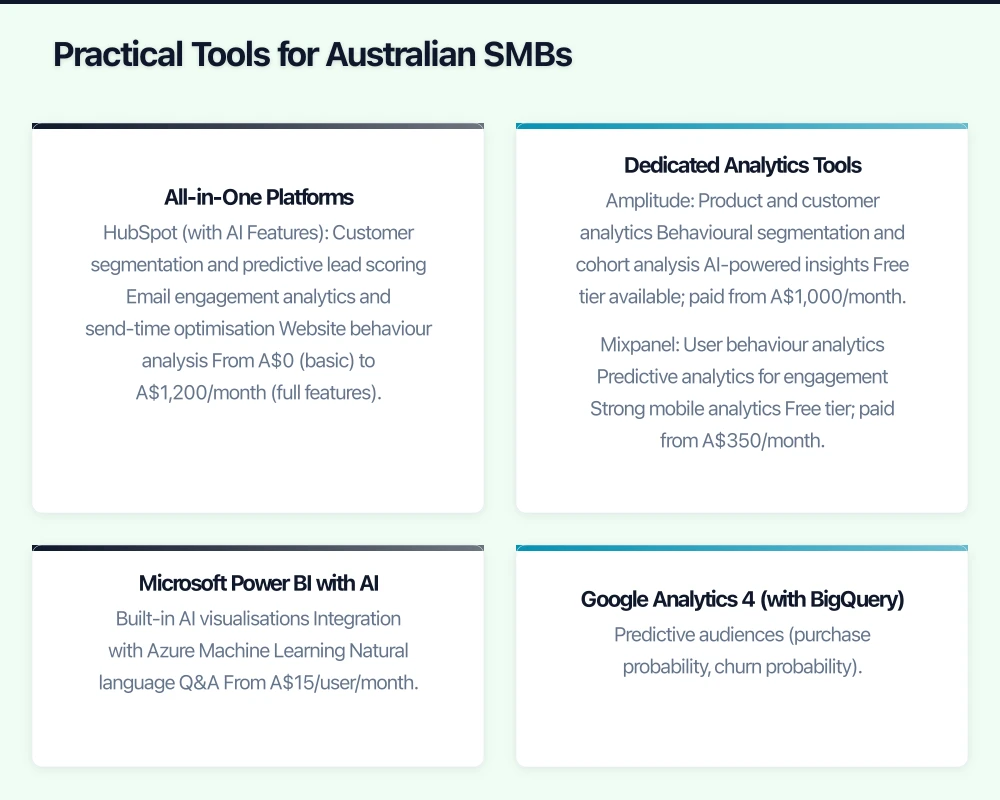
Amplitude
- Product and customer analytics
- Behavioural segmentation and cohort analysis
- AI-powered insights
- Free tier available; paid from A$1,000/month
- Best for digital products and SaaS
Mixpanel
- User behaviour analytics
- Predictive analytics for engagement
- Strong mobile analytics
- Free tier; paid from A$350/month
- Best for apps and digital platforms
Heap
- Automatic event capture
- AI-powered insights
- Retroactive analysis capability
- From A$500/month
- Best for businesses wanting minimal implementation
Microsoft Power BI with AI
For businesses in the Microsoft ecosystem:
- Built-in AI visualisations
- Integration with Azure Machine Learning
- Natural language Q&A
- From A$15/user/month
- Best for businesses with Microsoft 365
Google Analytics 4 (with BigQuery)
Free option with significant capability:
- Predictive audiences (purchase probability, churn probability)
- Automated insights
- Export to BigQuery for advanced analysis
- Free (BigQuery costs for heavy usage)
- Best for businesses with strong web/app presence
Building Customer Insights Capability
Tools matter less than the foundation you build.
Step 1: Unify Your Customer Data
AI analytics require consolidated data. Common sources to connect:
Transaction Data
- POS/e-commerce systems
- Accounting software (Xero, MYOB)
- Subscription/billing platforms
Engagement Data
- Email platform (Mailchimp, Campaign Monitor)
- Website analytics
- Social media engagement
Service Data
- Support tickets
- Feedback and reviews
- NPS/CSAT responses
Create a Single Customer View Use a Customer Data Platform (CDP) or CRM to unify these sources:
- Segment (A$120/month+)
- Customer.io
- HubSpot CRM (free basic)
- ActiveCampaign
Step 2: Define Questions Worth Answering
Don’t start with “give me insights.” Start with specific questions:
Revenue Questions
- Which customers are most likely to purchase again in 30 days?
- What products should we recommend to different customer segments?
- Which acquisition channels produce highest lifetime value customers?
Retention Questions
- Which customers are at risk of churning?
- What early warning signs predict churn?
- What interventions are most effective for at-risk customers?
Product Questions
- What features correlate with retention?
- Which products/services drive repeat purchases?
- What combinations are commonly purchased together?
Step 3: Start with One Use Case
Don’t try to boil the ocean. Pick one high-value use case:
For E-commerce: Start with purchase propensity—who’s likely to buy and what.
For Subscription Businesses: Start with churn prediction—who’s likely to cancel.
For Service Businesses: Start with CLV prediction—which prospects deserve most attention.
For Retail: Start with segmentation—who are your customer groups and what do they want.
Step 4: Implement, Measure, Iterate
Implementation
- Connect data sources
- Configure the model/tool
- Build initial outputs (dashboards, automated actions)
Measurement
- Define success metrics (conversion rate, retention rate, etc.)
- Establish baseline before implementing
- Track changes attributable to insights
Iteration
- Review model accuracy
- Refine based on results
- Expand to additional use cases
Real Australian SMB Examples
Case Study 1: E-commerce Fashion Retailer
Business: Online fashion retailer, 50,000 customers, A$3M revenue.
Challenge: High customer acquisition cost (A$45 per customer) with poor retention. Most customers purchased once and never returned.
AI Implementation:
- Implemented Klaviyo with predictive analytics
- Built CLV prediction model
- Created churn risk scoring
- Automated email journeys based on predicted behaviour
Results After 6 Months:
- Identified that customers who purchased from specific categories had 3x better retention
- Adjusted marketing to attract higher-retention customer profiles
- Automated re-engagement campaigns for at-risk customers
- Repeat purchase rate increased from 22% to 31%
- Customer lifetime value increased 28%
Investment: A$400/month for Klaviyo + 40 hours implementation
Case Study 2: B2B Professional Services
Business: Accounting firm, 800 clients, A$4M revenue.
Challenge: Partner time spent on clients didn’t correlate with revenue. Some small clients consumed disproportionate resources while high-potential clients were under-served.
AI Implementation:
- Connected practice management and CRM data to Power BI
- Built CLV prediction model
- Created client health scoring
- Identified service upsell opportunities
Results After 12 Months:
- Identified top 15% of clients by predicted future value
- Proactive engagement with high-value clients improved retention
- Reduced service levels for low-value, high-maintenance clients
- Revenue per partner increased 18%
- Client satisfaction for top-tier clients improved
Investment: A$2,000 for initial development + A$200/month ongoing
Case Study 3: Multi-Location Hospitality
Business: Restaurant group, 6 locations, A$8M revenue.
Challenge: Marketing spend wasn’t driving measurable results. Couldn’t connect promotional activity to actual customer behaviour.
AI Implementation:
- Unified POS data across locations with reservation and loyalty data
- Implemented customer segmentation
- Built visit frequency prediction
- Automated targeted promotions via email and SMS
Results After 9 Months:
- Identified high-value segments (business lunchers, occasion diners)
- Targeted promotions to specific segments vs. blanket discounts
- Marketing ROI improved from 1.2x to 3.1x
- Average check increased 11% for targeted customers
- Loyalty program engagement increased 45%
Investment: A$15,000 initial data platform + A$500/month ongoing
Common Pitfalls and How to Avoid Them
Pitfall 1: Starting Without Clean Data
AI analytics magnify data quality issues. If your customer data is full of duplicates, outdated information, and inconsistent formatting, AI will produce garbage insights.
Solution: Spend time on data quality before AI implementation. Deduplicate customer records, standardise formats, fill critical gaps. Budget 30-40% of project time for data preparation.
Pitfall 2: Expecting Magic
AI provides insights, not guarantees. A churn prediction model might be 75% accurate—much better than guessing, but not perfect. Acting on predictions requires human judgment.
Solution: Set realistic expectations. AI augments decision-making; it doesn’t replace it. Start with pilot programs and measure actual results before scaling.
Pitfall 3: Ignoring Privacy Requirements
Customer analytics involve personal information. Australian Privacy Act requirements apply, especially with the recent amendments expanding individual rights.
Solution: Ensure compliance before collecting and analysing customer data. Clear privacy notices, appropriate consent, data minimisation, and secure handling are non-negotiable.
Pitfall 4: Analysis Paralysis
Having more data and insights doesn’t automatically translate to better decisions. Some businesses get trapped in endless analysis without action.
Solution: Tie insights directly to actions. Every analysis should answer “What should we do differently?” If an insight doesn’t lead to action, it’s entertainment, not business intelligence.
Pitfall 5: Overcomplicating the Stack
You don’t need enterprise tools for SMB problems. Simple tools, well-implemented, beat complex tools gathering dust.
Solution: Start with the simplest tool that solves your problem. You can always upgrade later. The best insight system is one your team actually uses.
Getting Started: A Practical Roadmap
Month 1: Foundation
Week 1-2: Data Audit
- List all customer data sources
- Assess data quality in each
- Identify integration requirements
Week 3-4: Use Case Definition
- Interview stakeholders about decision needs
- Prioritise 2-3 potential use cases
- Define success metrics for top priority
Month 2: Implementation
Week 1-2: Data Preparation
- Clean and standardise priority data
- Connect data sources
- Validate unified data quality
Week 3-4: Tool Setup
- Configure selected analytics tool
- Build initial models/segments
- Create first dashboards/outputs
Month 3: Activation
Week 1-2: Pilot Activation
- Implement insights in limited scope
- Monitor results vs. baseline
- Gather feedback from users
Week 3-4: Refinement
- Adjust based on pilot learnings
- Expand successful elements
- Document processes for sustainability
Ongoing: Continuous Improvement
- Regular model performance review
- Expansion to additional use cases
- Data quality maintenance
- Team capability building
The Strategic Perspective
AI customer analytics isn’t about having fancier technology than competitors. It’s about understanding customers better and acting on that understanding faster.
The Australian SMBs getting value from AI analytics share common traits:
- They start with business questions, not technology
- They invest in data quality before analytics
- They connect insights directly to actions
- They measure results and iterate
The tools are accessible. The data exists. The opportunity is knowing your customers well enough to serve them better than anyone else can.
That competitive advantage is now available to Australian SMBs willing to invest the time and effort to build it.
Customer insights are only as good as the data model underneath them — a unified CRM keeps every interaction on one record. Our comparison of EngageBay, Salesforce, Mautic, SendFox, Salesflare and Twenty CRM for Australian small business covers which platforms give you that single source of truth.
Ready to unlock customer insights for your business? CloudGeeks helps Australian SMBs implement practical AI analytics solutions. Contact us to discuss how customer analytics could drive growth for your business.
How does cloud adoption fit your long-term business strategy? Ash Ganda explores technology leadership and digital maturity for growing businesses.
Ganda Tech Services brings together cloud infrastructure, web development, and mobile app expertise to help Australian businesses thrive in the digital economy.